
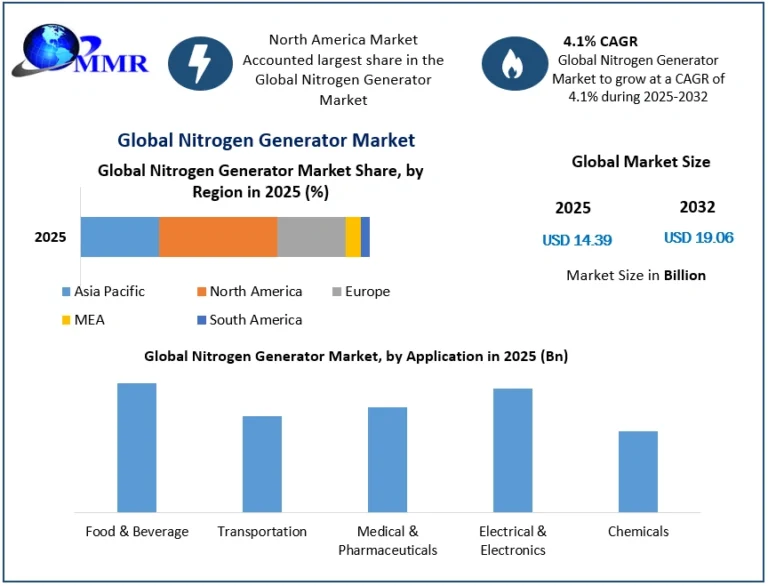
Key Highlights
-
Global Market Valuation: The industrial market capital reached USD 12.31 Billion in 2025, signaling heavy multi-sector reallocations away from traditional liquid gas tank logistics.
-
Long-Term Projection: Positioned to expand at a steady 5.2% CAGR through 2032, hitting USD 17.58 Billion as global high-tech and food preservation infrastructure demands climb.
-
Segment Dominance: Pressure Swing Adsorption (PSA) generators led technology market share in 2025 due to their capability to continuously achieve ultra-high purity levels up to 99.999%.
-
Fastest-Growing Variant: Membrane gas separation units are expanding rapidly, favored by smaller processing labs for their compact footprint, lower initial cost, and minimal maintenance overhead.
-
Regional Landscape: Europe holds dominant consumer-end market value via strict chemical safety integration, while Asia-Pacific drives the largest overall manufacturing production volume.
Why This Matters Now
The operational efficiency of modern high-volume manufacturing lines is tightly bound to a continuous, cost-controlled supply of inert gas. For decades, factories relied on external gas vendors to truck in high-pressure cylinders or vacuum-insulated liquid nitrogen tanks. However, volatile transport logistics, fluctuating monthly gas supplier surcharges, and the safety risks of storing high-pressure cryogenic tanks indoors have made bulk gas procurement an expensive operations bottleneck.
By executing a structural shift to automated on-site nitrogen generation systems, industrial facilities eliminate reliance on external supply chains. These systems take standard compressed ambient air and continuously isolate nitrogen molecules on-demand. This transition lowers long-term operational costs by up to 80%, optimizes floor space by clearing out bulky cylinder racks, and ensures processing lines never experience unexpected shutdowns due to delayed truck deliveries.
The underlying evaluation criteria for clean gas integration have completely changed under Industry 4.0 frameworks. Historically, production managers only evaluated basic flow volume and raw equipment pricing. Today, manufacturing ecosystems demand real-time process visibility and automated purity tuning. Facilities require smart nitrogen infrastructure that automatically tracks its own purity levels, logs oxygen contamination trends, and communicates directly with plant-wide control systems via secure digital networks.
Key Trends Driving Growth
The leading driver accelerating market expansion is the deep integration of programmable logic controllers (PLCs) and remote IoT telematics into modern generator footprints. Modern setups do not operate as blind mechanical valves; they run as data-connected platforms. Integrated sensors track intake compressor pressures, feed air moisture levels, and carbon molecular sieve bed cycles. This continuous stream of operational telemetry allows smart facilities to run predictive maintenance protocols—catching failing components or clogged filtration elements before they cause purity degradation or line downtime.
As illustrated in the operational schematic above, a standard PSA system alternates compressed air through twin pressure vessels packed with a Carbon Molecular Sieve (CMS). While the purifying tower adsorbs oxygen and water vapor to discharge clean, dry nitrogen, the secondary tower undergoes a regeneration phase, exhausting the trapped oxygen back into the atmosphere. Managing this precise cycle requires advanced automation software to protect the longevity of the adsorption media.
Another primary driver is the global boom in advanced electronics fabrication and high-density semiconductor packaging. During high-temperature reflow soldering, even trace amounts of oxygen can cause components to oxidize, resulting in micro-defects and ruined production batches. By utilizing automated PSA systems to flood soldering chambers with ultra-pure 99.999% nitrogen, electronics manufacturers prevent oxidation, achieve uniform solder joints, and maximize component yields.
Additionally, strict international food safety regulations and clean-label preservation trends are expanding the use of Modified Atmosphere Packaging (MAP). Food processors are using nitrogen flushing to physically replace oxygen inside snack food bags and fresh produce containers, effectively stopping aerobic bacterial growth and rancidity without relying on chemical preservatives. The growth of automated, multi-line food fulfillment hubs ensures a highly resilient demand pipeline for compact membrane gas separation systems.
Segment Insights
-
Pressure Swing Adsorption (PSA) [Dominant Segment]: This technology maintains the leading market share. Its rugged dual-tower configuration allows industrial facilities to secure massive, continuous volumes of extreme-purity gas (up to 99.999%) required for critical laser cutting and chemical blanket systems.
-
Membrane Separation Systems: This segment is expanding at the fastest rate, particularly in explosive environments like offshore oil platforms and remote marine vessels, where a lightweight, moving-part-free, and modular design is necessary.
-
Food & Beverage Industry [Leading Application Share]: This sector commands substantial equipment placement, driven by global expansions in prepared meal packaging, bulk coffee storage, and large-scale brewing operations that use nitrogen for purging lines and counter-pressurizing tanks.
-
Pharmaceutical & Medical Manufacturing: This sector exhibits high value margins due to the rigid requirement for oil-free, sterile nitrogen gas flows that comply with strict regulatory product validation criteria.
Technology Comparison Matrix
When manufacturing facilities evaluate on-site gas infrastructure, choosing between technology families requires a clear balancing of purity requirements, flow consistency, and target initial expenditure budgets.
| Technology Type | Peak Gas Purity | Best-Suited Industrial Applications | Primary Operational Advantage |
| Pressure Swing Adsorption (PSA) | Up to 99.999% | Electronics assembly, laser cutting, pharmaceutical synthesis | Achieves extreme high purity for critical anti-oxidation environments. |
| Membrane Separation | 95% to 99.5% | Food packaging, oil pipeline purging, marine cargo blanketing | Modular design with zero moving parts, requiring minimal maintenance. |
| Cryogenic Distillation | Over 99.999% | Massive chemical complexes, semiconductor foundries | Delivers exceptionally high gas volumes for massive industrial sites. |
Regional Growth Story
Europe holds a highly organized, structurally dominant position within the global market, backed by dense pharmaceutical clusters in Germany, Switzerland, and the United Kingdom. Rigid regional safety policies, strict validation mapping for chemical manufacturing, and carbon reduction initiatives drive continuous retrofitting of old factories with high-efficiency, on-site generator machinery.
Concurrently, North America represents a mature, high-value consumer market, where aerospace manufacturing, defense logistics, and advanced laser-cutting industries fuel constant demand for high-capacity, twin-tower PSA systems. Meanwhile, the Asia-Pacific region represents the fastest-growing market by volume. Spurred by massive semiconductor foundry investments in Taiwan, South Korea, and Japan, alongside rapidly expanding packaged food processing industries across China and India, the region continues to scale up its localized industrial gas processing footprint.
Competitive Landscape
The competitive matrix of the global nitrogen generator industry is heavily focused on energy efficiency optimization, air-compressor pairings, and sustainable manufacturing alignments. Major engineering brands have shifted from building standalone mechanical assemblies to offering integrated, low-energy air-to-gas packages. This shift means that hardware suppliers who fail to provide variable-speed air compressor pairings alongside their generators face lower adoption rates as energy prices and corporate carbon accounting tighten worldwide.
Furthermore, direct engineering customization for specific manufacturing environments serves as a primary area of market differentiation. Industry leaders like Atlas Copco, Parker Hannifin, Ingersoll Rand, Air Products and Chemicals, and South-Tek Systems invest heavily in advanced molecular sieve configurations, integrated oxygen analyzers, and robust internal filtration paths. By offering complete systems that drop directly into specialized factory automation loops without requiring extensive structural engineering, these premium technology brands secure long-term capital contracts with global manufacturing giants.
Recent Strategic Frameworks
-
Energy-Efficient System Rollouts (2025): Top air compressor and gas equipment OEMs launch advanced variable-speed drive (VSD) air-nitrogen packages, lowering overall energy draw by dynamically adjusting compressor output to immediate gas consumption.
-
Modular Membrane Line Expansions (2025): Material science suppliers introduce high-durability polymer hollow-fiber membranes, allowing smaller food packaging plants to scale up gas production volume by adding modular membrane bundles.
-
Digital Telematics Standardizations (2024): Industrial gas generator innovators make high-definition touchscreen controllers and native Profinet/Modbus data connections standard features, allowing full integration into smart factory SCADA architectures.
Strategic Implications
For plant operations directors and chemical logistics managers, choosing a nitrogen delivery model directly affects facility utility costs and bottom-line manufacturing margins. Relying on traditional high-pressure cylinder deliveries or liquid tank leasing creates a continuous exposure to vendor price hikes, unrecorded residual gas waste, and transport delay risks. These operational issues can halt production lines, inflate facilities overhead, and disrupt strict delivery schedules when executing high-volume commercial manufacturing contracts.
For facility automation integrators, engineering consultants, and equipment vendors, providing open-architecture PLC connectivity and integrated gas analyzer instrumentation is mandatory to secure enterprise procurement contracts. As modern industries advance toward completely automated, data-driven factory setups, nitrogen generator brands providing closed, non-communicative mechanical systems will find themselves cut out of multi-million-dollar facility design cycles. Investing in smart flow-calibration software, oil-free filtration lines, and localized maintenance services is essential to maintain market leadership.
Future Outlook
The evolution of the nitrogen generator market will be defined by its ability to merge with self-optimizing industrial energy networks and AI-driven automated demand monitoring. As smart factories implement holistic power tracking, nitrogen generation systems must evolve into flexible utilities that adjust their intake and cycling times to avoid peak utility pricing windows. Future market leadership will belong to advanced multi-stage systems that integrate automated diagnostic routines directly into their software, calculating the exact remaining lifecycle of molecular sieves and dynamically re-calibrating flow distributions to maintain targeted gas purity under variable plant temperatures.
Ultimately, the industrial marketplace will split along distinct technological lines: forward-looking facilities that invest in intelligent, on-site, connected generation setups will lock in low operating expenses and secure green-factory certifications, while traditional operations remaining tethered to legacy external tank logistics will face rising supply chain costs in an increasingly competitive industrial economy.
Analyst Perspective
“The global nitrogen generator market has advanced beyond basic gas separation; it is now an essential element of modern automated process optimization,” notes an industrial utilities lead at Maximize Market Research. “As smart factory initiatives expand globally, installing on-site PSA and membrane systems gives manufacturing plants the independent control over gas purity and flow metrics required to achieve continuous, high-volume production without supply chain dependencies.”
About Maximize Market Research
Maximize Market Research Pvt. Ltd. (MMR) is a global market research and consulting company that provides reliable, data-focused, and practical business insights. The firm serves a wide range of industries, including healthcare, pharmaceuticals, technology, automotive, electronics, chemicals, personal care, and consumer goods. Through market forecasts, competitive analysis, strategic consulting, and industry impact assessments, MMR helps organizations understand changing market conditions, identify growth opportunities, and make informed business decisions for long-term success.
2nd Floor, Navale IT Park Phase 3
Pune Banglore Highway, Narhe
Pune, Maharashtra 411041, India
+91 9607365656
[email protected]


