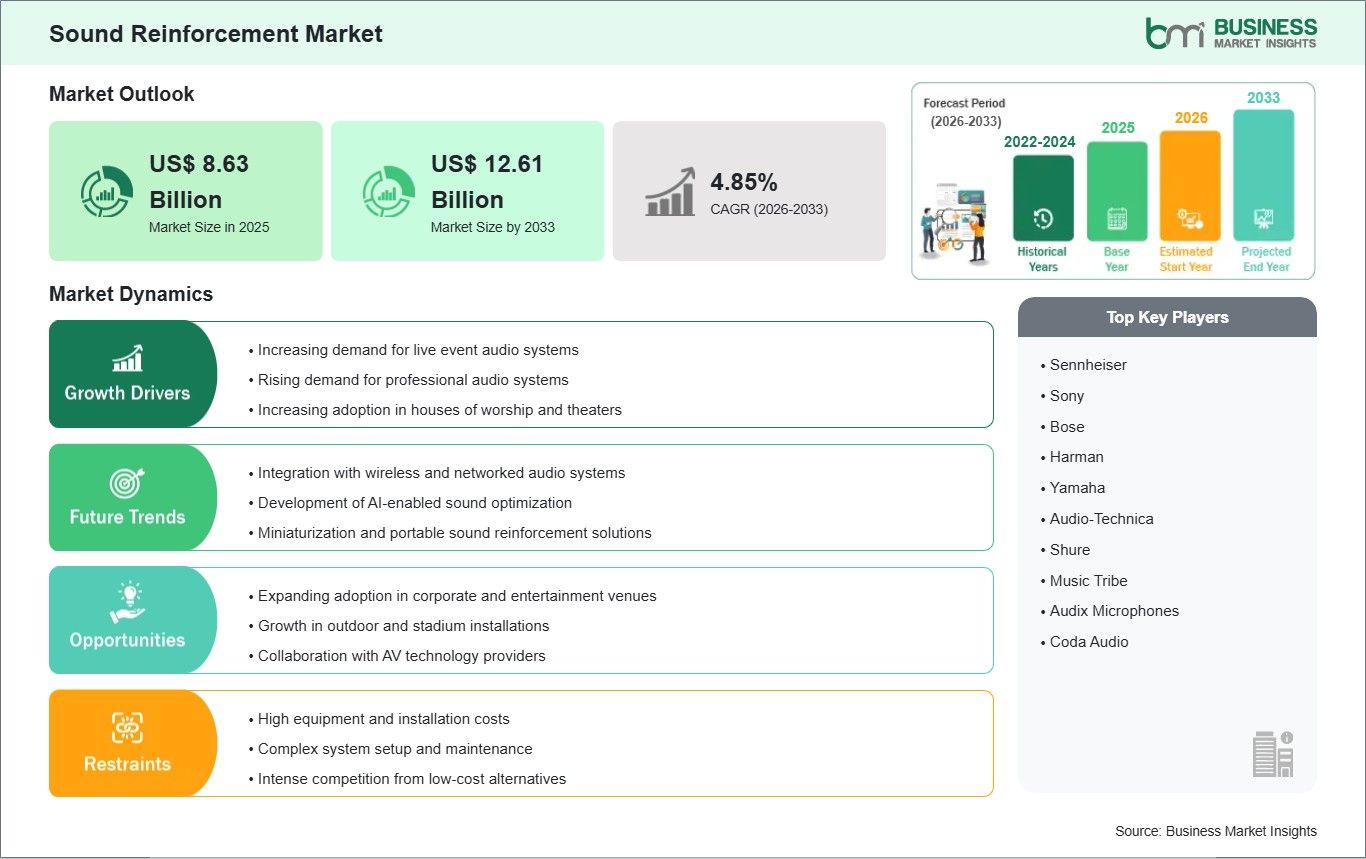
The global Sound Reinforcement Industry is experiencing steady growth, driven by the resurgence of live music concerts, the expansion of corporate AV infrastructure, and the growing demand for immersive audio experiences in large venues and stadiums.
According to Business Market Insights, the global Sound Reinforcement Market size is expected to reach US$ 12.61 billion by 2033 from US$ 8.63 billion in 2025. The market is estimated to record a CAGR of 4.85% from 2026 to 2033.
Technological advancement is continuously shaping the industry landscape, with major audio equipment manufacturers focusing on Audio over IP (AoIP) integration, AI-driven digital signal processing (DSP), and lightweight, active speaker arrays. Innovations in networked audio such as Dante and AES67 are drastically reducing cabling complexities while enhancing system flexibility. Strategic investments in research and development are accelerating the deployment of these advanced acoustic solutions across broadcasting studios, educational campuses, and hospitality venues globally.
Download Sample Report : https://www.businessmarketinsights.com/sample/BMIPUB00034404
What Is Sound Reinforcement?
A sound reinforcement system is an integrated combination of microphones, signal processors, amplifiers, and loudspeakers designed to capture, process, amplify, and distribute audio to a large audience. These systems are essential for ensuring that live sound whether spoken word, music, or broadcast audio is heard clearly and evenly across a designated listening area without distortion or acoustic feedback.
Sound reinforcement systems scale from small, portable public address (PA) setups used in conference rooms to massive, complex line-array configurations suspended in stadiums and arenas. They form the critical acoustic backbone for live events, theatrical performances, corporate summits, and educational lectures.
Market Drivers
A primary driver of the Sound Reinforcement Market is the massive global resurgence of live entertainment, including music festivals, theatrical tours, and international sports tournaments. These large-scale events demand high-fidelity, high-output audio systems to ensure a premium audience experience, driving significant procurement from rental companies and venue operators.
The modernization of commercial real estate and institutional facilities acts as another major catalyst. Corporate offices, higher education campuses, and government buildings are increasingly upgrading their AV infrastructure to support hybrid work environments, smart classrooms, and unified communications, fueling demand for integrated microphones, digital mixers, and installed speakers.
Furthermore, the rapid transition from legacy analog systems to networked digital audio (Audio over IP) is accelerating replacement cycles. Networked systems significantly lower installation costs, reduce heavy copper cabling, and allow system engineers to monitor and control audio routing remotely via software, making them highly attractive to end-users.
Get More Details: https://www.businessmarketinsights.com/buy/BMIPUB00034404
Market Segmentation
By Product Type
- Professional Speakers: The largest revenue-generating segment, encompassing point-source speakers, subwoofers, and sophisticated line arrays.
- Microphones: Includes wired and advanced digital wireless systems essential for capturing high-quality vocal and instrumental audio.
- Audio Mixers: Digital and analog consoles used to balance, route, and optimize multiple audio inputs.
- Power Amplifiers: Critical components that boost low-voltage audio signals to drive high-wattage loudspeakers.
- Signal Processors: Devices providing equalization, compression, and delay to tune the system to the venue’s acoustics.
- Other Product Types: Includes in-ear monitors, cabling, and rigging hardware.
By Format
- Digital Audio: The fastest-growing segment, dominating modern installations due to its superior signal-to-noise ratio, networkability, and DSP capabilities.
- Analog Audio: Primarily utilized in budget-conscious, small-scale setups or preferred by specific sound engineers for its warm acoustic characteristics.
By End User
- Large Venues & Events: The dominant segment, requiring massive arrays for stadiums, arenas, and outdoor festivals.
- Corporate: Driven by the expansion of conference centers, boardrooms, and auditoriums.
- Educational Institutions: Surging demand for smart classrooms and campus-wide public address systems.
- Studio and Broadcasting: Requires ultra-high-fidelity reference monitors and broadcast-grade microphones.
- Hospitality: Encompasses hotels, restaurants, and clubs demanding high-quality background and foreground music systems.
- Government Offices and Others: Includes legislative halls and houses of worship.
Regional Insights
- North America holds a dominant market share, fueled by a highly established live music and entertainment industry, immense sports stadium infrastructure, and continuous corporate AV investments across the United States.
- Europe maintains robust growth, driven by a dense circuit of summer music festivals, prominent theatrical hubs (like London’s West End), and strict regulations pushing venues toward highly controlled, directional audio systems to prevent noise pollution.
- Asia-Pacific is the fastest-growing region, propelled by rapid urbanization, massive infrastructure development, and a booming live events sector in countries like China, India, and Japan. Investments in smart cities and modern educational campuses further boost demand.
- Middle East & Africa is experiencing reliable growth due to the construction of mega-venues, luxury hospitality expansion, and major global events hosted in the GCC region.
- South & Central America is witnessing steady market expansion as international music tours increasingly route through the region and local corporate sectors modernize.
Top Players in the Sound Reinforcement Market
The competitive landscape features legacy audio pioneers and global technology conglomerates focused on digital integration and acoustic innovation.
- Shure Incorporated
- Yamaha Corporation
- Sennheiser electronic GmbH & Co. KG
- Bose Professional
- Harman International Industries (JBL Professional)
- Audio-Technica Corporation
- QSC, LLC
- d&b audiotechnik GmbH
- L-Acoustics
- Electro-Voice (Bosch Security Systems)
Technological Innovations
The integration of spatial and 3D immersive audio technologies is revolutionizing the sound reinforcement market. Leading manufacturers are developing advanced algorithms and object-based mixing platforms that allow sound engineers to place and move individual audio sources in a three-dimensional space. This creates an enveloping auditory experience that breaks away from traditional left-right stereo imaging, highly sought after in premium theatrical productions and immersive art installations.
Additionally, the shift toward self-powered (active) loudspeakers equipped with onboard digital signal processing and network connectivity is simplifying rigging and system tuning. Combined with predictive acoustic simulation software, system integrators can now accurately map venue coverage and optimize array angles before deploying a single speaker, ensuring uniform sound pressure levels and minimizing acoustic reflections.
Future Market Outlook
The future outlook for the Sound Reinforcement Market remains highly positive through 2033, driven by continuous upgrades in venue acoustics and the universal adoption of networked digital audio standards. As live audiences increasingly expect studio-quality sound in live settings, the demand for precision-engineered, high-fidelity audio equipment will intensify.
Market leadership over the next decade will belong to audio manufacturers capable of delivering seamless, software-driven ecosystems that blend superior acoustic performance with intuitive, scalable control interfaces, allowing end-users to manage complex AV networks with unprecedented ease.
Frequently Asked Questions (FAQs)
What is the projected size of the Sound Reinforcement Market by 2033?
The global market is projected to reach US$ 12.61 Billion by 2033, expanding from US$ 8.63 Billion in 2025.
What is the CAGR for the Sound Reinforcement Market?
The market is estimated to record a steady CAGR of 4.85% during the forecast period from 2026 to 2033.
Which end-user segment holds a dominant position in the market?
Large Venues & Events hold the largest market share, driven by the substantial equipment requirements for stadiums, arenas, and outdoor music festivals.
Which region is leading market growth?
North America currently dominates the global market, while the Asia-Pacific region is projected to experience the fastest growth due to rapid infrastructure development and a booming events sector.
What is the primary factor driving demand for sound reinforcement systems?
Key drivers include the global resurgence of live entertainment, the modernization of corporate and educational AV infrastructure, and the widespread transition to scalable, cost-effective Audio over IP (AoIP) systems.
Browse More Reports:
sustained release coatings market
About Us
Business Market Insights is a market research platform that provides subscription service for industry and company reports. Our research team has extensive professional expertise in domains such as Electronics & Semiconductor; Aerospace & Defense; Automotive & Transportation; Energy & Power; Healthcare; Manufacturing & Construction; Food & Beverage; Chemicals & Materials; and others.
Contact Us
If you have any questions about this report or would like further information, please contact us:
Contact person: Ankit Mathur
Email: [email protected]
Phone: +16467917070