Key Highlights
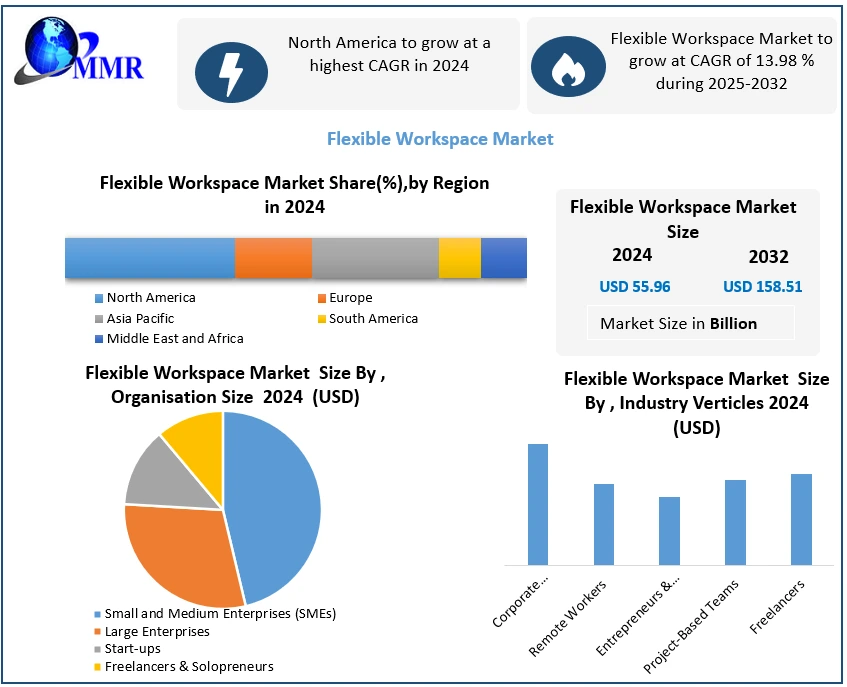
- The Flexible Workspace Market was valued at USD 55.96 billion in 2024 and is anticipated to reach nearly USD 158.51 billion by 2032, expanding at a CAGR of 13.98% from 2025 to 2032. The increase signals that flexible offices are becoming a permanent component of enterprise workplace and real-estate strategies.
- Co-working dominated the ownership segment in 2024 and is also identified as the fastest-growing segment. Its scale, networking benefits and cost efficiency are attracting start-ups and large enterprises.
- Corporate professionals led the end-user segment in 2024. Large organizations are using flexible offices to support distributed teams without assuming long-term property commitments.
- North America held the largest regional share in 2024, supported by major providers, advanced technologies and modern infrastructure capabilities.
- Asia Pacific is positioned for expansion as shared-office providers serve large companies, mid-sized organizations and start-ups seeking regional growth.
- Demand is shifting toward premium, technology-enabled workplaces that preserve collaboration and productivity across hybrid teams.
Why This Matters Now
Hybrid work has turned office capacity into a technology-enabled service rather than a fixed corporate asset. Enterprises now need workspaces that can expand, contract and support dispersed employees without locking capital into long leases, equipment and permanent fit-outs.
That shift creates a strategic opening for workspace operators, software vendors and connectivity providers. Flexible facilities must now deliver more than desks. They must offer reliable digital access, collaborative environments, adaptable layouts and consistent employee experiences across locations.
The Flexible Workspace Market expected rise from USD 55.96 billion in 2024 to USD 158.51 billion by 2032 shows that flexible workspace is moving into mainstream corporate planning. A 13.98% CAGR means operators that can combine physical capacity with scalable workplace services are positioned to capture recurring enterprise demand.
Market Overview
A flexible workspace is a fully equipped office that allows businesses to operate without paying the complete setup and equipment costs associated with a conventional workplace. The model includes private and rented offices, co-working spaces, virtual offices, dedicated desks, meeting rooms and other adaptable formats.
The commercial proposition is straightforward. Businesses gain access to operational offices while reducing fixed property exposure. Operators gain an opportunity to improve utilization by using each square foot across multiple customers, teams and working patterns.
Technology is increasing the versatility of these environments and changing how offices are designed. Employees can move between settings, alter their working environment and select spaces suited to individual or collaborative tasks. The result is a workplace model shaped by mobility, flexibility and efficient capacity allocation.
Employee comfort also carries a direct business implication. The report links workplace design with job satisfaction, productivity and retention. Flexible offices therefore compete not only against conventional real estate but also against enterprise investments in employee experience.
Key Trends Driving Growth
The strongest market driver is the expansion of hybrid work. Large enterprises are using flexible offices to support employees spread across different locations while avoiding long-term commitments to underused property. This benefits operators capable of offering consistent service standards across major urban centres.
Cost optimization is the second driver. Flexible facilities reduce the need for businesses to fund office setup, equipment and permanent capacity before demand is certain. That proposition is especially relevant for project teams, expanding companies and organizations entering new cities.
Technology-enabled environments are becoming a competitive requirement. Corporate customers increasingly expect workplaces that maintain productivity and collaboration across distributed teams. Operators must therefore treat digital access and workplace functionality as part of the core product rather than an optional facility upgrade.
The report also identifies the emergence of co-working spaces designed for exclusive groups and communities, including women-only and LGBTQ+ environments. This change shows that workspace providers are segmenting their offerings around customer identity, community and user experience instead of competing only through location and price.
The supplied report does not disclose quantified adoption of artificial intelligence, generative AI, machine learning, cloud platforms, 5G, edge computing or cybersecurity systems. It also does not provide figures for data centre investment or telecom network modernization. Those themes should not be assigned unsupported market values or growth effects.
Start Your Market Research Journey with a Free Sample Report
Segment Insights
- Dominant Segment Co-working: Co-working dominated the ownership category in 2024 and is expected to retain the largest share during the forecast period. Hybrid work, cost efficiency, scalability and networking benefits are encouraging both enterprises and smaller businesses to adopt shared offices.
- Fastest-Growing Segment Co-working: The report also identifies co-working as the fastest-growing ownership segment. Its ability to serve changing team sizes gives it an advantage over fixed office formats.
- Dominant End User Corporate Professionals: Corporate professionals led the end-user market in 2024. Enterprises increasingly use flexible facilities to support dispersed staff while limiting long-term real-estate commitments.
- Organization Opportunities: The market serves SMEs, large enterprises, start-ups, freelancers and solopreneurs. This broad customer base allows operators to diversify demand across business sizes and economic cycles.
- Industry Opportunities: Education, retail, IT and telecommunications, travel and hospitality, legal services, media and entertainment, automotive, banking and financial services, insurance and real estate are included among the principal industry verticals.
- Alternative Formats: Virtual offices, dedicated desks and meeting rooms allow providers to capture customers that need business presence, temporary capacity or collaboration space without full-time office occupancy.
Regional Growth Story
North America held the highest regional share in 2024. The report attributes this leadership to the presence of major market participants, advanced technologies and modern infrastructure capabilities. The United States is a central opportunity because its infrastructure supports the deployment of premium and technology-enabled flexible offices.
Europe includes the United Kingdom, Germany, France, Italy, Spain, Sweden and Austria within the report’s coverage. The report does not publish country-level shares or growth rates. The regional opportunity therefore centres on corporate demand for adaptable offices across established commercial markets rather than a disclosed numerical ranking between countries.
Asia Pacific is expected to register expansion as workspace companies provide shared serviced offices to more than 100 large companies, medium-sized organizations and start-ups. China, India, Japan and South Korea are included in the regional assessment, alongside Australia and several Southeast Asian markets.
For operators, Asia Pacific offers a multi-customer growth model. Large enterprises need distributed capacity, start-ups need lower entry costs and mid-sized businesses need offices that support regional expansion. Providers that can serve all three groups may improve occupancy while reducing dependence on a single customer segment.
The report also covers the Middle East and Africa and South America, including the GCC, South Africa, Brazil and Argentina. It does not disclose regional revenue shares or specific growth rates for those markets.
Competitive Landscape
The competitive field includes WeWork Companies, IWG through Regus, UCOMMUNE, The Office Group, Spaces, Smartworks, SpaceIQ, Industrious, Knotel, Kr Space, Servcorp, LiquidSpace, Awfis Space Solutions, 91Springboard, Convene and SimpliOffice.
The range of competitors shows that the market is developing across several business models. Some providers compete through physical networks and brand reach. Others focus on premium environments, workspace access, regional expansion or technology-supported space management.
Co-working leadership increases the strategic importance of scale. Operators with broad location networks can serve enterprises that require consistent workplace access across cities. Smaller providers must compete through community, specialized environments, service quality or stronger local market knowledge.
Corporate-professional dominance also changes pricing and service expectations. Enterprise customers require reliability, collaboration capacity and workplaces that support distributed teams. This favours operators capable of delivering standardized service without removing the flexibility that makes the model attractive.
The report’s table of contents includes mergers and acquisitions, technology roadmaps, regulatory landscapes and government initiatives, but the public summary does not disclose specific transactions, platform launches or investment amounts. No unsupported competitive development should therefore be attributed to individual companies.
Recent Developments
- Co-working providers are expanding spaces designed for exclusive groups and communities, including women-only and LGBTQ+ facilities.
- Large enterprises are increasing adoption of co-working solutions as hybrid work and cost-efficiency strategies reshape office portfolios.
- Demand is rising for premium, technology-enabled environments that support collaboration without long-term property commitments.
- Flexible workspace operators are serving large companies, medium-sized businesses and start-ups seeking regional expansion in Asia Pacific.
- Providers are broadening their portfolios across co-working, virtual offices, dedicated desks and meeting rooms to address different occupancy requirements.
Strategic Implications
Corporate leaders should evaluate flexible workspace as part of workforce and technology planning, not only property procurement. The strongest value appears when adaptable space, employee mobility and digital collaboration support the same operating model.
Workspace operators must balance utilization with experience. Filling capacity improves economics, but enterprise customers will remain only when technology, privacy, collaboration and service quality remain consistent.
Software and technology vendors can benefit by supporting workplace access, facility coordination and distributed-team productivity. The public report does not quantify these software opportunities, but its emphasis on technology-enabled environments confirms that physical space alone is no longer sufficient.
Investors should watch providers with diversified customer groups and scalable urban networks. Co-working leadership creates growth potential, but it also raises execution risk for operators that expand capacity without dependable enterprise demand.
Future Outlook
Flexible workspace will move deeper into corporate real-estate portfolios as hybrid work, cost control and workforce mobility alter office demand. Co-working providers will remain central, but future leadership will depend on the ability to combine physical reach with dependable technology and enterprise-grade service.
The decisive divide will separate digital workplace leaders that convert offices into responsive, connected service platforms from laggards that continue treating space as a fixed asset with a long lease.
Analyst Perspective
“The Flexible Workspace Market is entering a phase in which enterprises are prioritizing adaptable capacity, technology-enabled collaboration and lower long-term real-estate exposure. Co-working operators that can serve distributed corporate teams while maintaining service consistency will be positioned to capture the strongest demand,” said Yash Ghosalkar, Analyst at Maximize Market Research.
About Maximize Market Research
Maximize Market Research Pvt. Ltd. (MMR) is a global market research and consulting company that provides reliable, data-focused, and practical business insights. The firm serves a wide range of industries, including healthcare, pharmaceuticals, technology, automotive, electronics, chemicals, personal care, and consumer goods. Through market forecasts, competitive analysis, strategic consulting, and industry impact assessments, MMR helps organizations understand changing market conditions, identify growth opportunities, and make informed business decisions for long-term success.
Contact Us
2nd Floor, Navale IT Park Phase 3
Pune Banglore Highway, Narhe
Pune, Maharashtra 411041, India
+91 9607365656
[email protected]