Key Highlights
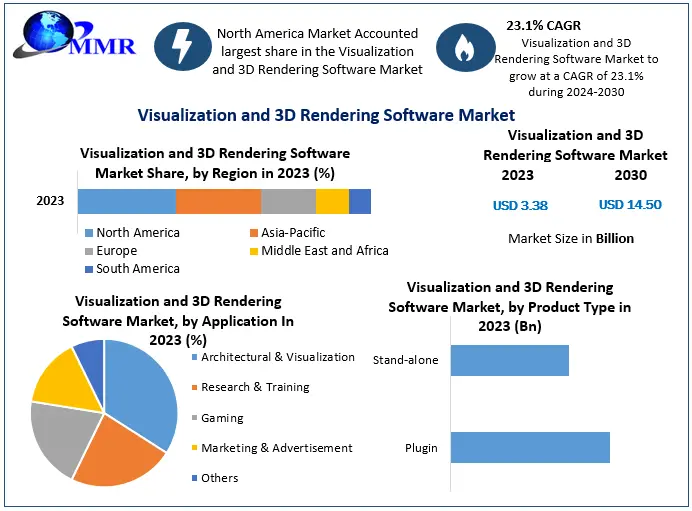
- Design, construction, media and training teams are moving from static drawings to real-time 3D visualization as faster decisions become a competitive requirement. The Visualization and 3D Rendering Software Market was valued at US$ 3.38 Bn in 2023 and is expected to reach nearly US$ 14.50 Bn by 2030, creating a major opportunity for software vendors, cloud rendering platforms, architecture technology providers and digital media companies.
- The Visualization and 3D rendering software market is forecast to grow at a 23.1% CAGR from 2024 to 2030, showing that visualization software is moving from specialist design teams into broader enterprise workflows.
- Architectural and Visualization is expected to hold the largest application share by 2030, making construction and real estate the strongest disclosed demand base.
- Cloud deployment is expected to grow rapidly during the forecast period, signaling demand for scalable rendering capacity and lower infrastructure friction.
- North America is expected to hold the highest share, while Asia Pacific is expected to grow rapidly because of investments in animation, graphics solutions and real estate growth in China, South Korea and India.
Why This Matters Now
Visualization has become a business-speed issue. Architects, engineers, designers, media teams and training organizations need 3D tools that convert ideas into photorealistic, decision-ready assets before budgets, approvals and customer expectations shift.
The strongest technology signal is not AI in the public page; AI, generative AI, 5G, edge computing, data center investments and telecom infrastructure expansion are not disclosed. The supported transformation is cloud-based 3D rendering, virtual modelling, smart-city design, real-time visualization and software-driven creative production.
Market Overview
Visualization and 3D rendering software market uses 3D software to create images and render designs. Its applications include Architectural and Visualization, Research and Training, Gaming, Marketing and Advertisement, and others.
Industry verticals include Construction and Real Estate, Energy and Utilities, Media and Entertainment, Education, Healthcare and Life Science, and others. Product types include plugins and standalone tools, while deployment models include on-premise and cloud.
The public page contains a visible header inconsistency: the top panel lists US$ 3.38 Bn as forecast market size, while the overview and scope table state US$ 3.38 Bn in 2023 and US$ 14.50 Bn by 2030. This article uses the overview and scope-table values because they match the supplied market-size statement.
Key Trends Driving Growth
Virtual modelling and building design are the first growth drivers. MMR identifies rising need for virtual modelling, building design and architecture planning for smart cities as major forces behind market expansion.
Real-time rendering is the second driver. Faster decision-making capability helps designers, builders and clients review projects earlier, reducing approval friction and improving commercial visibility before physical work begins.
Cloud-based rendering is the clearest cloud migration signal. The report identifies rising use of cloud-based 3D rendering services as a lucrative growth opportunity, giving enterprises a way to access rendering capacity without relying only on local infrastructure.
Gaming and videography are expanding the market beyond architecture. MMR states that demand for high-end gaming and videography is expected to create growth prospects, giving software vendors exposure to entertainment, digital media and content creation workflows.
The main restraints are lack of IT infrastructure, lower demand in developing countries, security concerns and privacy concerns. These constraints make cloud trust, infrastructure readiness and data protection important selection criteria for enterprise buyers.
Start Your Market Research Journey with a Free Sample Report
Segment Insights
- Dominant Segment Architectural and Visualization: Architectural and Visualization is expected to hold the largest market share by 2030. Growth is driven by adoption in construction and real estate, where firms use visualization to present projects to clients and improve profit and market value.
- Fastest-Growing Segment: The public MMR page states that Research and Training, Cloud deployment, Construction and Real Estate, and Media and Entertainment are expected to grow rapidly, but it does not disclose usable segment CAGRs. No fastest-growing segment is inferred.
- Deployment Signal Cloud: Cloud deployment is expected to grow rapidly during the forecast period, showing demand for scalable, externally hosted rendering resources.
- Industry Signal Construction and Real Estate: Construction is identified as the key major driver of adoption because architects, designers, BIM modellers and other professionals increasingly use 3D rendering software.
- Media and Entertainment Signal: Media and Entertainment demand is high, particularly in North America, because animation, VFX, digital media and film production require 3D rendering software.
Regional Growth Story
North America dominates the global market during the forecast period and is expected to hold the largest share by 2030. Growth is linked to increased use of 3D rendering software by construction companies and real estate firms seeking faster project completion.
Asia Pacific is expected to grow rapidly during the forecast period. MMR links regional demand to rising investments in animation and graphics solutions across building and real estate, media and entertainment, and healthcare.
China, South Korea and India are the strongest disclosed Asia Pacific country signals. Rapid growth of the real estate industry in these emerging countries is expected to support demand for visualization and 3D rendering software.
The report covers the United States, Canada, Mexico, the UK, France, Germany, Italy, Spain, Sweden, Austria, China, South Korea, Japan, India, Australia, Indonesia, Malaysia, Vietnam, Taiwan, Bangladesh and Pakistan. Country-level revenues, AI deployment values, 5G trends, data center investments and cybersecurity spending are not disclosed.
Competitive Landscape
Key players include Siemens AG, Dassault Systemes, Trimble, Corel Corporation, Chaos Group, NewTek, Luxion, Autodesk, Adobe Systems, Nvidia, Next Limit Technologies, SAP, The Foundry Visionmongers, Render Legion, Christie Digital Systems, Act-3D, Altair Engineering, Cebas Visual Technology, Embodee, OTOY and Robert McNeel and Associates.
Autodesk is expected to hold the largest share during the forecast period. Its portfolio includes 3D modelling software, 3D CAD software, 3D animation, 3D printing, 2D CAD drafting and 3DS Max, which positions it strongly across architecture, design, media and product development workflows.
Competition is moving toward platform breadth and workflow integration. Vendors that can combine modelling, rendering, animation, plugins, cloud deployment and user-friendly interfaces will have stronger pricing power than tools focused only on narrow rendering tasks.
The public page does not disclose named recent acquisitions, partnerships, AI launches, data center investments, telecom network expansions or cybersecurity product launches. The visible competitive direction is cloud rendering, photorealistic visualization, plugins, construction design workflows, animation and digital media production.
Recent Developments
- Cloud Rendering Opportunity: Rising use of cloud-based 3D rendering services is expected to provide lucrative market prospects during the forecast period.
- Smart-City Planning Demand: Demand for virtual modelling, building design and architecture planning for smart cities is identified as a key market driver.
- Research and Training Adoption: Demand is rising for detailed visual representation of research objects such as instruments, internal body organs and micro particles.
Strategic Implications
For CIOs and CTOs, visualization software is becoming part of enterprise software modernization in design-heavy sectors. The strongest use cases connect cloud rendering, collaborative design review, photorealistic project visualization and faster stakeholder approvals.
For construction and real estate leaders, 3D rendering can improve project communication and client conversion. The report links adoption to the need to visualize projects for clients, increase profit and improve market value.
For investors, the market offers exposure to cloud rendering, architectural visualization, digital media, gaming, education technology, healthcare visualization and plugin ecosystems. The main risks are weak IT infrastructure, security concerns, privacy issues and lower adoption in developing countries.
Future Outlook
The Visualization and 3D Rendering Software Market is forecast to grow from US$ 3.38 Bn in 2023 to nearly US$ 14.50 Bn by 2030 at a 23.1% CAGR. Growth will come from architectural visualization, construction and real estate, cloud deployment, research and training, high-end gaming, videography, media and entertainment, education and healthcare applications.
The next phase will test whether vendors can turn rendering tools into scalable, cloud-connected visualization platforms for design, construction and digital content teams. Future digital leaders will control real-time visual workflows from concept to client approval; laggards will remain tied to slow static design processes while competitors convert 3D visualization into faster decisions and stronger customer experience.
Analyst Perspective
“Visualization and 3D rendering software is becoming strategic design infrastructure as construction, real estate, media, education and healthcare organizations demand faster, clearer and more immersive decision-making tools,” said Yash Ghosalkar, Analyst at Maximize Market Research. “The strongest providers will combine cloud rendering, user-friendly interfaces, photorealistic output, plugin ecosystems and industry-specific workflows.
About Maximize Market Research
Maximize Market Research Pvt. Ltd. (MMR) is a global market research and consulting company that provides reliable, data-focused, and practical business insights. The firm serves a wide range of industries, including healthcare, pharmaceuticals, technology, automotive, electronics, chemicals, personal care, and consumer goods. Through market forecasts, competitive analysis, strategic consulting, and industry impact assessments, MMR helps organizations understand changing market conditions, identify growth opportunities, and make informed business decisions for long-term success.
Contact Us
2nd Floor, Navale IT Park Phase 3
Pune Banglore Highway, Narhe
Pune, Maharashtra 411041, India
+91 9607365656
[email protected]