Key Highlights
-
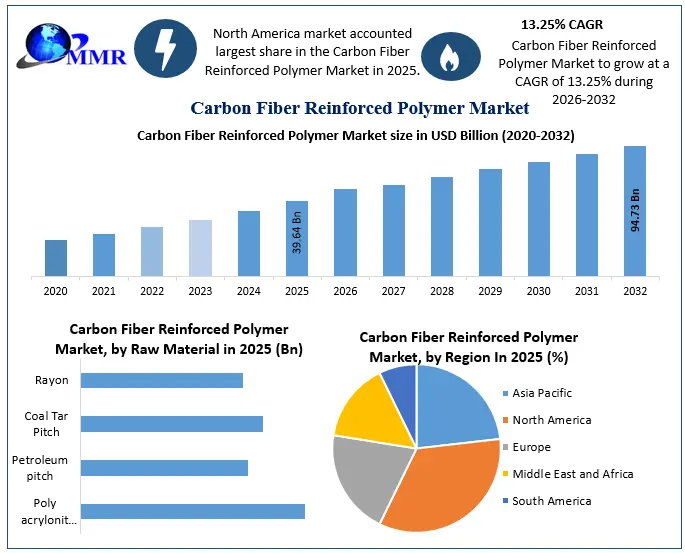
Global Carbon Fiber Reinforced Polymer Market is expected to grow at a CAGR of 13.25% and reach US$ 94.73 Billion by 2032, signalling a structural shift as CFRP becomes a core material in multiple industries rather than a niche composite.
-
Demand is driven by downstream applications in aerospace, automotive, wind energy, industrial equipment and sports where strength-to-weight ratio and fatigue performance are critical.
-
Capacity expansions and process upgrades are accelerating to close the gap between growing demand and historically constrained CFRP supply.
-
Sustainability, CO₂ reduction commitments and circular economy agendas push manufacturers to invest in recycling, re-use and lower-impact production routes.
-
Competitive dynamics are intensifying as integrated CFRP players and specialty materials firms race to secure feedstocks, technology leadership and long-term contracts with OEMs.
Why This Matters Now
Chemicals and materials executives can no longer treat CFRP as a specialty corner case. A market heading to US$ 94.73 Billion by 2032 at 13.25% CAGR means carbon fiber reinforced polymers will shape future platform choices across aerospace, automotive, wind energy, industrial machinery and consumer goods.
For procurement leaders and industrial buyers, this growth implies tighter competition for quality capacity, more complex price cycles and greater strategic importance for CFRP in long-term contracts. For investors, it signals that CFRP sits at the intersection of performance, energy efficiency and decarbonization—making it central to materials strategy for the next decade.
Market Overview
Carbon fiber reinforced polymer size combines carbon fibers with a polymer matrix to deliver high stiffness, low weight and strong fatigue resistance. It is used wherever traditional metals and heavier composites cannot meet weight and performance requirements: aircraft structures, automotive body and chassis components, wind turbine blades, pressure vessels, sports equipment and high-end industrial parts.
Reaching US$ 94.73 Billion by 2032 at 13.25% CAGR marks a transition from niche aerospace and sports markets into broad industrial adoption. CFRP is increasingly specified in mainstream vehicle platforms, structural components and energy systems rather than only in flagship or luxury applications.
What changed is the convergence of three drivers: stricter CO₂ rules, electrification and the search for higher efficiency. Lightweight materials now directly impact range, fuel burn, load capacity and asset utilization, giving CFRP a clear economic role beyond performance branding.
Key Trends Driving Growth
What changed? First, decarbonization and efficiency targets are now embedded in regulatory frameworks and OEM strategies. Lightweight structures reduce energy use in mobility and industrial systems, making CFRP a lever for meeting fleet and asset-level carbon goals.
Second, electrification raises range and weight sensitivity. Battery-heavy vehicles need lighter bodies and components to maintain range and performance; CFRP can deliver weight savings where metals reach their limits. This drives demand beyond traditional high-performance niches.
Third, design and manufacturing technologies have matured. Advances in resin systems, preforms, automated layup, RTM, pultrusion and curing reduce cycle times and expand shape options. CFRP is now more compatible with industrial-scale series production, not just low-volume, high-cost components.
Request a Free Sample Copy or View Report Summary: https://www.maximizemarketresearch.com/request-sample/4367/
Segment Insights
-
Dominant Segment – Aerospace and High-Performance Applications
Aerospace and other high-performance segments still dominate CFRP demand, given the material’s long history in aircraft structures, engines, and space and defence applications. This dominance means aerospace investment cycles, fleet renewal plans and regulatory frameworks around efficiency and noise strongly influence CFRP volumes and specifications. -
Fastest-Growing Segment – Automotive and Energy (Wind, Pressure Vessels)
Automotive and energy-related uses—such as wind turbine blades and composite pressure vessels—represent the fastest-growing segments. As carmakers and energy firms pursue weight reduction, durability and lifetime efficiency, CFRP moves into more models and projects, driving scale and pushing down relative costs. -
Feedstock and Resin Choices
CFRP relies on carbon fiber feedstock and polymer resins, with choices between thermoset and thermoplastic matrices depending on application and processing. Feedstock availability and resin technology directly shape cost structures and recycling options, making upstream strategy critical for competitive advantage. -
Downstream Demand Patterns
Downstream demand is diversified across aerospace, automotive, energy, sports and industrial sectors. This cross-industry footprint gives CFRP resilience against cycles in any single end-use, but forces producers to manage complex qualification, certification and approval processes in multiple regulatory environments.
Regional Growth Story
In the United States, CFRP benefits from robust aerospace, defence, automotive and energy sectors. Investments in new aircraft platforms, advanced mobility, hydrogen and pressure vessel systems reinforce demand, while domestic capacity and technology ecosystems strengthen supply resilience.
Germany and broader Europe drive CFRP demand through automotive lightweighting, wind energy expansion and high-end industrial machinery. EU decarbonization goals and regulatory pressure on emissions make advanced composites attractive, but also heighten scrutiny on production emissions and end-of-life management.
China invests aggressively in aerospace, automotive and wind energy, creating significant CFRP demand and driving efforts to build local carbon fiber and composite capacity. These moves reshape global trade flows and competitive dynamics as Chinese producers seek a larger role in the CFRP supply chain.
Japan and South Korea have strong technology bases in carbon fiber and composites. Their automotive and electronics sectors, combined with materials expertise, position them as key players in high-performance CFRP applications and advanced processing development.
India’s industrial and infrastructure growth, combined with rising aerospace and automotive activities, creates long-term CFRP potential. As local industries step up in manufacturing and mobility, CFRP use can expand from niche imports into more integrated domestic supply and design.
Competitive Landscape
CFRP competition involves integrated carbon fiber producers, composite materials specialists, and OEM-affiliated supply chains. Large players with upstream carbon fiber assets and downstream composite processing gain pricing power and capacity control, particularly in high-specification aerospace and energy contracts.
Acquisitions and joint ventures signal strategic attempts to secure feedstock, expand processing capabilities and enter new regional markets. When a company buys a carbon fiber plant or partners with an aerospace or automotive OEM, it signals an intent to lock in long-term demand and influence design choices, narrowing options for competitors.
Investments in recycling and circular technologies show which firms are preparing for the next regulatory wave. Companies that can offer certified recycled CFRP or lower-carbon production routes will be better positioned with OEMs facing scope 3 pressure and public scrutiny.
Recent Developments
-
Capacity expansions and new CFRP lines launched to meet rising demand from aerospace, automotive and energy applications.
-
Investments in automated manufacturing and digital process control, aiming to lower cycle times and increase repeatability for larger volume projects.
-
Programs targeting CFRP recycling, re-use and waste reduction, aligned with sustainability and circular economy commitments.
-
Partnerships between CFRP producers and OEMs to co-develop application-specific solutions, from vehicle platforms to turbine blades and hydrogen tanks.
Strategic Implications
For chemical and materials manufacturers, CFRP’s 13.25% CAGR and US$ 94.73 Billion target by 2032 mean capital allocation decisions around carbon fiber, resin systems, processing technology and recycling will directly affect long-term competitiveness. Treating CFRP as a core strategic material, not a side line, becomes essential.
Procurement leaders in aerospace, automotive and energy must manage CFRP supply risks, qualification timelines and pricing structures. Long-term contracts, multiple qualified sources and joint development agreements can reduce volatility and support innovation.
Investors should recognize CFRP’s dual nature: it is both a performance material and a decarbonization enabler. Portfolio exposure to CFRP players with strong technology, recycling capabilities and diversified end-use bases can offer leverage to the broader transition in mobility and energy systems.
Future Outlook
With the Global Carbon Fiber Reinforced Polymer Market expected to reach US$ 94.73 Billion by 2032 at a 13.25% CAGR, the next decade will be defined by how quickly CFRP moves from specialist platforms to standard engineering choices in mainstream vehicles, infrastructure and energy assets. Recycling, lower-impact production and industrial-scale automation will transition CFRP from scarce high-end composite to a widely used strategic material.
The decisive advantage will belong to companies and industrial buyers that embed CFRP in integrated, low-carbon design and manufacturing strategies—while those that cling to metal-dominated, incremental approaches risk losing performance, regulatory headroom and market relevance as lightweight, high-efficiency materials become the new baseline.
Related Reports
Ethylene Vinyl Acetate Market https://www.maximizemarketresearch.com/market-report/global-ethylene-vinyl-acetate-market/15195/
Global Plasticizers Market https://www.maximizemarketresearch.com/market-report/global-plasticizers-market/6429/
Global Substation Maintenance Market https://www.maximizemarketresearch.com/market-report/global-substation-maintenance-market/74340/
Analyst Perspective
“As aerospace, automotive and energy sectors push for lighter, stronger and lower-carbon assets, players that commit to scaling carbon fiber reinforced polymers with robust feedstock, recycling and technology strategies will shape both materials pricing and competitive dynamics across global manufacturing,” Ankita Kagawade
About Maximize Market Research
Maximize Market Research Pvt. Ltd. (MMR) is a global market research and consulting company that provides reliable, data-focused, and practical business insights. The firm serves a wide range of industries, including healthcare, pharmaceuticals, technology, automotive, electronics, chemicals, personal care, and consumer goods. Through market forecasts, competitive analysis, strategic consulting, and industry impact assessments, MMR helps organizations understand changing market conditions, identify growth opportunities, and make informed business decisions for long-term success.
2nd Floor, Navale IT Park Phase 3
Pune Banglore Highway, Narhe
Pune, Maharashtra 411041, India
+91 9607365656
[email protected]