Key Highlights
-
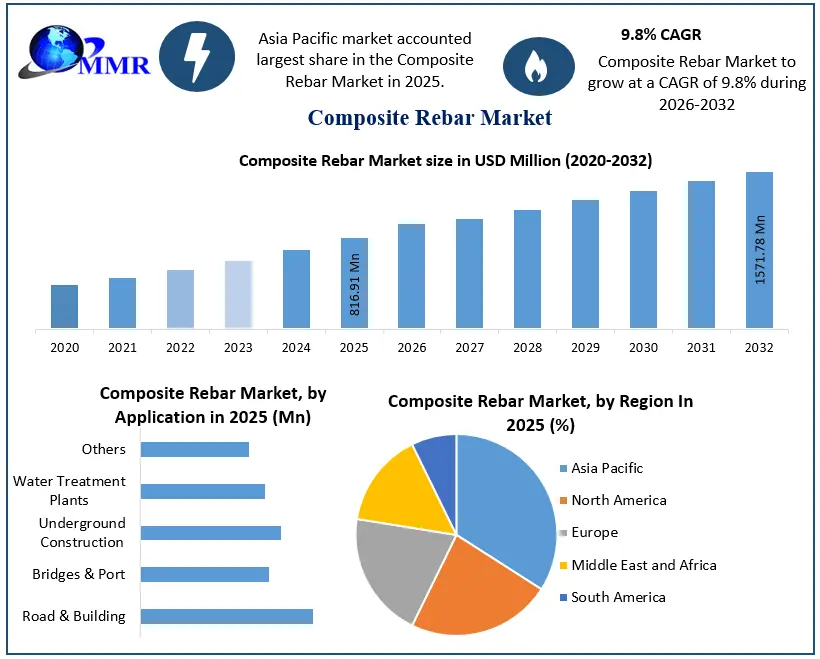
The global composite rebar market is expanding at a 9.8% compound annual growth rate during the forecast period from 2025 to 2032.
-
The market has reached an established baseline valuation of USD 744 million, driven by systemic infrastructure renewal across major industrialized economies.
-
The infrastructure and construction segment represents the dominant downstream end-user category, anchored by extensive civil engineering, bridge, and tunnel deployments.
-
Glass Fiber Reinforced Polymer constitutes the primary product type due to its proven weight reduction advantages and high resistance to aggressive chemical environments.
-
The Asia-Pacific region maintains absolute dominance over the global market volume while acting as the fastest-growing geographical theater through 2032.
Why This Matters Now
Structural concrete corrosion costs global industrial asset owners billions in annual maintenance and premature structural failures, threatening the stability of critical supply routes. Procurement leaders must immediately overhaul traditional steel reinforcement contracts as structural engineering regulations shift systematically toward non-corrosive alternatives. This market disruption forces polymer composite manufacturers and raw chemical producers to scale resin output to capture newly diverting construction supply chains. Industrial buyers who continue to rely exclusively on carbon steel face escalating long-term lifecycle liabilities and severe compliance penalties under modern sustainable development mandates. Civil engineers are fundamentally redesigning coastal infrastructure, ports, and wastewater treatment installations to integrate advanced fiber-reinforced polymers, permanently shifting procurement away from traditional metal foundries. The rapid integration of these durable materials directly changes capital allocation frameworks across global infrastructure funds and heavy chemical processing operations.
Market Overview
The global Composite Rebar Market centers on the production, distribution, and structural integration of fiber reinforced polymer reinforcement elements designed to completely replace steel inside concrete structures. These specialized rebars are engineered from high-strength fibers embedded within a polymer matrix, creating a lightweight component that prevents internal concrete degradation. The scope of this industry encompasses global manufacturing networks, specialized pultrusion processing facilities, and regional industrial supply paths. Driven by the critical demand for durable infrastructure, these non-metallic alternatives are expanding their footprint across public and private sector projects.
Valuation records indicate the composite rebar market has reached an established valuation of USD 744 million, with total global revenue moving forward at a 9.8% compound annual growth rate from 2025 to 2032. This rapid growth occurs as supply capabilities scale steadily across key manufacturing hubs to match rising demand from global civil engineering portfolios. The transition from a specialty chemical niche to a primary structural material is supported by long-term corporate procurement shifts aiming to eliminate the risks of internal rust and concrete spalling. Consequently, composite rebars are becoming default specifications for projects built in high-moisture, marine, and chemically aggressive zones.
Key Trends Driving Growth
The primary catalyst for market acceleration is the widespread shift toward entirely corrosion-free infrastructure in coastal and marine environments. Traditional steel reinforcement fails rapidly when exposed to saltwater and de-icing chemicals, causing catastrophic internal cracking that shortens structural lifespans. Composite rebars completely resist electrochemical oxidation, providing long-term lifecycle cost savings that protect public and private capital investments. This structural advantage allows public works authorities to extend the operational lifespan of bridges, highways, and seawalls without recurring maintenance costs.
Simultaneously, the global push for sustainable, eco-friendly building materials is accelerating the adoption of fiber reinforced polymer technologies. The manufacturing and transport of composite solutions generate a smaller environmental footprint compared to carbon-intensive steel production lines. Architects and structural engineers use these green building characteristics to satisfy strict regional environmental mandates and achieve international sustainability certifications. This regulatory alignment transforms composite rebar from an optional design variation into a compliance tool for multi-national construction firms.
Furthermore, structural weight reduction has emerged as an operational trend altering project economics on the job site. Composite rebars are significantly lighter than their steel equivalents, directly simplifying logistics, field handling, and structural installation. This physical difference reduces heavy equipment requirements, lowers site labor expenses, and optimizes long-distance transport costs for industrial contractors. As labor shortages challenge the global construction industry, the ease of handling lightweight reinforcement allows projects to maintain tight completion schedules.
Segment Insights
-
Infrastructure and Construction (Dominant End User): This segment maintains its leading position in the end-user category because civil engineering projects require enormous material volumes for long-span bridges, highway networks, and tunnels.
-
Glass Fiber Reinforced Polymer (Primary Type): This material variant commands the highest consumption volumes because it provides cost-effective mechanical performance, structural durability, and high corrosion resistance.
-
Basalt Fiber Reinforced Polymer (Fastest-Growing Segment): This product sub-segment is expanding rapidly as automated manufacturing lines optimize the processing of volcanic rock fibers into high-temperature resistant structural components.
-
Coastal and Marine Applications: Coastal developments account for a rapidly expanding share of specialized procurement, driven by municipal investments in harbors, docks, and coastal defense barriers.
Regional Growth Story
The Asia-Pacific region dominated the global composite rebar market in 2024 and is projected to expand at the fastest rate during the 2025 to 2032 forecast period. This geographic dominance is driven by rapid urbanization, massive infrastructure programs, and direct government capital investments across emerging economies like China, India, Indonesia, and Vietnam. China and India operate as the primary volume drivers, utilizing high-capacity domestic pultrusion manufacturing plants to support extensive domestic mega-projects. This regional concentration of production capacity gives Asia-Pacific significant influence over global volume availability and export pricing structures.
In North America, early regulatory adoption, advanced engineering standards, and high infrastructure renewal needs support steady market expansion. The United States and Canada benefit from established testing frameworks that allow engineers to confidently deploy fiber reinforced polymer composites in major public highway bridges. Meanwhile, the European market, led by Germany, shows concentrated growth tied to strict sustainability laws and green building initiatives. European procurement teams favor composite alternatives to meet regional carbon reduction targets, which offsets higher local manufacturing and energy input costs.
Competitive Landscape
The global composite rebar market is defined by a mix of established international materials corporations and specialized composite manufacturers. Key industry participants include Aslan FRP (Owens Corning), Hughes Brothers Inc., Pultrall Inc. (V-ROD), Marshall Composite Technologies LLC, Kodiak Fiberglass Rebar LLC, Neuvokas Corp., BP Composites Ltd., Polux (Basanite Industries), and Schoeck. These companies compete on chemical formulation, tensile performance, manufacturing efficiency, and structural certification.
Market leaders focus on expanding their regional distribution networks to secure long-term supply agreements with global construction groups. By scaling up continuous automated pultrusion lines, these manufacturers lower unit production costs and compete directly with traditional steel pricing. They also invest in technical support teams to help engineers navigate building code transitions, accelerating market penetration across conservative construction sectors.
Recent Developments
-
Aslan FRP, backed by Owens Corning, has optimized its production footprint to expand the supply of certified glass fiber reinforced polymer rebars across global infrastructure networks.
-
Pultrall Inc. has upgraded its V-ROD manufacturing lines to improve product consistency and satisfy the quality criteria required by municipal transport authorities.
-
Schoeck has expanded its regional technical advisory teams to accelerate the integration of specialized non-metallic reinforcement within complex commercial and industrial architectural designs.
-
Emerging composite manufacturers are forming strategic partnerships with local concrete ready-mix suppliers to provide pre-integrated structural systems directly to construction sites.
Strategic Implications
The rapid growth of the composite rebar market signals a structural shift in how industrial builders manage raw material risk and lifecycle costs. Procurement leaders must move away from short-term transactional purchasing and implement long-term material strategies that account for structural durability. Companies that integrate composite solutions early protect their projects from volatile steel tariffs and regional trade restrictions.
Additionally, as chemical and resin producers see traditional commodity lines mature, the high-performance composites sector offers an opportunity to capture premium margins. This shift forces a reorganization of capital, with investments moving toward advanced fiber processing and specialized polymer blending plants.
Future Outlook
The global composite rebar market is positioned for sustained long-term growth as international engineering codes standardize the deployment of non-metallic materials. Market leadership will belong to manufacturers that successfully automate production to match conventional steel volumes while maintaining the certified product tracking required by public safety regulators.
Analyst Perspective
“The global composite rebar market has passed its initial adoption phase and is now a mainstream structural option,” states Ankita Kagawade, Lead Analyst at Maximize Market Research. “With the Asia-Pacific region driving high volume demand and North America setting advanced engineering standards, procurement professionals must secure reliable polymer and fiber supply lines to protect themselves against the inevitable decline of traditional steel reinforcement.”
About Maximize Market Research
Maximize Market Research Pvt. Ltd. (MMR) is a global market research and consulting company that provides reliable, data-focused, and practical business insights. The firm serves a wide range of industries, including healthcare, pharmaceuticals, technology, automotive, electronics, chemicals, personal care, and consumer goods. Through market forecasts, competitive analysis, strategic consulting, and industry impact assessments, MMR helps organizations understand changing market conditions, identify growth opportunities, and make informed business decisions for long-term success.
2nd Floor, Navale IT Park Phase 3
Pune Banglore Highway, Narhe
Pune, Maharashtra 411041, India
+91 9607365656
[email protected]
Maximize Market Research is a high-growth market research and business consulting firm serving clients globally. Through detailed technical analysis and comprehensive industrial tracking, the firm delivers actionable market insights to corporate boardrooms, chemical executives, and procurement decision-makers worldwide.