Key Highlights
-
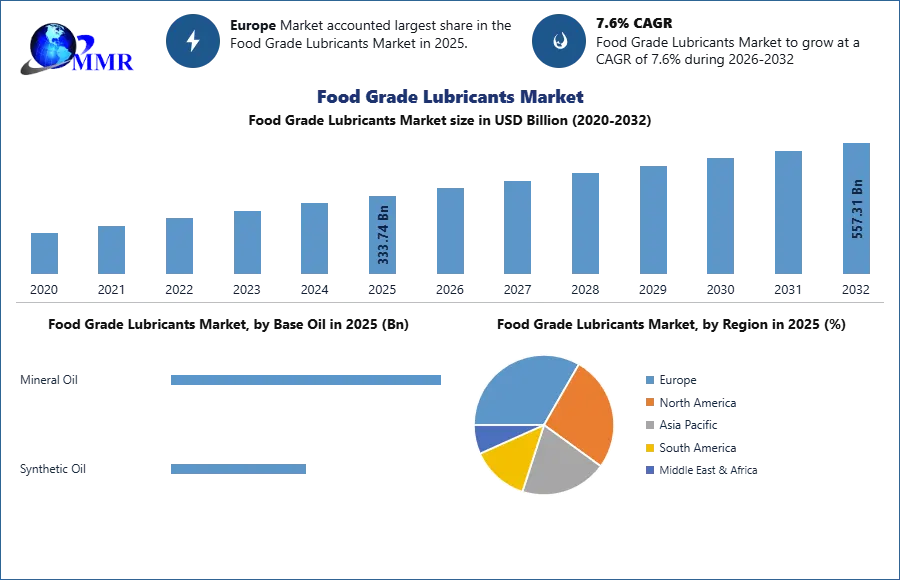
The global food grade lubricants market is expanding from USD 333.74 million in 2025 to USD 557.31 million by 2032, sustained by a 7.6% continuous growth rate.
-
Highly regulated H1 formulations dominate the market due to escalating compliance mandates surrounding incidental food contact risks across automated processing lines.
-
Cost-effective mineral oils command major volume shares, but performance limits under extreme temperatures accelerate a sector-wide migration toward synthetic base oils.
-
Europe controls the highest market share, supported by an industrial network of over 240,000 active food and beverage manufacturing entities.
-
Consolidation shapes market structure, highlighted by major strategic assets shifting ownership to expand product breadth and capture regional pricing power.
Why This Matters Now Industrial food processing, pharmaceutical, and cosmetic manufacturing lines are operating under unprecedented regulatory scrutiny and velocity. A single product contamination incident can dismantle global supply chains, destroy brand equity, and trigger immediate fiscal penalties. Plant operators can no longer treat machinery maintenance as a secondary utility.
What changed is the structural zero-tolerance threshold for uncertified chemical exposure in consumer goods. Why now? Rapid automation and high-speed conveyor configurations increase the physical stress on mechanical components, elevating the risk of lubricant misting or leakage. Procurement leaders, chemical manufacturers, and institutional investors must understand that the transition to certified food machinery lubrication has evolved from a voluntary risk-mitigation strategy into an absolute operational mandate for global market access.
Market Overview The global food grade lubricants market reached a valuation of USD 333.74 million in 2025. Driven by expanding manufacturing investments and compliance integration, the market is poised to grow at a 7.6% CAGR, reaching USD 557.31 million by 2032. Food grade lubricants are highly specialized fluids designed to withstand chemical degradation, protect metallurgy from corrosion, and provide dependable wear prevention while remaining physiologically inert, tasteless, odorless, and colorless.
The industry segment segments these materials into three primary classifications: H1, H2, and H3. H1 lubricants are explicitly engineered for environments where incidental food contact is technically possible. H2 formulations serve closed systems where physical contact with consumer products is impossible, while H3 variants are restricted to rust prevention and general cleaning duties on non-product-contact surfaces. The ongoing expansion of downstream pharmaceutical lines and commercial food manufacturing acts as the primary engine for this sustained volume growth.
Key Trends Driving Growth The sudden proliferation of specialized delivery mechanisms represents a major technological advancement. Specifically, the expanding availability of high-performance food grade lubricants in aerosol configurations has transformed daily maintenance routines on the factory floor. Aerosol lubricants permit precise application to intricate mechanical links, chain systems, and hard-to-reach packaging assemblies. This targeted delivery optimizes volume consumption and reduces the risk of over-lubrication, which frequently leads to product contamination.
Simultaneously, shifting consumer preferences toward clean-label food products and dietary wellness have forced food processors to modernize their manufacturing facilities. Upgraded infrastructure requires lubricants with excellent oxidation stability and neutral chemical behaviors toward delicate packaging plastics and rubber seals. Low-cost raw materials help downstream margins, but strict additive rules restrict H1 formulations. This creates a technical challenge, prompting deeper investments into specialized chemical research and development.
Segment Insights
-
Dominant Segment: H1 lubricants represent the leading product category by volume and value. Widespread integration across multi-stage production lines where incidental product exposure is a risk secures this dominance. These lubricants are increasingly formulated using high-purity synthetic base oils such as polyalphaolefins (PAO), polyalkylene glycol (PAG), and custom esters to satisfy international food safety standards.
-
Dominant Base Oil Type: Mineral oil remains the leading base oil choice due to its lower raw material cost, extensive industrial supply chains, and sufficient capabilities in standard operating environments. These formulations rely on highly refined petroleum-based white oils to maintain compliance.
-
Fastest-Growing Segment: Synthetic base oils are outperforming alternative segments in growth velocity. Industrial plants are rapidly adopting synthetic variants to achieve superior thermal stability, extended service life, and reliable mechanical protection under severe freezing or high-bake processing temperatures.
-
Primary Downstream Segment: Food processing stands as the dominant application sector. Extensive networks of high-speed mixers, intensive sorting conveyors, and heavy-duty packaging machinery require consistent, high-volume lubrication cycles to maintain uninterrupted operational uptime.
Regional Growth Story Europe claimed the largest global market share in 2025. This leading position is sustained by an extensive manufacturing infrastructure consisting of more than 240,000 food and beverage processing operations. European production facilities operate under intense regulatory supervision, where strict compliance dictates the absolute adoption of certified non-toxic lubricants. The mature industrial footprint across Germany and surrounding manufacturing centers ensures steady, high-volume procurement of technical fluids.
Conversely, the Asia Pacific region is expanding as the fastest-growing geographical market. Rapid economic development, rising consumer spending on processed packages, and the construction of massive production facilities in China, India, and Japan drive this regional expansion. China, in particular, is implementing tougher national safety frameworks and modernizing its heavy industrial processing plants. To support continuous operations under extreme temperatures, regional processors rely on advanced food grade fluids. This shifting landscape offers major opportunities for international chemical suppliers.
Competitive Landscape The competitive environment is consolidating as major producers acquire specialized assets to control regional pricing power and diversify their patent portfolios. Large chemical players are actively buying niche formulation brands to secure immediate access to proprietary technology and certified product lines. These strategic asset transfers allow larger entities to optimize their manufacturing capacities and deploy comprehensive global distribution channels.
At the same time, companies are trying to balance high-performance lubrication with eco-friendly profiles. Tightening additive regulations limit the use of standard anti-wear chemicals, forcing manufacturers to find alternative molecular configurations. Competitors are using advanced synthetic chemistry to create high-purity fluids that deliver excellent machinery protection without violating health mandates.
Recent Developments
-
On 15 June 2025, Interflon introduced Interflon Food Lube 3H, a dual-action fluid that serves simultaneously as a direct release agent and an NSF H1 lubricant. This dual certification allows commercial bakeries and meat processors to eliminate separate chemical inventories, simplifying compliance and lowering operational costs.
-
On 10 April 2025, CRC Industries launched an updated series of NSF-certified food grade lubricants, greases, and industrial cleaners utilizing specialized spray delivery systems. The technology targets high-speed automated packaging lines, improving contamination prevention during rapid manufacturing changes.
-
FUCHS Petrolub SE successfully completed the acquisition of specialized food-grade lubricant assets from Shell International Petroleum, absorbing the globally recognized CASSIDA brand portfolio. This structural acquisition increases FUCHS’ global market share and gives it greater pricing leverage across international distribution channels.
Strategic Implications The shifting dynamic between mineral and synthetic oils requires immediate adjustments in procurement strategy. While mineral-based industrial white oils offer short-term cost benefits, their performance limitations under extreme physical stress increase long-term maintenance costs. Procurement leaders must re-evaluate total cost of ownership models. Investing in synthetic lubricants extends drain intervals, reduces energy use, and lowers the risk of catastrophic machinery wear.
Furthermore, recent asset acquisitions highlight the changing structure of the market. As major chemical firms acquire independent formulators, small-scale buyers face a shrinking pool of independent suppliers. To protect their supply chains from market disruptions, downstream manufacturers should establish multi-year supply contracts with consolidated market leaders.
Future Outlook Looking forward, the industry will favor advanced synthetic formulations that can handle extreme mechanical stress while meeting strict safety compliance. Companies that fail to update their older production setups to handle these advanced fluids risk facing regulatory penalties and reduced production efficiency. Ultimate market leadership belongs exclusively to chemical manufacturers that integrate advanced synthetic performance with flexible, dual-certified fluid delivery systems.
Analyst Perspective “The global market is undergoing a major shift as food safety rules tighten and manufacturers demand higher performance,” said Ankita Kagawade, Research Analyst at Maximize Market Research. “The transition from traditional white mineral oils to advanced synthetic fluids is no longer just for special applications; it is now a core requirement for companies looking to protect their supply chains and improve plant efficiency.”
About Maximize Market Research
Maximize Market Research Pvt. Ltd. (MMR) is a global market research and consulting company that provides reliable, data-focused, and practical business insights. The firm serves a wide range of industries, including healthcare, pharmaceuticals, technology, automotive, electronics, chemicals, personal care, and consumer goods. Through market forecasts, competitive analysis, strategic consulting, and industry impact assessments, MMR helps organizations understand changing market conditions, identify growth opportunities, and make informed business decisions for long-term success.
2nd Floor, Navale IT Park Phase 3
Pune Banglore Highway, Narhe
Pune, Maharashtra 411041, India
+91 9607365656
[email protected]