Key Highlights
-
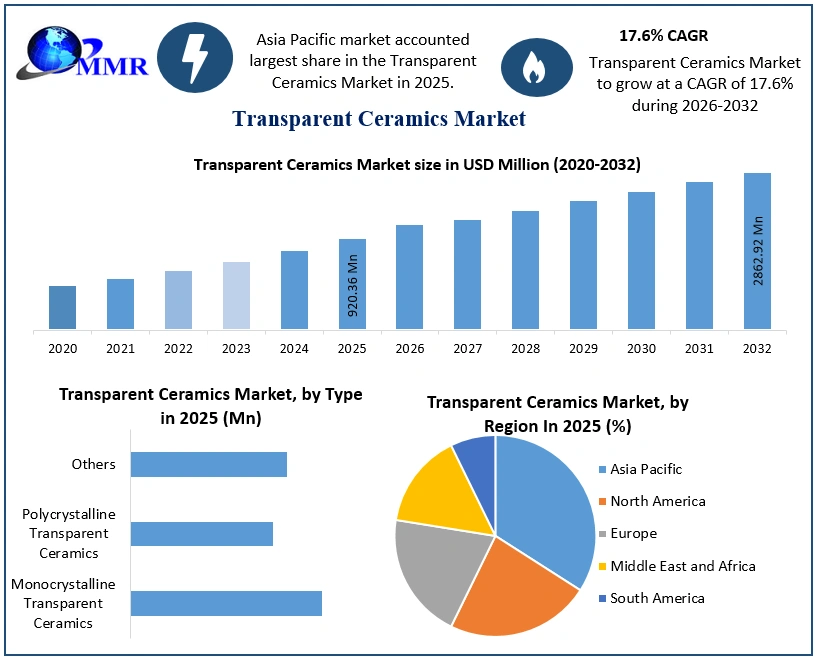
The global transparent ceramics market is projected to expand from USD 920.36 million in 2025 to USD 2,862.92 million by 2032, demonstrating a 17.6% CAGR.
-
Aerospace, defense, and security applications dominate consumption patterns, capturing 45% of total market shares.
-
Monocrystalline transparent ceramics dominate the product type landscape due to their uniform crystal structure and superior optical clarity.
-
Production of specialized materials like aluminum oxynitride relies on scarce raw materials, causing elevated manufacturing expenses and prolonged development cycles.
-
Geopolitical investments in hypersonic platforms are fueling a 40% growth spike in infrared-transparent materials like spinel and ALON.
Why This Matters Now Unprecedented escalation in global military spending and rapid semiconductor nodes are pushing legacy optical glass materials beyond their physical break points. Industrial buyers and procurement leaders face immediate supply friction as structural material requirements shift toward high-purity, transparent polycrystalline alternatives.
The core commercial challenge stems from extreme manufacturing constraints and high structural yield losses. Achieving optical clarity within an engineered ceramic matrix requires intensive sintering profiles and capital-intensive powder purities, frequently resulting in high scrap rates. For component buyers in defense and aerospace, these processing bottlenecks threaten long-term program timelines and trigger severe pricing volatility. Chemical manufacturers who fail to master cost-effective sintering architectures will lose high-margin contracts to vertically integrated specialists who control the underlying powder synthesis pipelines.
Market Overview The global transparent ceramics market recorded an industrial valuation of USD 920.36 million in 2025. High-velocity technical adoption across optoelectronics and extreme-atmosphere infrastructure ensures long-term capital deployment. Total revenue across the global sector is projected to reach USD 2,862.92 million by 2032, growing at an annualized compound rate of 17.6%.
Transparent ceramics represent advanced polycrystalline or monocrystalline materials engineered to combine the optical transparency of conventional glass with the superior mechanical hardness and thermal shock resistance of structural ceramics. These unique physical formulations allow components to operate efficiently within highly corrosive, high-temperature, or blast-prone environments. The broad commercial footprint spans aircraft windows, vehicle armor systems, laser gain media, semiconductor chamber tools, and advanced medical diagnostics. This wide downstream distribution provides chemical processors with a highly profitable buffer against cyclical macro-economic corrections.
Key Trends Driving Growth Accelerating global military modernization programs serve as the main operational engine for volume consumption. Modern defense frameworks rely on hypersonic missile systems and next-generation guided munitions that experience extreme friction-induced thermal loading during atmospheric flight. Because traditional glass and plastics melt or warp under these parameters, defense buyers are aggressively substituting legacy components with aluminum oxynitride and spinel radomes. This shift reshapes procurement cycles, locking in long-term volume commitments for certified advanced material suppliers.
Simultaneously, the global semiconductor equipment sector is expanding its integration of transparent ceramic fixtures. Next-generation microchip fabrication involves aggressive plasma etching and extreme thermal cycling inside vacuum chambers. Advanced ceramics resist chemical degradation far better than quartz, directly extending tool lifetimes and reducing production downtime for electronics manufacturers. This industrial substitution trend creates a stable, high-margin commercial avenue outside the traditional defense sector.
Manufacturing process breakthroughs form the foundational technology trend. Processors are progressively moving beyond slow, manual hot-pressing techniques toward automated near-net-shape casting and rapid spark plasma sintering. These manufacturing innovations lower overall cycle times and optimize energy utilization per batch. For industrial buyers, this technical evolution reduces the total cost of component ownership and expands total volume availability across the supply chain.
Segment Insights
-
Dominant Application Segment: Aerospace, Defense, and Security. This category commands 45% of total global demand. Growth is anchored by non-discretionary procurement of aircraft transparencies, ballistic missile domes, and advanced personal protection armor systems.
-
Dominant Product Type: Monocrystalline Ceramics. This structure commands the leading share of global revenue. The segment’s position is secured by its highly uniform atomic lattice, which provides the defect-free clarity required for precision lenses and high-power laser gain media.
-
Fastest-Growing Segment: Optoelectronics. Capturing a stable 30% market share, this application avenue is expanding rapidly as manufacturers integrate clear ceramic lenses into commercial lidar sensors, high-end camera systems, and smartphone camera enclosures.
-
Healthcare Sector Penetration: Medical imaging applications now account for 20% of global shares. Healthcare equipment providers are boosting procurement of translucent ceramics to manufacture high-durability components for X-ray tubes and computed tomography scanners.
Regional Growth Story The global landscape reflects an intense concentration of capital and technical capability within key industrial zones. North America holds a dominant position in the global transparent ceramics architecture, anchored primarily by the massive military-industrial complex of the United States. High defense research budgets and localized procurement mandates ensure steady capital allocation for local suppliers. US aerospace firms maintain tight relationships with domestic ceramic processors to insulate defense supply loops from foreign trade dependencies.
The Asia Pacific region functions as the fastest-growing industrial corridor, driven by systemic capacity additions in China, India, and Japan. China is expanding its manufacturing output of optical-grade ceramics to feed its domestic defense and consumer electronics lines. India’s accelerating infrastructure and defense investments provide a strong commercial baseline for local components. Japan continues to leverage its technical leadership in semiconductor manufacturing equipment, using high-purity transparent ceramics to fortify its global electronics supply chain. Meanwhile, European manufacturing centers like Germany are focusing capital toward high-power laser applications and advanced medical imaging components to capture premium export values.
Competitive Landscape The competitive architecture of the transparent ceramics sector is moderately consolidated, featuring specialized material science corporations with deep intellectual property portfolios. Entering the market requires enormous capital deployment due to the specialized nature of high-temperature sintering furnaces and precision diamond grinding machinery. Major players shaping global corporate strategy include Surmet Corporation, II-VI Incorporated, CeraNova, and CoorsTek.
These top-tier manufacturers compete aggressively on processing yields and purity metrics. Market power is concentrated among firms that maintain proprietary powder processing formulations and internal shaping capabilities. Competitors like Advanced Ceramic Manufacturing, Optics Balzers, Meller Optics, INO, CeramTec GmbH, Toshiba, and Konoshima Chemicals Co. Ltd. are focused on vertical integration. To insulate their operations from raw material cost spikes, these organizations are forming exclusive supply partnerships with high-purity chemical suppliers, effectively locking out non-integrated fabricators.
Recent Developments
-
Chemical processors face ongoing margin volatility as the synthesis of aluminum oxynitride and spinel optics continues to experience high manufacturing costs and prolonged defense qualification cycles.
-
Advanced manufacturing institutions are investing heavily in automated near-net-shape fabrication centers to reduce structural yield losses and lower the cost of large-format ceramic windows.
-
Industrial components suppliers are accelerating the commercialization of fusion-grade high-power ceramic lasers to capture emerging market shares in heavy industrial cutting and medical surgery systems.
-
Strategic partnerships between prime defense contractors and advanced ceramic houses are consolidating the control of proprietary sintering know-how within domestic trade borders.
Strategic Implications The high capital requirements of aluminum oxynitride synthesis indicate a permanent structural bottleneck for downstream system integrators. Component buyers who operate without long-term pricing agreements are highly vulnerable to margin degradation. Because producing these high-purity materials relies on precise, energy-intensive processes, pricing power remains concentrated with integrated processors who can absorb yield losses across diversified product lines.
This structural reality explains the recent surge in automated manufacturing investments. By transitioning to near-net-shape casting, market leaders are actively working to reduce scrap rates and minimize expensive post-sintering diamond machining. This change alters the competitive landscape; future profitability belongs to companies that eliminate manual machining steps rather than those operating on low labor costs.
Furthermore, long defense qualification cycles mean that switching material vendors introduces severe regulatory friction. Once a specific ceramic dome or window is integrated into a missile or aircraft platform, substitution becomes cost-prohibitive. This dynamic rewards early-mover corporations who lock in specified positions on multi-year defense platforms, establishing a captive revenue stream that insulates them from macroeconomic downturns.
Future Outlook The global transparent ceramics market will continue its evolution toward automated, large-format manufacturing scales. Traditional optical glass will continue to lose market share across high-stress defense and industrial equipment lines. Supply chain resilience will become the primary competitive metric as geopolitical friction impacts the availability of rare-earth dopants and high-purity aluminum oxides.
Winning corporations will be those that successfully scale internal powder formulation lines while automating their post-sintering finishing operations. Fabricators that rely on open-market powder sourcing or fail to lower their manufacturing scrap rates will face irreversible margin erosion and eventual exclusion from premium industrial supply chains.
Analyst Perspective “The rapid escalation of hypersonic defense architectures and advanced semiconductor tools is fundamentally transforming the transparent ceramics sector from a boutique specialty niche into a critical strategic material market,” stated Ankita Kagawade, Research Analyst at Maximize Market Research. “Long-term market leadership now depends on mastering automated near-net-shape sintering technologies to systematically reduce yield losses and secure stable raw material pipelines.”
About Maximize Market Research
Maximize Market Research Pvt. Ltd. (MMR) is a global market research and consulting company that provides reliable, data-focused, and practical business insights. The firm serves a wide range of industries, including healthcare, pharmaceuticals, technology, automotive, electronics, chemicals, personal care, and consumer goods. Through market forecasts, competitive analysis, strategic consulting, and industry impact assessments, MMR helps organizations understand changing market conditions, identify growth opportunities, and make informed business decisions for long-term success.
2nd Floor, Navale IT Park Phase 3
Pune Banglore Highway, Narhe
Pune, Maharashtra 411041, India
+91 9607365656
[email protected]