
Key Highlights
-
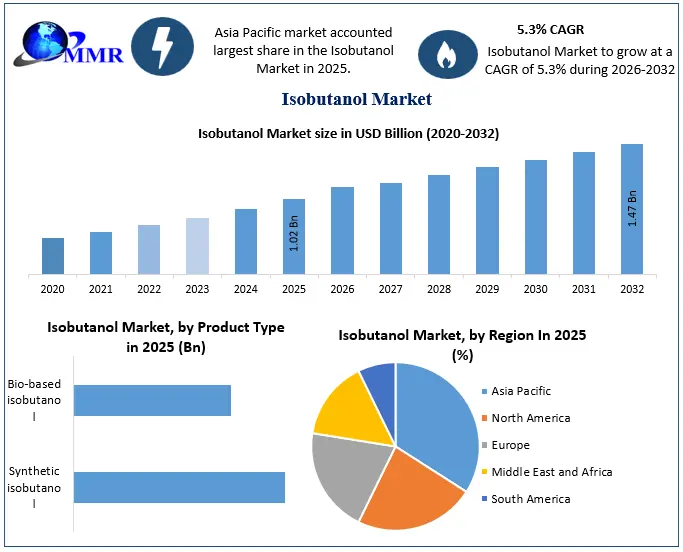
Isobutanol Market valued at USD 1.02 billion in 2025.
-
Market projected to reach USD 1.47 billion by 2032 at a 5.3% CAGR.
-
Paints and coatings remain among the largest application segments worldwide.
-
Bio-based isobutanol is gaining momentum as sustainability initiatives accelerate.
-
Automotive, construction, chemicals, and fuel industries continue driving demand.
-
Asia-Pacific leads market growth through expanding manufacturing and industrialization.
Why This Matters Now
Growing demand for sustainable chemicals, stricter environmental regulations, and expanding industrial production are reshaping the specialty chemicals landscape. Manufacturers increasingly seek versatile solvents and chemical intermediates that improve product performance while supporting sustainability goals.
The Isobutanol Market, valued at USD 1.02 billion in 2025, is projected to reach USD 1.47 billion by 2032, expanding at a 5.3% CAGR. Stable long-term growth reflects rising demand across coatings, adhesives, fuel additives, and specialty chemical manufacturing while encouraging continued investment in bio-based production technologies.
Market Overview
Isobutanol size is an important specialty alcohol widely used as an industrial solvent, chemical intermediate, fuel additive, and raw material for manufacturing coatings, plastics, lubricants, and synthetic chemicals. Its excellent solvency, low volatility, and favorable chemical properties make it valuable across multiple industrial applications.
Demand continues to expand as manufacturers seek high-performance chemicals capable of enhancing product quality while meeting increasingly stringent environmental regulations. The transition toward renewable and bio-based feedstocks is further strengthening market opportunities.
The industry’s diversified customer base—including automotive, construction, paints and coatings, chemicals, pharmaceuticals, and energy—provides resilience against cyclical fluctuations in individual end-use industries.
Key Trends Driving Growth
The paints and coatings industry remains one of the strongest demand drivers for isobutanol. Growing construction activity, infrastructure investment, and automotive production continue increasing consumption of high-performance coating formulations that rely on isobutanol as a solvent and intermediate.
Bio-based isobutanol is emerging as a major industry trend. Manufacturers are investing in renewable production technologies to reduce carbon emissions and address growing customer demand for sustainable chemical solutions.
Fuel applications continue supporting market expansion. Isobutanol is increasingly evaluated as a biofuel component and gasoline blending additive because of its favorable energy content and compatibility with existing fuel infrastructure.
Chemical manufacturing remains another major growth engine. Isobutanol serves as a key intermediate in producing plasticizers, esters, lubricants, and specialty chemicals used across numerous industrial sectors.
Technology innovation is improving production efficiency and expanding commercial applications. Companies continue investing in advanced fermentation technologies, process optimization, and sustainable manufacturing methods to strengthen competitiveness and reduce production costs.
Environmental regulations and corporate sustainability initiatives are encouraging greater adoption of renewable chemicals, positioning bio-based isobutanol as an increasingly attractive alternative to conventional petrochemical products.
Request a Free Sample Copy or View Report Summary: https://www.maximizemarketresearch.com/request-sample/56743/
Segment Insights
-
Dominant Segment: Paints and coatings continue to represent one of the largest application segments, driven by expanding construction, automotive manufacturing, and industrial infrastructure development worldwide.
-
Fastest-Growing Segment: Biofuels and renewable chemicals are expected to witness the fastest growth as governments and industries prioritize low-carbon alternatives and sustainable fuel technologies.
-
Industrial-grade and bio-based isobutanol products enable manufacturers to serve a wide range of applications across chemicals, pharmaceuticals, coatings, lubricants, and fuel additives.
-
Demand continues expanding across automotive, construction, packaging, chemical processing, and industrial manufacturing, creating diversified revenue opportunities for market participants.
Regional Growth Story
Asia-Pacific remains the largest and fastest-growing regional market due to rapid industrialization, expanding chemical manufacturing, and rising investments in automotive and construction industries. China continues leading regional demand through its extensive industrial base and growing specialty chemicals sector.
India is emerging as a significant growth market as chemical manufacturing capacity expands alongside increasing infrastructure development and industrial production.
North America benefits from ongoing innovation in renewable chemicals, biofuel technologies, and advanced manufacturing. The region also supports growing investment in sustainable chemical production.
Europe maintains steady demand through strong environmental regulations, advanced automotive manufacturing, and increasing adoption of bio-based industrial chemicals. Germany remains a major contributor due to its well-established chemical industry and commitment to sustainable manufacturing.
Regional competitiveness increasingly depends on production efficiency, technological innovation, sustainable feedstocks, and integrated supply chains.
Competitive Landscape
Competition is increasingly centered on sustainable production technologies, product innovation, and manufacturing efficiency.
Leading manufacturers continue investing in production expansion, renewable feedstocks, and advanced chemical processing technologies to improve product quality while lowering production costs.
Strategic investments in bio-based manufacturing capacity are strengthening long-term market positioning as customers seek environmentally responsible chemical suppliers.
Research and development remains a critical competitive differentiator. Companies developing high-purity isobutanol grades and innovative production technologies are improving profitability while expanding into higher-value specialty applications.
Manufacturers capable of delivering reliable supply, regulatory compliance, technical expertise, and sustainable product portfolios are expected to strengthen long-term customer relationships.
Recent Developments
-
Continued investment in bio-based isobutanol production technologies.
-
Growing demand from paints, coatings, and specialty chemical manufacturing.
-
Expansion of renewable fuel research supporting isobutanol adoption.
-
Increasing focus on sustainable chemical production and lower-carbon manufacturing processes.
Strategic Implications
Procurement leaders are increasingly prioritizing suppliers capable of delivering consistent product quality, sustainable sourcing, and reliable supply chains. Purchasing decisions increasingly consider environmental performance alongside pricing and technical specifications.
Chemical manufacturers should continue investing in renewable feedstocks, production efficiency, and specialty-grade products to strengthen competitive positioning and improve long-term profitability.
Investors should view isobutanol as a strategic specialty chemical benefiting from multiple structural growth drivers, including industrial expansion, sustainable chemistry, renewable fuels, and advanced materials manufacturing.
Companies expanding bio-based production capacity while strengthening technical capabilities are likely to improve market positioning as global demand for sustainable industrial chemicals accelerates.
Future Outlook
The Isobutanol Market is positioned for steady long-term growth, supported by expanding industrial manufacturing, increasing demand for specialty chemicals, and the transition toward sustainable production technologies. Paints and coatings will remain a primary demand driver, while bio-based chemicals, fuel additives, and advanced chemical intermediates create new opportunities. Companies combining production efficiency, technological innovation, and sustainable manufacturing capabilities will be well positioned to capture future market growth.
Related Reports
Global Tetraacetylethylenediamine (TAED) Market https://www.maximizemarketresearch.com/market-report/tetraacetylethylenediamine-taed-market/105249/
Global Pearlescent Pigment Market https://www.maximizemarketresearch.com/market-report/global-pearlescent-pigment-market/80641/
Global Pine Derived Chemicals Market https://www.maximizemarketresearch.com/market-report/global-pine-derived-chemicals-market/21722/
Analyst Perspective
“Isobutanol is evolving beyond its traditional role as an industrial solvent to become an important building block for sustainable chemical manufacturing. Companies investing in bio-based production technologies, product innovation, and diversified industrial applications will be best positioned to capitalize on long-term market growth.” — Ankita Kagawade
About Maximize Market Research
Maximize Market Research Pvt. Ltd. (MMR) is a global market research and consulting company that provides reliable, data-focused, and practical business insights. The firm serves a wide range of industries, including healthcare, pharmaceuticals, technology, automotive, electronics, chemicals, personal care, and consumer goods. Through market forecasts, competitive analysis, strategic consulting, and industry impact assessments, MMR helps organizations understand changing market conditions, identify growth opportunities, and make informed business decisions for long-term success.
2nd Floor, Navale IT Park Phase 3
Pune Banglore Highway, Narhe
Pune, Maharashtra 411041, India
+91 9607365656
[email protected]


