
Healthcare providers are competing for international patients with greater urgency as treatment affordability, specialized expertise, and digital care coordination redefine global healthcare delivery. Investors, hospital networks, insurers, and governments are responding because international patient flows increasingly influence healthcare revenues, infrastructure investment, and national competitiveness.
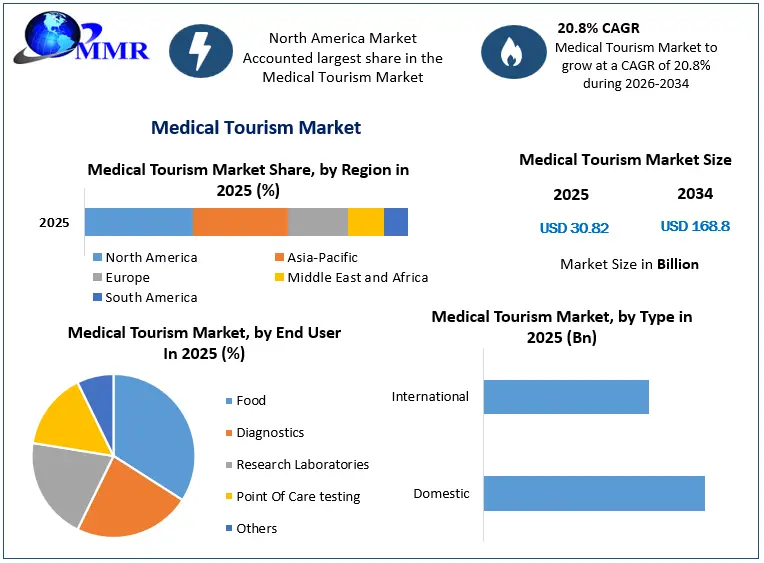
The Medical Tourism Market was valued at USD 30.82 Billion in 2025 and is projected to reach USD 168.8 Billion by 2034, expanding at a 20.8% CAGR during the forecast period. The pace of growth signals that medical tourism is shifting from a niche healthcare service into an important component of global healthcare strategy.
Key Highlights
- Medical Tourism Market valued at USD 30.82 Billion in 2025
- Expected to reach USD 168.8 Billion by 2034
- Forecast CAGR: 20.8% (2026–2034)
- Affordable specialty treatments continue attracting international patients.
- Government support and healthcare infrastructure investments strengthen destination competitiveness.
- Telemedicine improves pre-treatment consultations and post-operative follow-up.
- Advanced medical technology expands treatment availability across leading destinations.
- Digital health platforms improve patient engagement and international care coordination.
Why This Matters Now
Healthcare inflation, long waiting lists, and unequal access to specialized treatments are changing how patients seek care. More individuals are comparing treatment quality, cost, and availability across borders rather than limiting choices to domestic healthcare systems.
For providers, this creates opportunities to diversify revenue through international patient programs. For insurers and payers, medical tourism introduces new models for controlling treatment costs while maintaining clinical quality. Governments benefit through healthcare exports, hospital investments, and broader economic activity generated by international visitors.
Market Overview
Medical tourism involves patients traveling internationally to receive medical treatments that are unavailable, delayed, or significantly more expensive in their home countries. The market covers treatments ranging from cardiovascular procedures and neurological care to dental reconstruction, fertility services, cosmetic surgery, and orthopedic interventions.
The market’s expansion is supported by lower treatment costs, improved hospital infrastructure, internationally recognized clinical expertise, and broader access to advanced medical technologies. Favorable government policies in several countries are encouraging both public and private investment in healthcare facilities designed to serve international patients.
Growing acceptance of cross-border healthcare also changes hospital business models. Providers increasingly compete through international accreditation, multilingual patient services, integrated travel support, and digital engagement rather than pricing alone.
Key Trends Driving Growth
Healthcare affordability remains the strongest demand driver. Patients continue seeking complex procedures in destinations offering substantial cost advantages without compromising treatment quality. This economic value proposition is expanding patient volumes across multiple specialties.
Digital health is strengthening patient confidence throughout the treatment journey. Telemedicine enables virtual consultations before travel while supporting follow-up care after patients return home. This reduces continuity-of-care concerns that historically limited international treatment adoption.
Healthcare infrastructure investment is becoming increasingly strategic. Governments recognize medical tourism as a contributor to economic growth and continue supporting hospital modernization, regulatory improvements, and international healthcare partnerships to attract overseas patients.
Artificial intelligence and digital diagnostics are gradually improving operational efficiency within internationally focused hospitals. Although adoption varies across regions, AI-supported imaging, patient scheduling, and clinical decision support are helping providers deliver more efficient patient experiences.
Specialty medicine also continues expanding. High-demand procedures including cardiovascular treatment, fertility care, cosmetic surgery, neurological services, and dental reconstruction increasingly attract international patients seeking specialized expertise unavailable or unaffordable domestically.
𝐃𝐨𝐰𝐧𝐥𝐨𝐚𝐝 𝐏𝐃𝐅 𝐁𝐫𝐨𝐜𝐡𝐮𝐫𝐞 @https://www.maximizemarketresearch.com/request-sample/34172/
Segment Insights
- Dominant Segment: Not specified in the supplied MMR report.
- Fastest-Growing Segment: Not specified in the supplied MMR report.
- Patients increasingly travel for cardiovascular, neurological, dental, fertility, cosmetic, and reconstructive procedures.
- Teleconsultation enhances patient management before and after treatment.
- Advanced medical technologies improve the attractiveness of leading medical tourism destinations.
Regional Growth Story
The United States continues generating outbound demand as treatment costs remain comparatively high for many specialized procedures. International providers position themselves as cost-effective alternatives while emphasizing internationally recognized clinical standards.
Germany and the United Kingdom continue emphasizing high-quality specialized healthcare, although waiting times for selected procedures encourage some patients to consider overseas treatment options.
China, Japan, India, and South Korea continue strengthening healthcare capabilities through hospital modernization, advanced medical technologies, and specialty treatment expansion. India particularly benefits from competitive treatment pricing, English-speaking healthcare professionals, and growing investments in internationally oriented hospital infrastructure. South Korea maintains strong positioning in cosmetic procedures and advanced medical services, while Japan and China continue investing in technology-intensive healthcare delivery.
Across these regions, healthcare spending, digital health adoption, and supportive government initiatives continue improving international patient access and provider competitiveness.
Competitive Landscape
Competition increasingly depends on comprehensive patient experience rather than treatment cost alone. Hospital groups are investing in international patient departments, multilingual clinical support, digital communication platforms, and integrated travel coordination.
Healthcare providers adopting advanced technologies strengthen both clinical outcomes and operational efficiency. Investments in minimally invasive procedures, modern diagnostics, robotic-assisted surgery, and digital patient engagement enhance competitive differentiation while improving long-term patient satisfaction.
Government participation also shapes competition. Favorable healthcare policies, infrastructure funding, and international promotion campaigns strengthen destination attractiveness while encouraging private investment in internationally accredited healthcare facilities.
Recent Developments
- Governments continue supporting healthcare infrastructure investments to expand international patient capacity.
- Telemedicine adoption is improving continuity of care for cross-border patients.
- Healthcare providers continue expanding access to advanced medical technologies.
- Public-private collaboration supports broader development of medical tourism ecosystems.
- Digital patient engagement platforms continue improving international treatment coordination.
Strategic Implications
Medical tourism is becoming increasingly integrated into broader healthcare strategy rather than remaining a standalone travel service. Hospital operators that invest in digital patient pathways, internationally recognized quality standards, and specialty treatment capabilities will be positioned to capture higher-value international patient volumes.
Biotechnology companies, pharmaceutical manufacturers, and medical device suppliers also benefit as internationally focused hospitals increasingly adopt advanced therapies and innovative treatment technologies. Payers may expand reimbursement models incorporating approved international care pathways where quality and cost objectives align.
Providers unable to demonstrate measurable clinical outcomes, efficient patient coordination, and digital engagement may struggle as international patients become more selective and transparent quality comparisons become easier.
Future Outlook
The Medical Tourism Market is expected to maintain strong momentum as healthcare affordability, specialty medicine, telehealth, and hospital modernization continue expanding cross-border patient mobility. Organizations combining clinical excellence with digital patient experiences and internationally competitive healthcare infrastructure will define the market’s next growth phase, while slower adopters risk losing both patients and long-term competitive relevance.
Analyst Perspective
“Medical tourism is entering a new phase where healthcare quality, digital patient engagement, and integrated care pathways are becoming equally important as treatment affordability. Providers investing in technology, infrastructure, and international patient experience will be best positioned to capture sustained global demand.” — Komal Patil, Analyst
About Maximize Market Research
Maximize Market Research Pvt. Ltd. (MMR) is a global market research and consulting company that provides reliable, data-focused, and practical business insights. The firm serves a wide range of industries, including healthcare, pharmaceuticals, technology, automotive, electronics, chemicals, personal care, and consumer goods. Through market forecasts, competitive analysis, strategic consulting, and industry impact assessments, MMR helps organizations understand changing market conditions, identify growth opportunities, and make informed business decisions for long-term success.
2nd Floor, Navale IT Park Phase 3
Pune Banglore Highway, Narhe
Pune, Maharashtra 411041, India
+91 9607365656
[email protected]


