
Key Highlights
-
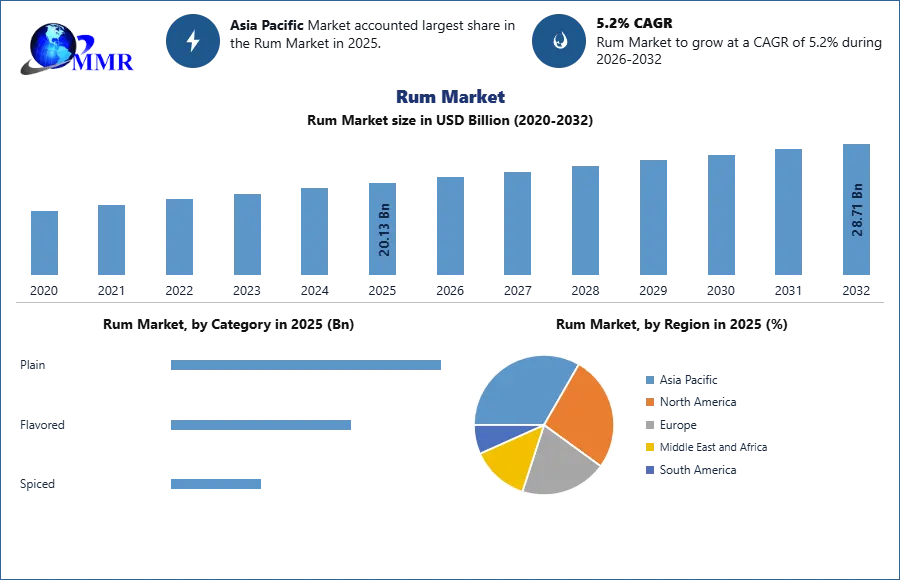
The global Rum Market achieved a valuation of USD 20.13 billion in 2025 and is projected to scale to USD 28.71 billion by 2032, expanding at a compound annual growth rate (CAGR) of 5.2%.
-
Dark rum commands structural dominance within the product type segment, favored for its complex, smoky profiles developed through aging periods exceeding three years.
-
The Asia Pacific region leads global consumption, controlling over 40% of the total market share in 2025, with India acting as the world’s largest export hub for rum and tafia.
-
Off-trade distribution channels, including retail liquor shops and supermarkets, remain the dominant revenue generator, while digital on-trade home delivery formats are expanding fastest.
-
Post-pandemic physical and mental health awareness represents a core market constraint, as consumers alter purchasing habits to minimize alcohol-related health risks.
Why This Matters Now Beverage alcohol portfolios face a critical revenue ceiling if they fail to immediately pivot from entry-level white spirits toward premium aged dark configurations. Gen Z consumers are actively rejecting traditional drinking cultures in favor of complex, flavor-forward cocktail experiences, leaving standard, unaged inventories at risk of retail stagnation. Beverage executives who delay restructuring their aging cellars will see their shelf space captured by agile competitors offering highly differentiated, spiced, and infused portfolios.
This landscape shift requires immediate capital reallocation toward long-term barrel-aging programs and supply chain partnerships in key sugarcane regions. Because premium dark rum requires a minimum of three years in wood to achieve its desired flavor profile, production decisions made today dictate market share at the start of the next decade. Procurement teams must lock in raw material contracts now or face inventory shortages as global demand for aged spirits outstrips production capacities.
Market Overview The global Rum Market Size established a baseline valuation of USD 20.13 billion in 2025. Fueled by rising per capita incomes and a global surge in premium cocktail consumption, total revenues are projected to reach USD 28.71 billion by 2032. This growth represents a steady 5.2% CAGR from 2026 to 2032, reflecting strong capital investment across both multinational spirit conglomerates and artisanal distilleries.
Market Valuation Horizon (USD Billion)
2025: ████████████████████ 20.13
2032: ████████████████████████████ 28.71 (Projected at 5.2% CAGR)
This steady expansion shows how quickly rum is shedding its historical reputation as a low-cost mixing spirit. Distillers are upgrading their operational infrastructure to support premiumization, positioning aged varieties to compete directly with high-end whiskeys and cognacs. The market is capitalizing on this shift, using distinct distillation techniques from sugarcane molasses and fresh juice to attract affluent consumers.
Key Trends Driving Growth The rapid expansion of the global cocktail industry acts as the primary engine for market growth. Rising disposable incomes across emerging and developed nations are shifting consumer preferences toward specialized drink menus in pubs, bars, and fine-dining restaurants. Rum functions as a foundational spirit in this space, owing to its natural ability to blend smoothly into both traditional and exotic cocktail formulations.
This cocktail trend is heavily driven by Gen Z consumers who are entering the legal drinking age with a preference for experiential flavor profiles. This demographic is quick to reject plain spirits, leaning instead toward innovative options like coffee, butterscotch, pineapple, cocoa, and herbal infusions. This behavior is driving immediate spiced rum sales across commercial on-premises venues, forcing brands to launch unique line extensions.
Conversely, a sharp increase in post-pandemic health awareness serves as a primary market restraint. Modern consumers are increasingly aware of the long-term physical risks of excess alcohol consumption, including high blood pressure, weakened immune systems, and liver disease. This shift toward personal wellness is forcing distilleries to adjust their marketing strategies, focusing heavily on premium, lower-volume “sipping” rums rather than mass-market high-volume products.
𝐃𝐨𝐰𝐧𝐥𝐨𝐚𝐝 𝐏𝐃𝐅 𝐁𝐫𝐨𝐜𝐡𝐮𝐫𝐞 @ https://www.maximizemarketresearch.com/request-sample/190152/
Segment Insights
-
Dark Rum [Dominant Segment by Type]: This product segment dominated the market in 2025, driven by a growing consumer preference for bold, smooth, and smoky flavor profiles developed through extensive oak barrel aging of three years or more.
-
Flavored Rum: This category retains a dominant role in commercial cocktail innovation, with leading global brands like Bacardi, Malibu, Kraken, Captain Morgan, and Sailor Jerry capturing substantial market share through sweet, fruity, and spiced variations.
-
Off-Trade Distribution [Dominant Segment by Channel]: Supermarkets, specialty liquor stores, and local retail shops generated the majority of market revenue in 2025, providing consumers with easy, direct access to both domestic and imported spirit brands.
-
On-Trade Delivery [Fastest-Growing Channel Segment]: Driven by the rapid expansion of e-commerce platforms and immediate home-delivery applications, this segment is projected to achieve the fastest growth rate over the forecast horizon.
Regional Growth Story The Asia Pacific region dominates the global Rum Market, commanding over 40% of total market revenue in 2025. This leading position is driven by a massive legal drinking population and a fast-expanding urban middle class across India and China. India stands as the world’s largest individual market for rum, exporting 54,374 thousand liters of rum and tafia in 2025 alone, backed by a powerful agricultural sector that produces roughly 22% of the world’s sugarcane supply.
Regional Rum Market Dynamics & Structural Foundations
Asia Pacific:  40%+ Global Market Share / World's Largest Sugarcane Production Hub (India 22%)
North America: Fastest-Growing Regional Market / High On-Premises Pub & Bar Proliferation
Caribbean:     Historical Core / Authentic Regional Distillation Driving Exporter Revenues
North America is on track to be the fastest-growing regional market over the forecast period. Prolific bar, lounge, and pub cultures across the United States and Canada are creating consistent demand for premium, high-value spirit imports. This commercial demand is reinforced by strong e-commerce retail networks that allow North American consumers to source rare, aged international bottles easily.
Simultaneously, the Caribbean market maintains its historic role as the worldwide benchmark for production authenticity. Exporters across Jamaica, Barbados, Cuba, and the Dominican Republic are leveraging their unique production heritage to command premium prices in international markets. This global demand ensures that the sugar and distillation industries remain core economic drivers and primary income sources for the Caribbean region.
Competitive Landscape The global market features intense competition among major spirits conglomerates, with prominent brands like Bacardi, Diageo (Captain Morgan), Pernod Ricard (Malibu), and Proximo Spirits (The Kraken) executing aggressive growth strategies. To protect their shelf space from a rising tide of independent craft distilleries, these market leaders are actively pursuing technical partnerships and targeted mergers and acquisitions (M&A). This consolidation allows corporate players to instantly acquire unique flavor portfolios and secure established regional distribution networks.
For independent distilleries and smaller rivals, this corporate activity signals that surviving on local heritage alone is no longer viable over a 12-to-24-month horizon. Multinational brands are using their massive marketing budgets to scale flavored and spiced products globally, pushing retail entry barriers higher. To remain competitive, smaller players must either pivot to ultra-premium, single-barrel allocations that insulate them from mass-market price wars, or form strategic distribution alliances with larger logistics networks.
Recent Developments
-
Spirit producers are introducing distinctive flavor expressions, such as Kraken Black Roast Coffee and Captain Morgan Cherry Vanilla, to capture the attention of younger consumers.
-
Industrial distilleries are forming long-term supply agreements with major sugarcane processors in India to secure high-quality molasses amidst changing global weather patterns.
-
E-commerce platforms are upgrading their age-verification systems to support legal, direct-to-home shipping of premium spirits, accelerating on-trade delivery growth.
-
Traditional Caribbean distilleries are expanding their production lines for high-end aged dark rums to capitalize on the global premiumization trend.
Strategic Implications The global shift toward premium aged varieties is completely changing how distilleries manage their cash flow and inventory. Maintaining aged dark rum stocks for three to ten years requires significant upfront capital tied up in barrel warehouses, alongside ongoing costs for monitoring and evaporation loss. This long investment cycle makes it difficult for cash-strapped local producers to compete with multinational brands that have the financial runway to wait out extended maturation periods.
Distillery Capital Expenditure & Inventory Allocation
├─ Raw Material Sourcing: Securing sugarcane molasses from top global producers
├─ Maturation Infrastructure: Long-term oak barrel storage (Minimum 3-year horizon)
└─ Distribution Upgrades: Integrating with digital e-commerce home-delivery channels
Furthermore, changing consumer habits are shaking up traditional distribution routes. While local retail shops and supermarkets continue to handle the majority of volume sales, the rapid rise of digital checkout options means brands must rethink their logistics networks. Spirits companies that partner early with high-growth delivery applications will gain an immediate advantage in urban markets, leaving slow-moving brands isolated from tech-savvy younger shoppers.
Future Outlook The global industry will increasingly favor spirits companies that can successfully bridge the gap between historic distillation authenticity and modern, flavor-forward cocktail culture. Growth will be concentrated in premium aged dark portfolios and innovative spiced line extensions that appeal directly to younger legal drinkers. Distilleries that secure stable sugarcane supply lines while investing heavily in digital direct-to-consumer delivery networks will capture dominant retail market share, whereas brands stuck producing generic, low-margin white mixing spirits will likely face terminal margin erosion.
Analyst Perspective “The global rum sector is undergoing a profound structural re-evaluation, driven by the twin forces of premiumization and cocktail innovation,” states Siddhi Dole, Research Analyst at Maximize Market Research. “The brands achieving the highest growth are those successfully moving away from mass-volume value plays and investing in aged dark inventories and unique flavor profiles that resonate with experiential Gen Z consumers.”
About Maximize Market Research
Maximize Market Research Pvt. Ltd. (MMR) is a global market research and consulting company that provides reliable, data-focused, and practical business insights. The firm serves a wide range of industries, including healthcare, pharmaceuticals, technology, automotive, electronics, chemicals, personal care, and consumer goods. Through market forecasts, competitive analysis, strategic consulting, and industry impact assessments, MMR helps organizations understand changing market conditions, identify growth opportunities, and make informed business decisions for long-term success.
2nd Floor, Navale IT Park Phase 3
Pune Banglore Highway, Narhe
Pune, Maharashtra 411041, India
+91 9607365656
[email protected]


