Why This Matters Now
Food safety failures are becoming a business risk for meat producers, retailers and regulators as global supply chains become more complex. Companies across the food ecosystem are increasing investments in testing systems that detect contamination before products reach consumers.
The Meat Testing Market is gaining strategic importance because safety compliance now affects brand reputation, trade access and operational continuity. Meat processors, exporters, laboratories and regulatory agencies are prioritizing faster testing technologies that support preventive quality control rather than reactive recalls.
Market Overview
Meat testing refers to analytical processes used to examine meat products for pathogens, allergens, chemicals, contaminants and authenticity concerns. These testing systems help determine whether meat is safe for human consumption and whether products meet regulatory and quality requirements across the supply chain.
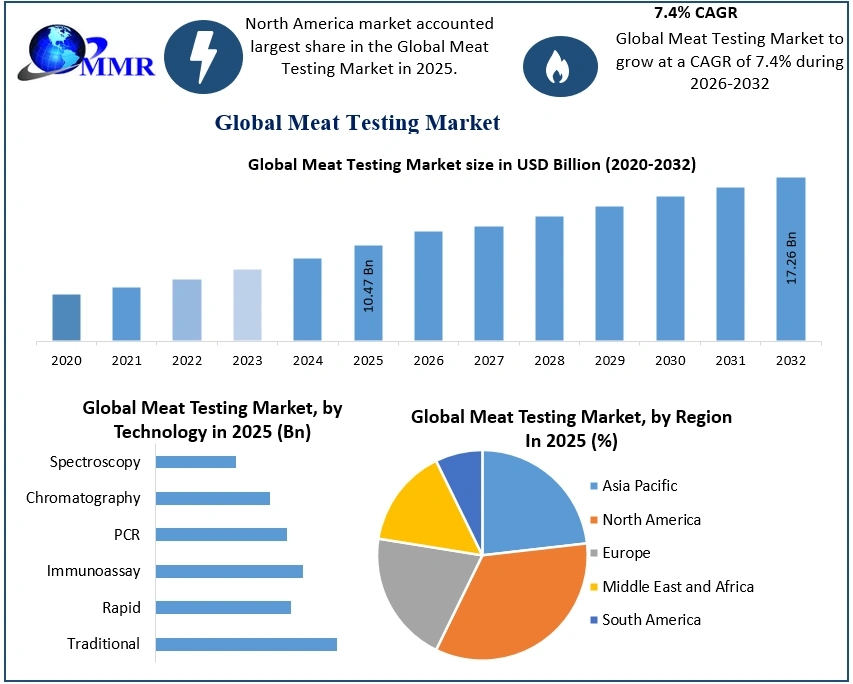
The market reached USD 10.47 billion in 2025 and is forecast to expand to USD 17.26 billion by 2032. The growth trajectory is linked to increasing demand for meat and seafood testing services, rising research and development activity, rapid testing innovations and stronger food safety regulations.
The business shift is clear: food manufacturers are moving from basic quality checks toward advanced analytical systems that support traceability, compliance and consumer confidence.
Key Trends Driving Growth
Foodborne contamination remains a major concern for governments and businesses. Meat products can face risks from pathogens, improper storage, cross-contamination and supply chain handling issues. Testing companies are responding with technologies that provide faster identification of safety risks.
Rapid diagnostics are changing the economics of meat quality management. Faster detection reduces the time between sample collection and decision-making, helping processors limit losses and improve production efficiency.
PCR-based testing is gaining attention because it enables automated detection and supports species identification applications. Its adoption signals a broader move toward laboratory automation and precision-based food safety testing.
Consumer behavior is also influencing demand. Growing awareness around nutrition, product authenticity and safe food consumption is increasing pressure on manufacturers to demonstrate transparent quality practices.
Regulatory compliance is becoming a competitive factor. Companies operating across international markets require testing capabilities that support different food safety standards, import requirements and certification processes.
Request a Free Sample Copy or View Report Summary
Segment Insights
- Dominant Segment — Target Tested: Pathogen Testing
Pathogen testing represents the leading segment because contamination risks from improper storage, handling and supply chain movement continue to drive demand for microbial detection. Food recalls and safety concerns increase the need for reliable pathogen identification systems. - Fastest-Growing Segment — Asia Pacific Regional Demand
Asia Pacific is expected to record strong growth as demand for meat-based ingredients rises among expanding consumer groups. Increasing food imports, exports and awareness of safety requirements create opportunities for testing providers. - Sample Type Segment — Meat Category Leadership
Meat remains the dominant sample type due to high consumption of poultry products and increasing consumer focus on poultry safety. The growth of ready-to-eat meat products further increases testing requirements. - Technology Segment — PCR Technology
PCR technology leads among testing methods because it delivers rapid results and supports detection of unknown species. Its efficiency strengthens adoption across food testing laboratories.
Regional Growth Story
North America remains the leading region for the Meat Testing Market. The region benefits from strict food safety regulations, higher consumer awareness and increased attention toward meat product recalls. The United States market also has significant meat production activity, supporting continued demand for testing services.
Europe continues to represent an important market due to established food safety frameworks and demand for quality assurance across the food supply chain. Germany, the UK and other European markets maintain strong testing infrastructure.
Asia Pacific represents the next major growth opportunity. China, India, Japan and South Korea are seeing increased demand for meat products, food imports and advanced safety monitoring systems. Rising disposable income and changing dietary patterns are supporting market expansion.
Competitive Landscape
The Meat Testing Market includes global inspection, certification and laboratory service providers competing through technology capabilities, geographic reach and regulatory expertise.
Companies such as SGS, Eurofins Scientific, Bureau Veritas, Intertek, TÜV SÜD and ALS Limited compete by expanding analytical services and improving testing coverage.
Competitive positioning is increasingly linked to speed, accuracy and the ability to support global food supply chains. Providers that combine advanced testing technologies with regulatory knowledge are positioned to capture demand from multinational food producers.
Recent Developments
- Increased investment in rapid testing technologies is supporting faster contamination detection and improving operational decisions for meat producers.
- Expansion of testing service portfolios is helping companies address growing demand for meat and seafood quality analysis.
- Adoption of multi-containment detection systems is creating opportunities for laboratories to provide broader food safety solutions.
Strategic Implications
For food manufacturers, investment in testing infrastructure is becoming a risk-management decision. Stronger testing capabilities help reduce recall exposure, protect consumer trust and support international market access.
For laboratory service providers, the opportunity lies in combining molecular diagnostics, automation and regulatory expertise. The competitive advantage will come from delivering faster results without compromising accuracy.
For investors, the market presents opportunities linked to food safety modernization, laboratory expansion and technology adoption. Growth will favor companies that can support both developed markets with strict regulations and emerging markets building food quality systems.
Future Outlook
The Meat Testing Market will continue expanding as food producers face higher expectations for transparency, safety and compliance. Demand will increasingly move toward rapid, technology-enabled testing platforms that improve supply chain control.
Future leaders will be the companies that combine advanced diagnostics, global regulatory capability and scalable testing networks, while laggards will struggle to meet rising expectations for speed, accuracy and food safety assurance.
Analyst Perspective
“Growing pressure for safer food systems is changing how meat producers approach quality management. Advanced testing technologies, rapid diagnostics and stronger regulatory compliance are creating new opportunities across the global meat supply chain,” said Komal Patil, Research Analyst.
About Maximize Market Research
Maximize Market Research Pvt. Ltd. (MMR) is a global market research and consulting company that provides reliable, data-focused, and practical business insights. The firm serves a wide range of industries, including healthcare, pharmaceuticals, technology, automotive, electronics, chemicals, personal care, and consumer goods. Through market forecasts, competitive analysis, strategic consulting, and industry impact assessments, MMR helps organizations understand changing market conditions, identify growth opportunities, and make informed business decisions for long-term success.
2nd Floor, Navale IT Park Phase 3
Pune Banglore Highway, Narhe
Pune, Maharashtra 411041, India
+91 9607365656
[email protected]