Market Overview
The Industrial Control and Factory Automation Market sits at the center of the broader industrial transformation sweeping global transportation and automotive manufacturing.
Modern production environments increasingly rely on integrated control architectures that connect machines, robotics, sensors, software platforms, and enterprise systems into a unified operating environment. This shift is driven by manufacturers seeking faster production cycles, improved product quality, labor optimization, and supply-chain visibility.
The emergence of Industry 4.0 strategies has accelerated adoption across automotive assembly plants, battery manufacturing facilities, semiconductor fabrication centers, logistics hubs, and transportation infrastructure projects. Industrial enterprises are deploying AI-enabled automation platforms, predictive maintenance systems, digital twins, and Industrial IoT solutions to improve operational performance and reduce unplanned downtime.
For automotive manufacturers transitioning from internal combustion engines to electrified platforms, these capabilities are becoming increasingly important as production complexity rises.
Key Trends Driving Growth
The most significant change in the market is the movement toward intelligent and autonomous manufacturing.
Industrial robotics adoption is expanding as manufacturers pursue flexible production lines capable of handling multiple vehicle platforms and varying production volumes. The industrial robots segment is expected to experience some of the strongest growth within automation systems, reflecting increasing demand for precision manufacturing and reduced labor dependency.
Another major trend is the growing role of software. Manufacturing execution systems, cloud-connected industrial platforms, AI-driven analytics, and predictive maintenance applications are becoming central to factory operations. Software-driven automation allows manufacturers to optimize throughput, monitor asset performance, and support continuous improvement initiatives.
Edge computing is also gaining traction. By processing data closer to machines and production equipment, manufacturers can reduce latency and enable faster operational decisions. This capability is particularly valuable in automotive production environments where real-time quality control and process optimization directly affect profitability.
The expansion of smart factories is further accelerating demand for integrated control systems, robotics, machine vision technologies, and connected industrial infrastructure.
Request a Free Sample Copy or View Report Summary
Segment Insights
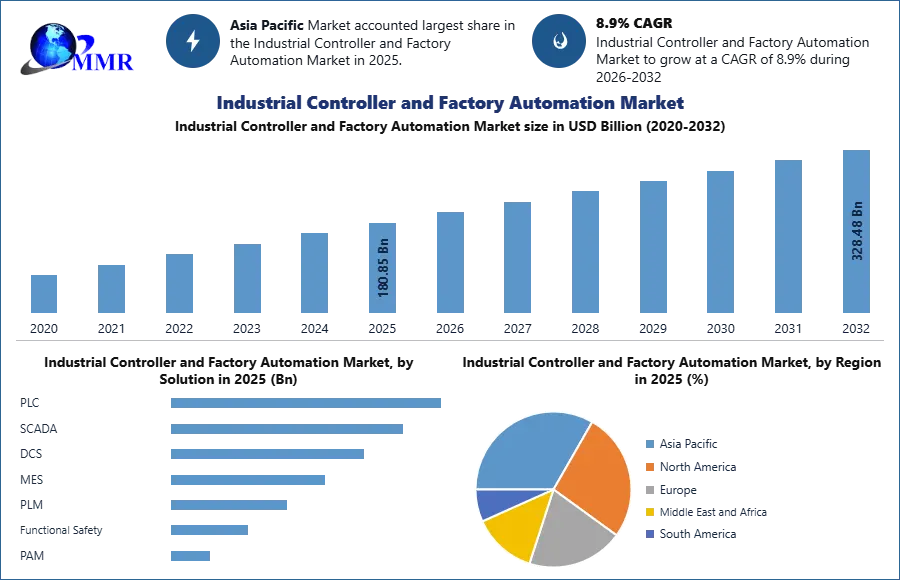
- Dominant Segment: Distributed Control Systems (DCS) represent a leading technology category due to their ability to manage complex industrial operations, provide centralized control, and support continuous production environments.
- Fastest-Growing Segment: SCADA solutions are demonstrating strong growth momentum as industries adopt remote monitoring, cloud connectivity, real-time visibility, and intelligent infrastructure management.
- Industrial robotics remains among the fastest-growing automation components as manufacturers invest in smart factories and autonomous production systems.
- Manufacturing continues to represent a leading end-use segment due to widespread adoption of smart production technologies and industrial digitalization initiatives.
- Software-driven automation solutions are expanding rapidly as manufacturers prioritize AI analytics, predictive maintenance, and digital transformation strategies.
Regional Growth Story
Asia-Pacific remains a critical center for automation investment due to its extensive manufacturing base and ongoing industrial modernization efforts. Automotive production growth, electronics manufacturing expansion, and government-backed smart manufacturing initiatives continue to drive automation spending throughout the region.
China, Japan, South Korea, and India are investing heavily in advanced manufacturing technologies to strengthen competitiveness and support next-generation industrial ecosystems. These markets are increasingly focused on robotics deployment, intelligent production systems, and digitally connected factories.
In the United States, automation investment is increasingly linked to reshoring strategies, semiconductor production, EV manufacturing, warehouse automation, and data-center expansion. Automation providers are benefiting from growing demand for intelligent manufacturing capabilities that improve productivity and supply-chain resilience.
Germany continues to play a significant role through its leadership in industrial engineering, Industry 4.0 initiatives, and advanced manufacturing technologies, reinforcing Europe’s position in industrial automation innovation.
Competitive Landscape
Competition is shifting beyond hardware performance toward platform ecosystems.
Leading automation companies including ABB, Siemens, Schneider Electric, Rockwell Automation, Honeywell, Mitsubishi Electric, and Yokogawa Electric are increasingly combining software, AI, industrial controls, cybersecurity, and cloud connectivity into integrated offerings.
This evolution signals a broader competitive transition. Manufacturing customers increasingly value digital ecosystems capable of delivering operational intelligence rather than standalone automation equipment.
Recent investments also indicate growing emphasis on regionalized manufacturing networks. Automation suppliers are aligning production, R&D, and supply chains closer to major industrial markets to reduce risk and improve responsiveness.
The strategic advantage is shifting toward companies capable of integrating automation hardware, industrial software, analytics, and AI into a unified operational architecture.
Recent Developments
- Schneider Electric expanded its focus on regionalized R&D and localized manufacturing to support growing demand in automation and electrification markets.
- Rockwell Automation reported stronger demand across warehouse automation, semiconductor, energy, and data-center sectors, highlighting renewed industrial investment momentum.
- Manufacturers continue increasing deployment of AI-powered automation platforms, predictive maintenance systems, and Industrial IoT-enabled production environments.
- Industrial robotics adoption continues to accelerate as companies pursue flexible and autonomous manufacturing operations.
Strategic Implications
For automotive OEMs, factory automation is becoming essential for scaling EV production, managing complex vehicle architectures, and maintaining cost competitiveness.
For Tier-1 suppliers, automation investments support quality control, production flexibility, and supply-chain resilience. As vehicle programs become increasingly software-driven, suppliers capable of leveraging digital manufacturing platforms will gain stronger positions within automotive ecosystems.
For investors, the market signals continued convergence between industrial automation, artificial intelligence, software platforms, and advanced manufacturing infrastructure.
For governments and regulators, automation supports domestic manufacturing competitiveness, workforce productivity, energy efficiency, and industrial modernization goals.
Future Outlook
The next phase of industrial competition will not be defined solely by who builds the best vehicle, battery, or mobility platform. It will be defined by who builds the most intelligent factory—because manufacturers that combine automation, AI, software, and real-time industrial control into a unified operating system will set the pace of global transportation innovation, while laggards risk becoming permanently uncompetitive.
Analyst Perspective
“The Industrial Control and Factory Automation Market is evolving from traditional process optimization toward intelligent, connected manufacturing ecosystems. Companies that successfully integrate automation, digitalization, and AI-driven decision-making will be best positioned to capture the next wave of industrial competitiveness.” — Dharati Raut, Analyst
About Maximize Market Research
Maximize Market Research Pvt. Ltd. (MMR) is a global market research and consulting company that provides reliable, data-focused, and practical business insights. The firm serves a wide range of industries, including healthcare, pharmaceuticals, technology, automotive, electronics, chemicals, personal care, and consumer goods. Through market forecasts, competitive analysis, strategic consulting, and industry impact assessments, MMR helps organizations understand changing market conditions, identify growth opportunities, and make informed business decisions for long-term success.
2nd Floor, Navale IT Park Phase 3
Pune Banglore Highway, Narhe
Pune, Maharashtra 411041, India
+91 9607365656
[email protected]