Key Highlights
- Solar hybrid inverters are becoming a strategic technology connecting solar generation, battery storage, and grid infrastructure.
- Rising investments in distributed energy resources are expanding deployment across residential, commercial, and industrial sectors.
- Energy security concerns and grid reliability challenges are accelerating demand for hybrid power solutions.
- Storage integration is becoming a core market driver as utilities and consumers seek greater energy flexibility.
- Grid modernization programs are increasing the value of intelligent power management technologies.
- Renewable energy expansion across major economies is creating long-term demand for hybrid inverter systems.
- Digital monitoring and advanced energy management capabilities are reshaping competitive differentiation.
Why This Matters Now
The energy sector is entering a new phase where generation capacity alone is no longer enough. Utilities, businesses, and households increasingly need technologies capable of balancing intermittent renewable energy, battery storage assets, and grid connectivity simultaneously.
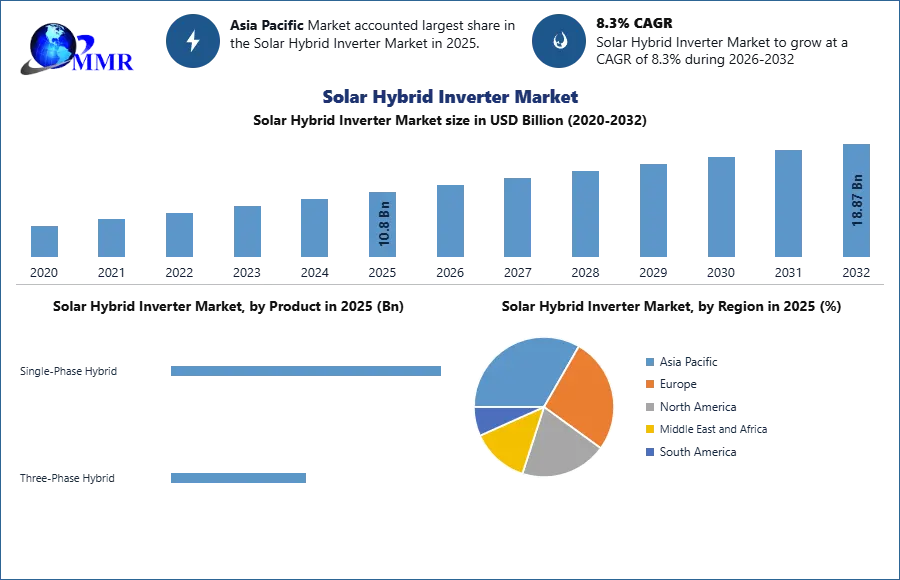
Solar hybrid inverters sit at the center of this transition. According to Maximize Market Research, the global Solar Hybrid Inverter Market was valued at USD 10.8 billion in 2025 and is projected to reach nearly USD 18.87 billion by 2032, growing at a CAGR of 8.3%. Every percentage point of growth signals expanding investment in resilient, decentralized energy infrastructure rather than traditional standalone power systems.
Market Overview
The role of hybrid inverters has evolved beyond simple power conversion. They have become intelligent energy management platforms capable of coordinating solar panels, battery storage systems, and grid supply in real time.
What changed is the economics of distributed energy. Falling storage costs, growing renewable deployment, and increasing grid instability have created demand for integrated energy systems rather than isolated technologies. Hybrid inverters allow consumers and businesses to optimize energy consumption while maintaining backup power capabilities.
Why now? Governments are accelerating decarbonization efforts, utilities are modernizing aging infrastructure, and industries are seeking greater protection from energy price volatility. The convergence of these trends is transforming hybrid inverter adoption from a niche application into a mainstream energy strategy.
Get a sample of the report: https://www.maximizemarketresearch.com/request-sample/65883/
Key Trends Driving Growth
Renewable energy deployment remains the primary catalyst. As solar installations expand globally, operators increasingly require systems capable of managing both generation and storage assets efficiently.
Energy storage integration is creating a second growth engine. Hybrid inverters enable seamless interaction between solar arrays and batteries, allowing users to maximize self-consumption and improve resilience during outages. This capability aligns directly with growing investments in battery energy storage systems worldwide.
Grid modernization initiatives are also reshaping demand. Utilities in major markets are investing in smarter networks capable of supporting distributed generation. Hybrid inverters provide the digital intelligence needed to integrate decentralized resources into increasingly complex electricity systems.
Electrification trends add another layer of demand. As electric vehicles, heat pumps, and electrified industrial processes increase electricity consumption, energy users are looking for technologies that improve flexibility while reducing dependence on conventional grid supply.
Digitalization is becoming a competitive differentiator. Advanced monitoring, automation, and intelligent energy management capabilities are transforming hybrid inverters from hardware products into software-enabled energy platforms.
Segment Insights
- Dominant Segment: Three-phase hybrid inverters lead the market because they support higher power loads and greater efficiency requirements in commercial and industrial applications. Their dominance signals growing demand from energy-intensive facilities seeking reliable solar-plus-storage solutions.
- Fastest-Growing Segment: Residential applications are projected to record the fastest growth. Rising electricity costs, increasing rooftop solar adoption, and consumer demand for energy independence are accelerating household investment in hybrid systems. This trend expands the market beyond utility-scale renewable deployment into consumer energy infrastructure.
- Commercial and industrial users continue to adopt hybrid inverters to improve operational resilience and reduce exposure to grid disruptions.
- Storage-enabled solar systems are becoming a preferred architecture across both residential and commercial installations due to their flexibility and reliability benefits.
Regional Growth Story
North America remains a major growth center for hybrid inverter deployment. Strong renewable energy investment, supportive policy frameworks, and expanding smart-grid initiatives are reinforcing market momentum. The region’s leadership reflects growing emphasis on resilience against extreme weather events and grid reliability concerns.
Asia-Pacific represents one of the most strategically important opportunities. China and India continue expanding renewable generation capacity while pursuing energy security objectives. Rapid urbanization, industrial growth, and electrification initiatives create favorable conditions for hybrid solar infrastructure.
Germany and the United Kingdom continue advancing renewable integration and distributed energy strategies. Hybrid inverters help address challenges associated with balancing intermittent generation while supporting national decarbonization goals.
Japan and South Korea are prioritizing energy resilience and grid flexibility. Hybrid technologies provide an avenue to improve power reliability while supporting broader clean-energy transitions.
Emerging markets are becoming increasingly important. Regions with grid instability or limited energy access view solar-plus-storage systems as a pathway to reliable electricity without requiring extensive conventional infrastructure expansion.
Competitive Landscape
Competition is shifting from inverter efficiency toward integrated energy ecosystems. Manufacturers are increasingly differentiating through storage compatibility, digital intelligence, monitoring capabilities, and grid-interactive functionality.
This signals a broader market transformation. Companies are no longer competing solely on hardware performance; they are competing on their ability to become central platforms within distributed energy networks.
The strategic direction is clear. Future leaders will be those capable of integrating solar generation, battery storage, smart energy management, and utility interaction into a seamless operating environment. As utilities invest in grid modernization and customers demand greater energy autonomy, technology integration becomes a critical competitive advantage.
The market structure also suggests increasing convergence between renewable energy technologies, storage providers, and digital energy management solutions. This convergence is likely to influence future partnerships, investment flows, and technology roadmaps across the energy sector.
Recent Developments
- Manufacturers continue introducing advanced hybrid inverter platforms designed for deeper integration with battery storage systems.
- Smart monitoring and digital energy management capabilities are becoming standard competitive features.
- Utility partnerships are expanding deployment of hybrid systems in grid-edge and off-grid environments.
- Increasing focus on real-time optimization and intelligent energy control is strengthening the value proposition of hybrid technologies.
Strategic Implications
For utilities, hybrid inverters provide a mechanism to integrate growing volumes of distributed energy resources without compromising grid stability.
For infrastructure investors, the market represents exposure to multiple structural themes simultaneously: renewable energy growth, storage deployment, grid modernization, and energy digitalization.
For industrial energy users, hybrid systems offer a practical pathway to lower operating costs, improve resilience, and advance carbon reduction objectives.
For policymakers, wider deployment supports energy security priorities while accelerating progress toward renewable energy and decarbonization targets.
Future Outlook
The next phase of energy transition will be defined not by how much renewable capacity is installed, but by how effectively renewable generation, storage assets, and grid infrastructure work together. Hybrid inverter technology is positioned at that intersection.
As distributed energy resources become increasingly important to national energy strategies, hybrid inverters will evolve into essential control systems for decentralized power networks. The companies, utilities, and nations that master solar-storage-grid integration will shape the next generation of energy infrastructure, while those that treat hybrid systems as optional equipment risk falling behind in a more digital, resilient, and decentralized power economy.
Analyst Perspective
“Solar hybrid inverters are becoming a foundational technology in the transition toward decentralized and intelligent energy systems. Their ability to connect solar generation, storage, and grid infrastructure positions them as a critical enabler of energy security, resilience, and long-term decarbonization objectives.” — Neha Nalawade
About Maximize Market Research
Maximize Market Research Pvt. Ltd. (MMR) is a global market research and consulting company that provides reliable, data-focused, and practical business insights. The firm serves a wide range of industries, including healthcare, pharmaceuticals, technology, automotive, electronics, chemicals, personal care, and consumer goods. Through market forecasts, competitive analysis, strategic consulting, and industry impact assessments, MMR helps organizations understand changing market conditions, identify growth opportunities, and make informed business decisions for long-term success.
Contact Maximize Market Research:
2nd Floor, Navale IT Park Phase 3
Pune Banglore Highway, Narhe
Pune, Maharashtra 411041, India
+91 9607365656
[email protected]