Key Highlights
-
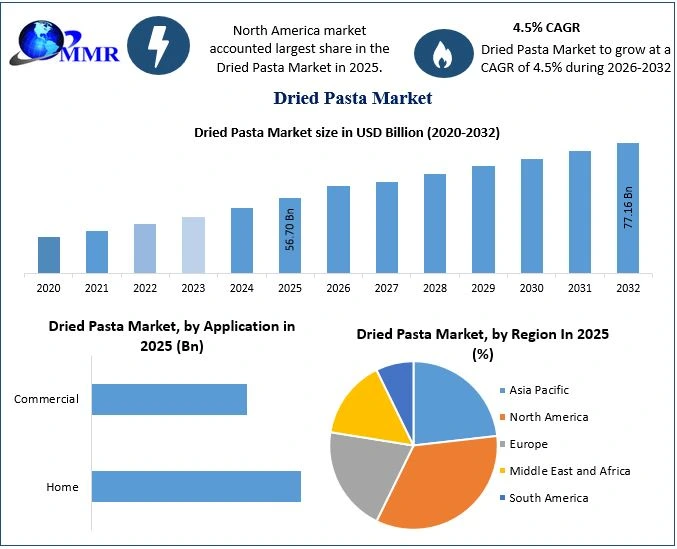
Market valuation expanding from USD 56.70 billion in 2025 to nearly USD 77.16 billion by 2032 at a 4.5% CAGR.
-
The demand floor remains fortified by consumer needs for cost-effective, long shelf-life pantry items.
-
Health and wellness innovations dictate production updates, with high-protein and allergen-friendly formulations expanding.
-
Barilla Group’s capacity expansion in Avon, New York, targets a massive 3,000-ton reduction in annual CO2 emissions.
-
North America exhibits dominant commercial volume presence, supported by intensive specialty and organic sector investments.
-
Europe remains the foundational production hub, with market leaders leveraging premium, artisanal formats and specialized regional facilities.
Why This Matters Now
The transition of the global dried pasta market from USD 56.70 billion to USD 77.16 billion shatters the perception of this sector as a stagnant consumer staple category. Industrial operators are facing sudden product diversification pressures as consumers demand alternative grains, higher protein, and clean-label formulations. For plant managers, this means legacy, single-format extrusion lines must immediately give way to flexible, automated smart manufacturing solutions to manage rapid product changeovers without inducing devastating production downtime or sacrificing strict yield metrics.
Market Overview
Dried Pasta Market Industrial dried pasta manufacturing relies on the precise mixing of durum wheat semolina, water, and specialized ingredients into a uniform dough before high-pressure extrusion and intensive thermal drying. The simplicity of the raw inputs provides manufacturers with excellent household penetration and retailers with consistent traffic during inflationary periods.
However, maintaining the structural integrity and shelf stability of diverse shapes requires precise, real-time control over drying temperature profiles and humidity variables. As the industry advances toward its 2032 projected valuation of USD 77.16 billion, processing facilities are rapidly phasing out manual, empirical line monitoring in favor of integrated distributed control systems (DCS) to manage continuous high-speed extrusion.
Key Trends Driving Growth
Accelerating urbanization and shifting dietary preferences are forcing a massive scale-up in manufacturing facility output worldwide. Busy consumers increasingly prioritize fast, low-waste meal options, cementing dried pasta as a baseline requirement in urban retail baskets and foodservice inventories.
Simultaneously, the mainstreaming of high-protein, gluten-free, and low-carb variants is redrawing traditional factory layouts. Operations such as Grupo Gallo’s formulation blending 95% wheat with 5% pea protein, alongside Otelia Foods’ allergen-friendly bean-and-water lines, prove that modern ingredients introduce new rheological complexities. To process these non-traditional dough configurations without clogging high-pressure extruders, automation engineers are installing advanced inline sensory tracking and intelligent motor speed regulations.
Segment Insights
-
Chunky, Pen Nib, and Tube Shapes (Dominant Segment): Traditional shapes dictate the vast majority of industrial line capacity, requiring automated die-change sub-systems, high-capacity pneumatic conveying, and synchronized multi-stage drying chambers to prevent cracking.
-
Home and Retail Consumption (Dominant Application): Commanding the baseline volume of the global distribution footprint, this application requires high-speed vertical form-fill-seal packaging automation and automated case packing to secure thin-margin retail contracts.
-
Alternative Grain and High-Protein Formats (Fastest-Growing Segment): Accelerated by health-conscious consumer segments, this product tier demands agile manufacturing execution systems (MES) capable of enforcing rigid batch isolation and recipe management to prevent cross-contamination.
Regional Growth Story
Europe retains its status as the cultural reference point and primary production baseline for premium and artisanal pasta formats. Leading operators in Italy, Greece, and Spain are heavily focusing on factory digitization to optimize traditional slow-drying techniques at commercial scales, capturing premium margins while introducing whole-wheat and gluten-free lines.
North America, led by the United States, commands a dominant market presence in the global arena, acting as a primary site for substantial smart factory capital deployment. Manufacturers across the region are upgrading upstream mixing and downstream logistics to satisfy the rapid expansion of gourmet, organic, and alternative-grain options. In the Asia-Pacific region, urbanization and Western culinary integration are catalyzing high-speed facility development, prompting global brands to establish new automated operations in China, India, Japan, and South Korea to feed growing urban centers.
Competitive Landscape
The global competitive ecosystem is entering a period where technological leadership directly dictates market share acquisition. Industry giants such as Barilla Group, De Cecco, Nestlé SA, and Campbell Soup Company are shifting from pure capacity metrics to smart manufacturing efficiency. Similarly, active players like Ebro Foods SA, Rana Group, Delverde Industrie Alimentari S.p.A., and Pasta Zara S.p.A. are modernizing operations to maintain high agility across their international production facilities.
This push for technical excellence is clearly demonstrated by Barilla’s strategic multi-million-dollar expansion of its Avon, New York facility. By engineering this capacity increase to simultaneously eliminate approximately 3,000 tons of annual carbon emissions, Barilla signals a major shift: future volume expansions must be tied directly to resource optimization. For industrial technology providers, this creates an urgent demand for predictive energy analytics and optimized thermal control loops within drying towers to minimize fuel use.
Furthermore, the rise of agile competitors introducing specialized functional products—such as clean-label, allergen-friendly alternatives delivering 21 grams of protein per serving—indicates that ecosystem positioning is no longer determined solely by bulk output. Established brands are realizing that to protect their shelf space against premium innovators, their production lines must feature rapid recipe changes and highly flexible packaging capabilities.
Recent Developments
-
Strategic Green Expansion: Barilla Group executed a major production capacity expansion at its Avon, New York facility, integrating automated resource management to slash annual carbon emissions by approximately 3,000 tons.
-
Alternative Grain Scaled Integration: Otelia Foods integrated new processing line technologies to commercialize its allergen-friendly bean-and-water pasta, achieving a high-protein yield of 21 grams per serving.
-
Functional Portfolio Diversification: Grupo Gallo deployed specialized automated dosing systems to successfully integrate alternative plant proteins into its mainstream high-volume wheat lines.
Strategic Implications
For operations executives and plant engineers, these industry dynamics rewrite the rules of facility management. Relying on legacy, disconnected machinery introduces severe vulnerabilities when processing alternative grains like pea or bean proteins, which exhibit entirely different thermodynamic properties compared to standard durum semolina.
To maintain margin integrity across diverse product lines, plants must integrate their manufacturing execution systems (MES) directly with programmable logic controllers (PLCs) at the machine layer. This enables automated, real-time adjustments to hydration ratios, extrusion pressures, and drying temperatures based on live product data, ensuring consistent quality and eliminating manual trial-and-error.
Future Outlook
The evolution of the dried pasta market through 2032 will showcase a widening productivity gap between automated and manual operations. As e-commerce platforms and direct-to-consumer channels expand, brands face smaller, more frequent production runs of specialized products, requiring unprecedented operational agility. The future belongs to highly digitalized smart factories that use predictive maintenance and automated quality control to seamlessly balance high-volume efficiency with high-margin product flexibility.
Analyst Perspective
“The global dried pasta market is undergoing a structural transformation driven by intense product diversification and sustainability mandates,” says Sidhhi Dole, Research Analyst at Maximize Market Research. “As leading brands invest heavily in alternative-grain formulations and carbon-reduction initiatives, the manufacturing facilities that thrive will be those utilizing advanced process control technologies to achieve complete operational flexibility without sacrificing throughput.”
About Maximize Market Research
Maximize Market Research Pvt. Ltd. (MMR) is a global market research and consulting company that provides reliable, data-focused, and practical business insights. The firm serves a wide range of industries, including healthcare, pharmaceuticals, technology, automotive, electronics, chemicals, personal care, and consumer goods. Through market forecasts, competitive analysis, strategic consulting, and industry impact assessments, MMR helps organizations understand changing market conditions, identify growth opportunities, and make informed business decisions for long-term success.
2nd Floor, Navale IT Park Phase 3
Pune Banglore Highway, Narhe
Pune, Maharashtra 411041, India
+91 9607365656
[email protected]