Key Highlights
-
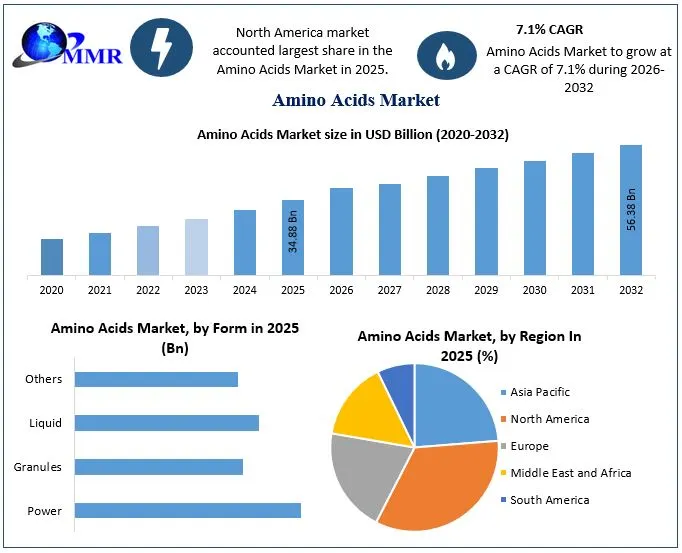
The global amino acids market is projected to expand from USD 34.88 billion in 2025 to USD 56.38 billion by 2032, representing a 7.1% CAGR.
-
Plant-based natural resources, including soybeans, corn, and grains, are rapidly scaling in adoption, driving backward vertical integration strategies among major manufacturers.
-
Industrial biotechnology and advanced downstream fermentation processes are replacing legacy chemical synthesis to optimize production costs and yield metrics.
-
Asia Pacific leads the global landscape in both total volume consumption and growth velocity, underpinned by massive industrial expansions in China and India.
-
Corporate capital deployment is shifting toward premium specialty segments, evidenced by significant asset acquisitions and high-purity production investments in Europe.
Why This Matters Now Volatile raw material pricing and tightening regulatory frameworks are forcing global chemical manufacturers and procurement leaders to completely restructure their supply lines. Industrial buyers can no longer rely on unintegrated, fossil-dependent supply chains without risking severe margin degradation.
The immediate commercial pressure stems from structural shifts in downstream consumption. Livestock producers demand precise amino acid feed additives to maximize output metrics, while biopharma operators require ultra-high-purity inputs for advanced therapeutics. Capital is rapidly moving away from unintegrated commodity chemical manufacturing toward high-margin, vertically integrated bio-refineries. Companies that fail to secure feedstock access or adopt advanced microbial fermentation technologies face immediate displacement by agile, integrated competitors.
Market Overview The global amino acids market achieved a valuation of USD 34.88 billion in 2025. Industrial consumption patterns across multiple downstream sectors indicate sustained volume expansion. The market will reach USD 56.38 billion by 2032, driven by an annualized growth rate of 7.1%. This expansion translates to a multibillion-dollar capital realignment across the broader chemicals and materials sector.
Amino acids operate as the fundamental structural units for protein synthesis, making them critical across non-discretionary industries. In food and beverage processing, these compounds function as essential nutritional fortifiers and flavor enhancers. The livestock sector relies on bulk amino acids to optimize animal health and conversion ratios in poultry, swine, and aquaculture. In the high-value pharmaceutical sector, amino acids serve as critical active blocks for synthesis in antibiotics, antacids, vaccines, and oncology therapies. This diversified downstream footprint shields the chemical sector from cyclical downturns in any single end-market.
Key Trends Driving Growth Accelerating demand for high-quality animal protein acts as the primary macroeconomic engine for volume consumption. Livestock operators integrate specific amino acid profiles into feed formulations to enhance herd productivity and lower overall feed volumes. This behavioral shift alters bulk chemical procurement strategies globally, establishing multi-year volume baselines for major producers.
Simultaneously, a widespread consumer shift toward health, fitness, and functional nutrition is driving high-value formulation growth. The pharmaceutical and nutraceutical sectors are increasing their procurement of crystalline amino acids to manufacture targeted dietary supplements. Furthermore, the consumer preference for natural ingredients is reshaping the personal care sector. Cosmetics manufacturers are substituting traditional synthetic chemical additives with plant-derived amino acid alternatives to meet clean-label regulatory standards and consumer expectations.
Technological disruption in industrial biotechnology forms the core operational trend. Manufacturers are progressively abandoning traditional chemical synthesis in favor of advanced fermentation and enzymatic processes. These bioprocesses utilize microbial engineering to convert basic agricultural feedstocks into complex, high-purity molecules. This transition lowers energy consumption profiles and enhances production yields, directly lowering the total cost of ownership for industrial buyers.
Segment Insights
-
Dominant Segment: Plant-Based Natural Resources. Feedstocks derived from soybeans, grains, and corn command the largest operational share of the market. This dominance is driven by the widespread agricultural availability of these crops and their high native protein concentrations.
-
Fastest-Growing Segment: Asia Pacific Regional Market. Driven by continuous manufacturing capacity additions and escalating domestic consumption, this geographic segment outpaces all other regional markets.
-
Feedstock Integration Trends: To mitigate severe raw material pricing volatility, leading chemical producers are actively executing vertical integration strategies. This structural realignment secures a consistent supply of input crops but introduces processing complexities, as transforming soybeans can alter protein ratios and disrupt manufacturing consistency.
-
Downstream Consumption Shift: The pharmaceutical grade segment is accelerating its capital requirements. While animal feed consumes the highest baseline volume, premium bio-based pharmaceutical amino acids yield significantly higher profit margins per metric ton.
Regional Growth Story The global market exhibits a clear bifurcation between mature, consumption-stable economies and high-velocity manufacturing hubs. North America and Europe function as mature industrial markets characterized by high per-capita consumption of dietary supplements and functional foods. In these regions, the United States, Germany, France, and the United Kingdom serve as the primary commercial anchors. Western manufacturers in these zones are pivoting away from basic commodity production, focusing instead on high-purity specialty chemicals to protect operating margins from low-cost imports.
Conversely, the Asia Pacific region operates as the primary driver of global growth and volume dominance. China and India lead this regional expansion. This leadership is fueled by massive domestic demand for animal feed additives and an escalating manufacturing footprint. The presence of dense agricultural production zones gives Asia Pacific chemical processors direct proximity to vital plant-based feedstocks, lowering logistics costs and enhancing export competitiveness. Meanwhile, South America and the Middle East & Africa remain emerging territories, building up baseline regulatory frameworks and importing bulk volumes to support local agricultural infrastructure.
Competitive Landscape The global competitive ecosystem is consolidating around a core group of highly capitalized multinational chemical corporations. These entities are leveraging scale, proprietary bioprocess technologies, and geographic distribution networks to lock in long-term supply agreements. Key market competitors actively defining the global landscape include Ajinomoto Co., Inc., Archer Daniels Midland Company, Cargill, Incorporated, CJ CheilJedang Corp., and Evonik Industries AG.
Market power is concentrated among players that control advanced industrial biotechnology platforms. Companies like Kyowa Hakko Kirin Co., Ltd., Novus International, Inc., Prinova Group LLC, Royal DSM N.V., and Sumitomo Chemical Co., Ltd. compete intensely on production efficiency and purity standards. Pure-play chemical commodity manufacturers face intensifying margin pressure from integrated agribusiness giants that control the underlying crop supply chains. This structural dynamic forces pure chemical companies to either invest heavily in downstream specialization or establish binding joint ventures with agricultural processors.
Recent Developments
-
On 10 December 2025, Croda International Plc formed a strategic supply partnership with Amino GmbH to scale the global availability of ultra-high-purity pharmaceutical-grade amino acids. This move directly optimized biopharma manufacturing efficiencies and enabled the commercial launch of Croda’s BioXPro™ high-purity histidine and arginine line in January 2026.
-
On 15 January 2026, Granules India Limited finalized the strategic acquisition of Senn Chemicals AG. This corporate transaction integrated specialized capabilities in manufacturing high-purity peptide-based intermediates and pharmaceutical-grade amino acid derivatives, expanding Granules’ premium biotechnology footprint.
-
On 24 April 2026, Evonik Industries AG announced an EUR 80 million capital investment at its Fermas production hub located in Slovakia. This capital expenditure implements advanced downstream fermentation technology, directly fortifying Evonik’s contract manufacturing scale for drug substances and complex bio-based amino acid products.
Strategic Implications The recent wave of corporate investments and acquisitions signals a profound structural realignment toward premiumization and localized supply security. Croda’s partnership with Amino GmbH demonstrates that chemical distributors are moving closer to specialized manufacturers to guarantee product purity. By securing dedicated access to high-purity histidine and arginine, Croda insulates its biopharma customers from supply chain shocks, establishing high barriers to entry for unaligned competitors.
Granules India’s acquisition of Senn Chemicals AG underscores a broader geographical shift. Indian pharmaceutical firms are aggressively acquiring European biotechnology assets to gain immediate access to proprietary peptide and amino acid derivative technologies. This transaction alters market structure by shifting high-value technical capabilities to firms with low-cost manufacturing bases.
Evonik’s EUR 80 million expansion in Slovakia highlights a critical shift in asset allocation. By investing heavily in advanced downstream fermentation at the Fermas hub, Evonik is scaling its contract development and manufacturing organization (CDMO) capabilities. This capital move demonstrates that future pricing power belongs to chemical companies that control bio-based, asset-flexible fermentation infrastructure rather than rigid, fossil-fueled chemical synthesis plants.
Future Outlook The global amino acids market will continue its structural evolution toward a bio-based, circular manufacturing model. Traditional chemical synthesis will face intensifying regulatory and economic pressures, accelerating the industry-wide transition to microbial fermentation. Price volatility in essential agricultural feedstocks like soybeans and corn will remain a major operational risk, punishing non-integrated producers.
Winning corporations will be those that successfully execute vertical integration to lock in plant-based feedstocks while simultaneously scaling specialized downstream biotechnology assets. Operators that rely on volatile open-market raw materials or fail to transition away from inefficient legacy chemical synthesis methods face rapid margin erosion and ultimate obsolescence.
Analyst Perspective “The rapid convergence of industrial biotechnology and chemical manufacturing is completely rewriting the rules of procurement and production in the global amino acids landscape,” stated Ankita Kagawade, Research Analyst at Maximize Market Research. “As evidenced by major capital deployments in Europe and strategic acquisitions across Asia, long-term market leadership now hinges entirely on securing high-purity plant-based feedstocks and mastering advanced bio-fermentation scale-up.”
About Maximize Market Research
Maximize Market Research Pvt. Ltd. (MMR) is a global market research and consulting company that provides reliable, data-focused, and practical business insights. The firm serves a wide range of industries, including healthcare, pharmaceuticals, technology, automotive, electronics, chemicals, personal care, and consumer goods. Through market forecasts, competitive analysis, strategic consulting, and industry impact assessments, MMR helps organizations understand changing market conditions, identify growth opportunities, and make informed business decisions for long-term success.
2nd Floor, Navale IT Park Phase 3
Pune Banglore Highway, Narhe
Pune, Maharashtra 411041, India
+91 9607365656
[email protected]