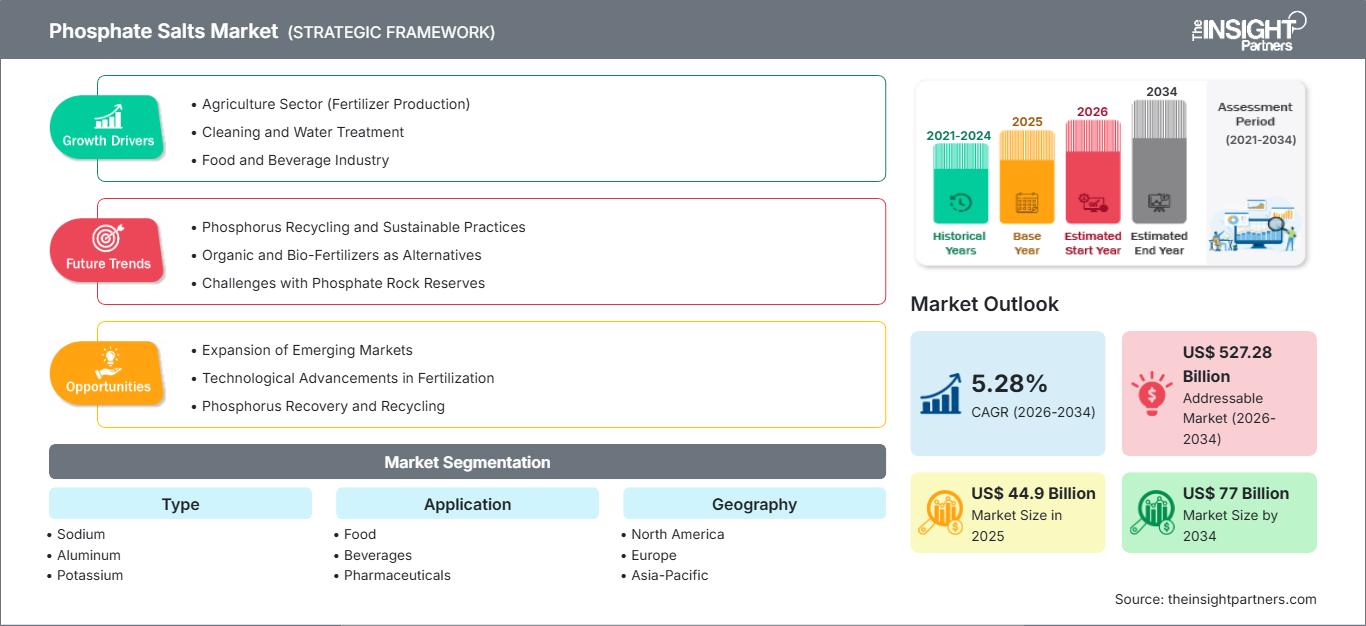
Fertiliser bags, water treatment plants, and pharmaceutical tablets don’t seem to belong in the same sentence, yet all three depend on the same family of compounds. Phosphate salts move quietly between farming, food processing, and drug manufacturing, and demand across each of those industries keeps climbing. The Phosphate Salts Market Size was valued at US$ 44.9 billion in 2025 and is projected to reach US$ 77 billion by 2034, expanding at a CAGR of 5.28% during 2026–2034. That growth trajectory reflects just how embedded these compounds are in modern agriculture and industrial processing.
What Is a Phosphate Salt?
A phosphate salt is a chemical compound formed from phosphoric acid, used across agriculture, water treatment, pharmaceuticals, and food processing. Common forms include monosodium phosphate, disodium phosphate, monopotassium phosphate, and trisodium phosphate, each suited to different industrial and consumer applications.
What’s Driving Demand for Phosphate Salts?
Agriculture remains the anchor application. Global food demand keeps rising alongside population growth, and phosphate-based fertilisers are essential for crop yield, particularly in regions expanding cultivated land or shifting toward more intensive farming practices. There is still no cost-effective substitute for phosphate as a core soil nutrient.
Request a Sample Copy of the Report: https://www.theinsightpartners.com/sample/TIPRE00030246
Water treatment is a fast-expanding use case. What makes this particularly significant is how many municipalities and industrial facilities are upgrading treatment infrastructure to meet stricter discharge and drinking water standards, and phosphate salts play a direct role in corrosion control and water softening processes within those systems.
Pharmaceutical and food-grade applications round out the demand base. Phosphate salts function as buffering agents, preservatives, and texture stabilisers, and both industries are growing steadily as processed food consumption rises and pharmaceutical manufacturing capacity expands globally. So what connects a wheat field, a water treatment plant, and a tablet press? All three rely on phosphate chemistry to function reliably at scale, something few other compounds can replicate across such different processes.
Segments Covered
By Grade
Technical grade holds the largest share, driven by industrial and water treatment applications.
Food grade is expanding steadily as processed food production rises globally.
Pharmaceutical grade is the fastest-growing category, tied to expanding drug manufacturing capacity.
By Type
Monosodium Phosphate leads type-level demand, widely used across food and industrial processing.
Disodium Phosphate serves as a key buffering agent in food and pharmaceutical formulations.
Monopotassium Phosphate is gaining share in agricultural fertiliser blends requiring potassium content.
Trisodium Phosphate remains important in water treatment and industrial cleaning applications.
Others includes specialty phosphate compounds for niche industrial uses.
By Application
Agriculture is the dominant application, tied directly to global fertiliser consumption volumes.
Water Treatment is a fast-growing application, propelled by infrastructure upgrades and tightening regulations.
Pharmaceutical and Food and Beverage applications rely on phosphate salts as functional additives.
Others includes detergent manufacturing and industrial cleaning formulations.
Key Market Players
- The Mosaic Company
- OCP Group
- EuroChem Group AG
- ICL Group Ltd.
- Nutrien Ltd.
- Innophos Holdings, Inc.
- Prayon SA
- Aditya Birla Chemicals
- Yara International ASA
- Jordan Phosphate Mines Company
Competition centres on backward integration into phosphate rock mining, which gives large producers a cost advantage, alongside investment in pharmaceutical and food-grade purification capacity to capture higher-margin segments.
Sustainability and Innovation Trends
Producers are investing in phosphate recovery technology that extracts the compound from wastewater and agricultural runoff, reducing both environmental impact and reliance on mined rock phosphate. Beyond that, low-impurity processing methods are gaining ground as pharmaceutical and food manufacturers demand higher-purity inputs. This is not just a regulatory response, it reflects a structural shift toward closed-loop phosphate use as mined reserves face growing scrutiny over long-term availability.
Buy Premium Report: https://www.theinsightpartners.com/buy/TIPRE00030246
Regional Outlook
Asia Pacific leads the market, driven by China and India’s massive agricultural base and rising fertiliser consumption. North America follows, supported by both large-scale farming operations and a mature pharmaceutical manufacturing sector in the US. Europe holds a steady share, with water treatment infrastructure upgrades and food-grade demand sustaining consumption across Germany, France, and the UK. South and Central America are emerging strongly, as Brazil’s expanding agricultural sector drives fertiliser demand higher.
Trending Reports
Ammonium Phosphate Facilitating Crop Nutrition Market
Industrial Wastewater Treatment Chemicals Market
Water-Soluble Fertilizers Market
About The Insight Partners
The Insight Partners is among the leading market research and consulting firms in the world. We take pride in delivering exclusive reports along with sophisticated strategic and tactical insights into the industry. Reports are generated through a combination of primary and secondary research, solely aimed at giving our clientele a knowledge-based insight into the market and domain. This is done to assist clients in making wiser business decisions. A holistic perspective in every study undertaken forms an integral part of our research methodology and makes the report unique and reliable.
Contact Us:
If you have any queries about this report or if you would like further information, please contact us:
Phone: +1-646-491-9876
E-mail: [email protected]
Also Available in: Korean | German | Japanese | French | Chinese | Italian | Spanish