Key Highlights
-
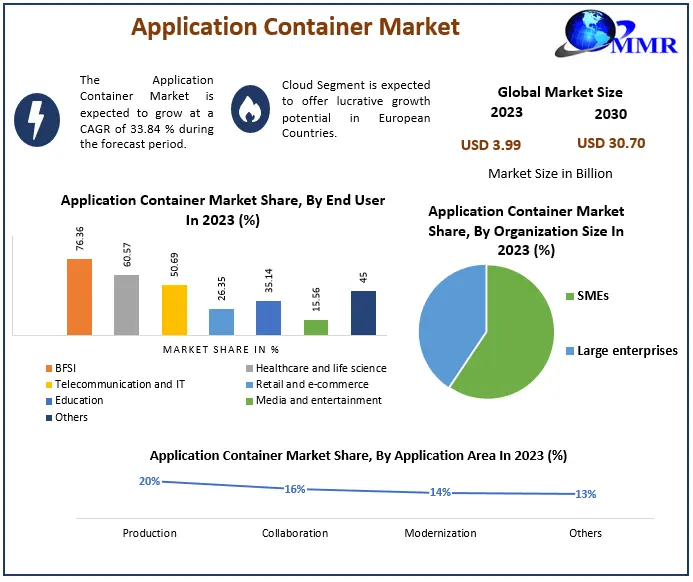
Application Container Market size is USD 3.99 Bn in 2023 and is forecast to reach nearly USD 30.70 Bn by 2030 at a 33.84% CAGR, confirming that container platforms are one of the fastest-growing layers in the enterprise and telecom stack.
-
Containers have moved from developer experiment to default packaging for cloud-native, microservices and AI workloads across IT and telecom.
-
Adoption is closely tied to public cloud growth, hybrid cloud strategies, 5G core modernization and edge computing deployments.
-
Platform competition now centers on orchestration, security, observability and multi‑cloud portability rather than basic container runtime.
-
Organizations using containers as a strategic abstraction layer gain faster release cycles, better resource utilization and more flexible deployment across data centers, clouds and edge sites.
Why This Matters Now
Digital transformation is hitting a scaling wall. AI, 5G, streaming, low‑latency services and always‑on digital channels demand software that ships faster, recovers quicker and runs anywhere. A market that grows from USD 3.99 Bn in 2023 to nearly USD 30.70 Bn by 2030 at 33.84% CAGR shows that application containers have become the architecture of choice for that new reality.
For CIOs, CTOs, cloud leaders and telecom executives, container strategy is now business strategy. The way you build and orchestrate containers will determine how fast you can roll out AI features, monetize 5G networks, modernize legacy OSS/BSS and migrate from monolithic applications to modular, revenue-driving digital products.
Market Overview
The Application Container Market around platforms and tools that package, deploy and manage applications and microservices in isolated, portable containers. With a 2023 base of USD 3.99 Bn and projected revenue of nearly USD 30.70 Bn by 2030, the market is in an explosive scale‑out phase rather than incremental growth.
Containers decouple applications from underlying infrastructure, making it easier to move workloads across on‑premise data centers, public clouds and edge locations without rewriting code. They are foundational to DevOps, CI/CD pipelines and microservices architectures that let teams ship new features in days, not months.
In the Information Technology & Telecommunications sector, containers power everything from 5G core network functions and network management systems to customer‑facing apps, streaming services and AI analytics platforms. For telcos, they are central to network function virtualization (NFV) and cloud-native network architectures.
Key Trends Driving Growth
The first major trend is full‑scale cloud-native adoption. Organizations are rewriting critical applications as microservices and deploying them on Kubernetes-based platforms in public and hybrid clouds. Containers are the unit of deployment, making them a direct beneficiary of every cloud‑native migration and greenfield digital initiative.
A second trend is telecom and 5G transformation. Network functions like packet core, IMS and RAN controllers are shifting from proprietary hardware into containerized network functions (CNFs). That shift allows telecom operators to run networks on cloud infrastructure, scale capacity elastically and roll out new services without forklift upgrades.
Third, AI and data-intensive workloads are becoming containerized. Data pipelines, model training jobs and inference services are packaged into containers to standardize environments and move workloads closer to data—whether that data lives in a cloud region, on‑premise cluster or edge node. This makes containers a key enabler of AI at scale.
Fourth, DevSecOps and platform engineering are rising. Central teams now build internal developer platforms on top of container orchestration, abstracting complexity away from application teams. Security, observability, policy and cost control are baked into these platforms, turning containers from a risk into a disciplined foundation for secure, compliant, high‑velocity delivery.
Request a Free Sample Copy or View Report Summary: https://www.maximizemarketresearch.com/request-sample/31793/
Segment Insights
-
Dominant Segment – [[Dominant Segment from MMR report]]
-
The report identifies a dominant segment—such as on‑premise or cloud deployment, a specific end‑user vertical like IT & Telecom, or a core service category—as holding the largest share of the Application Container Market.
-
This segment shows where containers have already become a default choice, with mature ecosystems, strong tooling and deep integration into existing IT and network operations.
-
-
Fastest-Growing Segment – [[Fastest-Growing Segment from MMR report]]
-
The fastest‑growing segment, whether defined by service type (managed container services), deployment (hosted), enterprise size (large enterprises or digital‑native SMEs) or vertical (telecom, BFSI, retail), marks where new demand is switching on fastest.
-
Vendors aligning product roadmaps and go‑to‑market models with this segment will capture an outsized share of the incremental USD 26+ Bn in container spend by 2030.
-
-
By Deployment and Service Model
-
Application containers span self-managed platforms in enterprise data centers and fully managed services offered by cloud providers and telcos.
-
Managed container services reduce operational complexity, making them particularly attractive to enterprises and operators that want the benefits of containers without building large internal platform teams.
-
-
By Enterprise Size and Use Case
-
Large enterprises deploy containers to modernize legacy systems, build new digital businesses and standardize environments across global operations.
-
Digital‑native and high‑growth companies use containers from day one to support rapid product iteration, multi‑region deployment and experimentation with AI, analytics and edge experiences.
-
Regional Growth Story
While the granular breakdown sits inside the report, container adoption typically tracks cloud maturity and telecom investment. North America, led by the United States, is a key driver, with hyperscale cloud providers, SaaS giants and major telecom operators all standardizing on Kubernetes and containers for new services.
In Europe, countries like Germany and the United Kingdom are using containerization to accelerate digital transformation in manufacturing, financial services, media and telecom, often within strict regulatory and data sovereignty constraints. Containers help separate application logic from infrastructure location, easing multi‑region compliance.
Asia Pacific—including China, India, Japan and South Korea—is a high‑growth arena, combining rapid cloud adoption with large‑scale 5G rollouts and a dense start‑up ecosystem. Local cloud providers, super‑apps and telecoms increasingly run container platforms at massive scale, making the region central to future container innovation.
Competitive Landscape
The Application Container Market blends open-source communities, cloud hyperscalers, traditional enterprise software vendors and telecom platform providers. Competition now focuses on who can offer the most complete cloud-native platform rather than on the container runtime itself.
Cloud providers use managed Kubernetes and container services to anchor broader ecosystems of databases, AI services, observability and security tools. This gives them strong leverage: once workloads run in their container platforms, adjacent services are easier to adopt, strengthening cloud lock‑in and pricing power.
Enterprise and telecom vendors compete by offering opinionated platforms that add carrier‑grade reliability, lifecycle management, multi‑cluster control and integration with existing OSS/BSS and ITSM systems. Strategic moves—acquisitions of Kubernetes specialists, partnerships with telcos, investments in edge platforms—signal a race to become the default control plane for modern applications and network functions.
Recent Developments
-
Rapid rollout of managed Kubernetes and container services by cloud providers targeting enterprise, developer and telecom workloads.
-
Increased use of container platforms in 5G cores and network functions as operators deploy cloud-native network architectures.
-
Expansion of platform engineering initiatives within large enterprises to provide internal developer platforms built on containers and Kubernetes.
-
Growing focus on container security, supply‑chain scanning and runtime protection as containers host more critical, customer-facing and regulated workloads.
Strategic Implications
For CIOs, CTOs and heads of infrastructure, containers now sit at the heart of modernization decisions. Choosing how to standardize on container platforms—managed versus self‑managed, single versus multi‑cloud, generic versus verticalized—directly affects agility, resilience, cost control and talent needs over the next decade.
Telecom operators face a clear choice: either run 5G cores, service platforms and OSS/BSS on modern container platforms, or risk falling behind cloud‑centric competitors that can launch services faster and scale more efficiently. Container strategy has become a proxy for overall network and service innovation capability.
For cloud providers and software vendors, container ecosystems are the new battleground for platform economics. The more workloads and data run in their container environments, the easier it is to cross‑sell AI, analytics, storage and security services, turning container adoption into long‑term recurring revenue and ecosystem lock‑in.
Future Outlook
By 2030, when the Application Container Market is projected to reach nearly USD 30.70 Bn on the back of a 33.84% CAGR, containers will be the default substrate for new enterprise, telecom and cloud applications rather than an emerging option. Most next‑generation connectivity, AI and digital services will be designed from the start for container-based deployment across clouds and edge.
The decisive divide will be between organizations that treat containers as a strategic platform for cloud-native, AI‑driven, 5G‑ready operations and those that adopt them tactically as another infrastructure tool. The former will ship faster, recover faster and monetize new digital opportunities sooner; the latter will discover that in a container‑first world, legacy stacks are the clearest marker of a digital laggard.
Related Reports
Insuretech Market https://www.maximizemarketresearch.com/market-report/global-insuretech-market/62931/
Global EMI Shielding Materials Market https://www.maximizemarketresearch.com/market-report/global-emi-shielding-materials-market/28737/
Global AWS Managed Services Market https://www.maximizemarketresearch.com/market-report/global-aws-managed-services-market/27019/
Analyst Perspective
“Application containers have moved from experimentation to the core of digital infrastructure,” “Enterprises and telecom operators that build robust, secure container platforms today will own the speed, scalability and flexibility needed to win in an AI‑ and 5G‑driven economy.”-Yash Ghosalkar
About Maximize Market Research
Maximize Market Research Pvt. Ltd. (MMR) is a global market research and consulting company that provides reliable, data-focused, and practical business insights. The firm serves a wide range of industries, including healthcare, pharmaceuticals, technology, automotive, electronics, chemicals, personal care, and consumer goods. Through market forecasts, competitive analysis, strategic consulting, and industry impact assessments, MMR helps organizations understand changing market conditions, identify growth opportunities, and make informed business decisions for long-term success.
2nd Floor, Navale IT Park Phase 3
Pune Banglore Highway, Narhe
Pune, Maharashtra 411041, India
+91 9607365656
[email protected]