Key Highlights
-
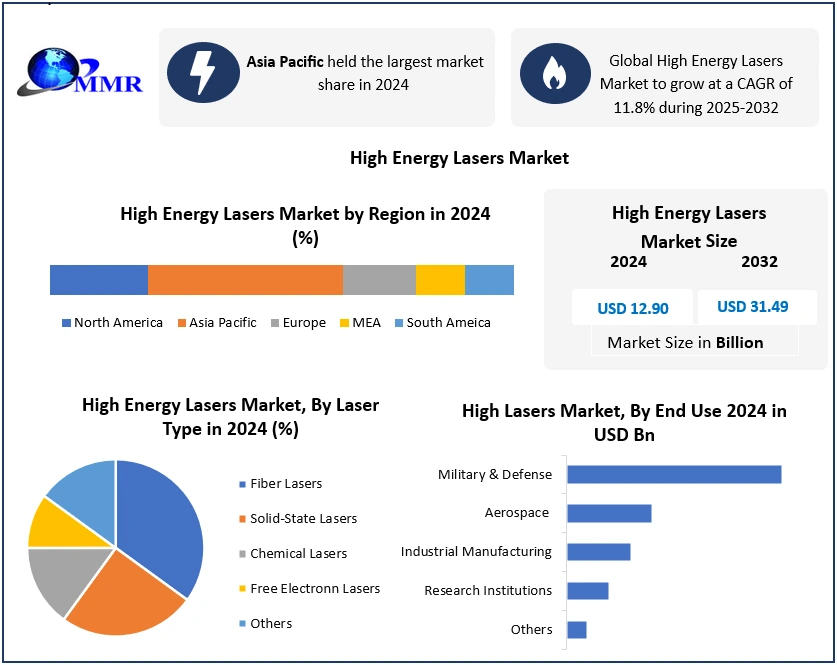
Market valuation expanding from USD 12.90 billion in 2024 to nearly USD 31.49 billion by 2032.
-
Sustained growth trajectory supported by a projected compound annual growth rate of 11.8 percent over the forecast period.
-
Fiber lasers emerging as the fastest-growing technology segment due to superior thermodynamic efficiency and lower maintenance requirements.
-
Military & Defense remains the dominant end-use industry sector, commanding substantial capitalization via directed energy defense systems.
-
Severe atmospheric propagation and multi-object tracking demands act as primary technical bottlenecks for developers.
Why This Matters Now
Geopolitical realignments and the accelerated race for sub-nanometer chip fabrication are forcing an immediate overhaul of industrial beam technologies. Modern electronic architectures demand extreme structural precision, creating an urgent bottleneck that conventional manufacturing systems cannot resolve.
For electronics original equipment manufacturers and foundry operators, the adoption of advanced high-energy laser systems is no longer an optional upgrade but a core requirement for next-generation survival. This structural transition unlocks unprecedented yield efficiencies while enabling defense systems to intercept rapid-fire threats.
Market Overview
The global high energy lasers market is undergoing a major structural transformation, scaling from USD 12.90 billion in 2024 to a projected USD 31.49 billion by 2032. This performance trajectory reflects an 11.8 percent compound annual growth rate, driven by a complete re-engineering of industrial processing and defense frameworks.
As precision requirements intensify within the electronics manufacturing services sector, high-energy systems are moving from specialized laboratory applications to high-throughput production lines. This commercial migration requires significant capital deployment from technology providers seeking to secure long-term market positions.
The market trajectory is heavily influenced by systemic shifts in sovereign industrial policy and automated defense networks. Production infrastructure is adapting to handle complex materials that require higher energy concentrations without causing thermal distortion to surrounding components.
Consequently, the deployment of these systems serves as an economic barometer for advanced industrial capacity, reflecting the broader intersection of computational scaling and advanced physical manufacturing.
Key Trends Driving Growth
Military combat dynamics have undergone a permanent shift, moving rapidly toward autonomous unmanned aerial vehicles and coordinated drone swarms. This evolution has driven massive capital deployment into directed energy weapons, which serve as the first line of defense for military bases and naval vessels. These systems offer nearly instant engagement speeds and deep magazines, enabling security forces to counter rapid-fire threats as long as an electrical power source is maintained.
Simultaneously, the demand for precision in industrial manufacturing has intensified, directly influencing the integration of high-power laser systems. Advanced component manufacturing now requires precise material ablation, cutting, and welding at scales that traditional mechanical tools cannot achieve. This trend is highly apparent in the production of dense electronic assemblies and specialized aerospace components, where thermal control and extreme accuracy dictate structural yield rates.
Operational efficiency parameters are also shifting the technical requirements for laser architectures. Engineering teams are prioritizing critical performance metrics, specifically beam quality, operational throughput, overall reliability, system cost, and size, weight, and power parameters. These variables force manufacturers to innovate continuously, developing compact systems that deliver higher power outputs while maintaining strict thermal and structural stability.
Segment Insights
-
Fiber Lasers (Fastest-Growing Segment): Capturing dominant market velocity due to high conversion efficiency, compact form factors, and reduced maintenance costs. This architecture is actively displacing traditional chemical systems across both defense hardware and automated assembly lines.
-
Chemical Lasers: Experiencing a structural decline in commercial market share, constrained by rising environmental regulations and severe operational safety hazards.
-
Solid-State Lasers: Securing steady capital inflows within aerospace protection and military applications due to high physical robustness and beam precision.
-
Free Electron Lasers: Remaining largely confined to experimental and early-stage development programs, showing long-term potential for high-power installations.
-
Military & Defense (Dominant Segment): Leading all end-use categories as global defense departments rapidly integrate laser systems for counter-UAV operations, satellite protection, and missile defense frameworks.
-
Aerospace & Industrial Manufacturing: Generating sustained demand through aircraft protection deployment and precision material processing lines.
Regional Growth Story
North America commands a leading position in the high energy lasers market, sustained by heavy research grants and expanding defense budgets within the United States. This regional dominance is reinforced by a highly mature aerospace industry and an established cluster of specialized technology providers. The presence of these domestic supply chains accelerates the commercialization of directed energy technologies from experimental prototypes to deployed field units.
Concurrently, the Asia-Pacific region is emerging as a critical engine of adoption, driven by massive manufacturing investments in China, India, and Japan. This region is leveraging high-energy laser systems to support its sprawling electronics manufacturing services and industrial production hubs.
Government-led initiatives to expand domestic manufacturing capacity are encouraging local corporations to integrate advanced laser automation, establishing Asia-Pacific as a vital theater for long-term market expansion.
Competitive Landscape
The competitive hierarchy is defined by intense research and development competition, where technical leadership directly dictates pricing power and contract acquisition. Prominent market participants include Beamtech Optronics, Laserline, IPG Photonics, Daheng Optics, REO, Coherent Dilas, MPB, and EI EN Group. These entities are actively investing in next-generation beam stabilization and power scaling to secure long-term defense and industrial contracts.
This market environment penalizes slow innovators, as defense agencies and industrial conglomerates demand rapid compliance with stringent size, weight, and power standards. Companies unable to master efficient thermal dissipation and multi-object tracking are losing market relevance.
As a result, market leaders are focusing heavily on vertical integration, controlling everything from specialized diode fabrication to advanced optical coating processes to protect their proprietary technology advantages.
Recent Developments
-
The Israeli Ministry of Defense successfully demonstrated an airborne laser system capable of intercepting and destroying unmanned aerial vehicles in operational environments.
-
Industrial suppliers increased production allocations for high-efficiency fiber lasers to meet rising volume requirements from the automated manufacturing sector.
-
Defense technology integrators expanded testing of platform-mounted laser weapons designed to safeguard commercial and military aircraft from shoulder-fired missile threats.
-
Research institutions secured expanded federal grants focused on solving atmospheric beam distortion issues caused by dust and humidity.
Strategic Implications
The primary engineering challenge facing the industry is developing a laser system capable of delivering destructive or transformative energy to a target while simultaneously tracking multiple moving objects. This issue is compounded by atmospheric propagation challenges, as dust, thermal turbulence, and humidity can degrade beam focus and reduce energy delivery.
Systems that cannot maintain precision over long distances face sharp competitive disadvantages in both tactical defense and high-throughput industrial operations.
For industrial operators, the deployment of these laser systems directly influences manufacturing throughput and operational cost structures. Implementing high-efficiency fiber systems reduces downtime and component wear, directly strengthening the bottom-line performance of advanced manufacturing facilities.
Consequently, the integration of these technologies serves as a reliable indicator of an organization’s manufacturing sophistication and its readiness to produce next-generation electronic components.
Future Outlook
The market is moving toward an architectural inflection point where traditional kinetic defense and mechanical manufacturing tools will be systematically replaced by photonic systems. Future market expansion will depend entirely on breakthroughs in beam quality and compact power management, enabling deployment across space-based, airborne, and mobile terrestrial platforms.
As power requirements scale upward, the separation between market leaders and lagging firms will be determined by their ability to maintain beam coherence through volatile environments.
Ultimately, organizations that master the integration of high-power fiber architectures and precise thermal stabilization will secure dominant positions across the global defense and industrial manufacturing supply chains, while slower-moving competitors risk complete technological obsolescence.
Analyst Perspective
“The rapid structural evolution of the global high energy lasers market highlights a critical pivot toward high-efficiency, compact fiber architectures designed to meet severe operational demands. As defense frameworks and high-throughput industrial lines face escalating precision requirements, the ability to deliver stable, high-power energy under volatile conditions will emerge as the primary differentiator for technology providers worldwide.”
— Neha Nalawade, Research Analyst
About Maximize Market Research
Maximize Market Research Pvt. Ltd. (MMR) is a global market research and consulting company that provides reliable, data-focused, and practical business insights. The firm serves a wide range of industries, including healthcare, pharmaceuticals, technology, automotive, electronics, chemicals, personal care, and consumer goods. Through market forecasts, competitive analysis, strategic consulting, and industry impact assessments, MMR helps organizations understand changing market conditions, identify growth opportunities, and make informed business decisions for long-term success.
2nd Floor, Navale IT Park Phase 3
Pune Banglore Highway, Narhe
Pune, Maharashtra 411041, India
+91 9607365656
[email protected]