Key Highlights
-
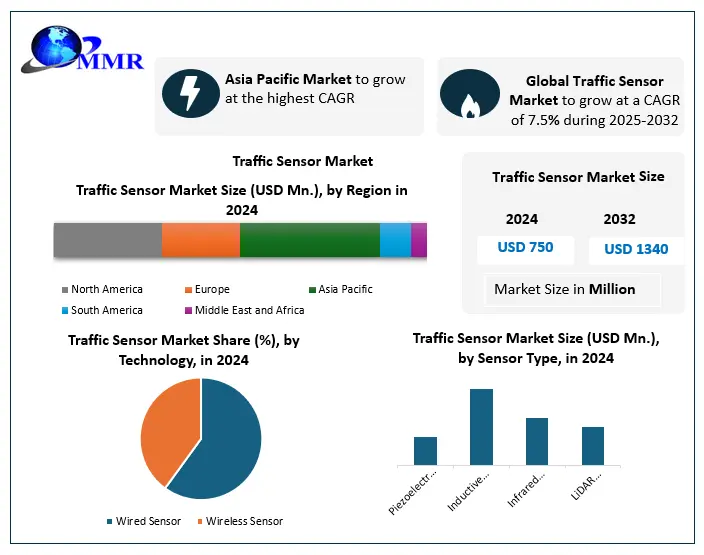
Market Scale & Momentum: The global traffic sensor market climbed to a valuation of USD 750 million in 2024 and is projected to expand at a 7.5% CAGR between 2025 and 2032, hitting USD 1340 million.
-
Infrastructure Transformation: Municipalities are rapidly integrating edge-computing capabilities into physical sensor housings, altering traditional component bills of materials for original equipment manufacturers (OEMs).
-
Silicon Volume Multiplication: The evolution from passive vehicle counting to real-time predictive traffic control generates structural demand for mixed-signal processing, memory, and 5G communication chips.
-
P3 Integration Models: Rising deployment of public-private partnerships (PPPs) accelerates project execution timelines, providing long-term structural revenue predictability for electronics manufacturing services (EMS) providers.
Why This Matters Now
The rapid scaling of intelligent transport systems (ITS) forces semiconductor foundries, electronics manufacturing service providers, and technology strategists to urgently recalibrate their long-term capacity allocations. Road networks are transforming into automated data-collection corridors, rendering basic mechanical or passive electronic components obsolete. This market disruption requires a fundamental shift toward solid-state processing at the extreme edge, where ambient data must be converted into actionable routing decisions in milliseconds. Electronics OEMs and semiconductor fabrication companies that establish early silicon architecture standards for these localized smart city nodes will capture high-margin, sticky government and institutional infrastructure pipelines, while slow-moving component suppliers face immediate marginalization.
Market Overview
The Traffic Sensor Market capital-intensive world of municipal transportation is executing an unprecedented pivot toward software-defined roadway hardware. Urban centers are encountering severe congestion backlogs, forcing planners to abandon passive data logs in favor of dynamic grid optimization. The global traffic sensor market reached USD 750 million in 2024 and is on track to touch USD 1340 million by 2032, driven by an annualized growth pace of 7.5%.
This expansion signals a profound transformation in how roadside equipment is developed, powered, and integrated. While concerns regarding sensor accuracy, structural hardware integration, and citizen data privacy present localized headwinds, the compounding economic losses associated with gridlock are compelling governments to accelerate system deployment. For component fabricators, this structural shift marks the transition of traffic sensors from basic electromechanical switches into complex, highly integrated processing ecosystems.
Key Trends Driving Growth
The core catalyst accelerating the marketplace is the institutionalization of smart city initiatives by global regulatory and administrative bodies. Municipalities are no longer deploying isolated sensors; they are constructing centralized, automated traffic management hubs that require constant streams of real-time telemetry. This demand has spurred the direct integration of Artificial Intelligence (AI) and the Internet of Things (IoT) inside roadside sensor platforms.
Furthermore, the operational push to reduce carbon emissions through localized traffic flow optimization is validating major capital expenditure allocations for sensor-based networks. Sensors are now expected to execute real-time edge processing to dynamic signal systems, dropping latency to near-zero levels. This technological convergence requires extensive integration of application-specific integrated circuits (ASICs) and high-performance microcontrollers, directly benefiting fabless chip designers and specialized silicon foundries.
Segment Insights
-
Dominant Sensor Segment: Inductive loop sensors maintained market dominance in 2024, utilizing deep-set roadway installation and long-standing electromechanical reliability to anchor legacy traffic networks.
-
Fastest-Growing Sensor Technologies: Radar, infrared, and LiDAR sensor variants represent the fastest-accelerating product categories, driven by the technical requirement for non-intrusive, multi-lane object tracking.
-
Dominant Technology Segment: Wired sensor technology dominated the market landscape in 2024, providing the secure, non-interrupted, and high-stability data transfers mandatory for mission-critical urban management.
-
Fastest-Growing Technology Segment: Wireless sensor technology networks are expanding at the fastest velocity, favored by installation cost reductions and frictionless integration with localized 5G architectures.
Regional Growth Story
North America represents a highly consolidated hub of sensor innovation, anchored by pioneering institutional deployments of intelligent transport systems across major urban transit zones. The presence of key global market leaders within the United States ensures rapid testing and commercialization of next-generation hardware platforms.
Simultaneously, the Asia-Pacific region is manifesting as the fastest-expanding manufacturing and deployment footprint, led by massive public infrastructure outlays in China, Japan, and India. Rapidly rising urban populations in these developing economies have created acute logistical challenges, compelling administrative authorities to mandate smart sensor integration in all new highway projects. This manufacturing surge provides direct volume stimulus to major electronics manufacturing hubs in Taiwan and South Korea, which are expanding their localized semiconductor production lines to feed the growing regional demand for roadside logic, memory, and power-management hardware.
Competitive Landscape
The competitive matrix features a blend of defense, imaging, and industrial automation powerhouses, including FLIR Systems, Sensys Networks, Teledyne Technologies, and Iteris Inc. inside the United States, alongside European heavyweights Kapsch TrafficCom AG, Jenoptik AG, Siemens Mobility, and Axis Communications.
The strategic maneuvers executed by these market leaders reveal a decisive shift away from localized hardware distribution toward full-stack ecosystem development. Companies are aggressively designing custom multi-sensor nodes that merge optical imaging, radar telemetry, and environmental logging inside a single enclosure. This structural consolidation signals that technology leadership is now defined by AI readiness and compute density. Manufacturers are expanding their R&D investments in edge computing and advanced component packaging to ensure their systems can process complex AI workloads locally without overwhelming municipal backhaul networks.
Recent Developments
-
Silicon Minimized Footprints: Hardware suppliers are introducing scaled-down, low-power sensor models designed to cut raw material usage while doubling internal data processing accuracy.
-
Standardized AI Integration: Top-tier sensor platforms are launching with pre-installed, AI-enabled analytics engines that automate multi-lane vehicle classification directly on the physical hardware unit.
-
5G Ecosystem Alignments: Leading manufacturers are entering joint developments with telecom infrastructure providers to embed 5G transceivers directly into wireless sensor mainboards for lag-free communication.
Strategic Implications
The evolution of the traffic sensor market carries profound technical implications for global semiconductor supply chains and EMS providers. Moving from legacy inductive loops to multi-modal radar and LiDAR systems radically transforms the internal components of roadside hardware. Every modern deployment requires a sophisticated semiconductor bill of materials including discrete RF components, high-speed analog-to-digital converters, flash memory modules, and specialized PMICs. Foundries running mature process nodes gain a stable, insulated demand stream that acts as an economic buffer against consumer market volatility. For EMS operators, the trend necessitates advanced environmental ruggedization and micro-electronics packaging capabilities, as these smart assemblies must survive extreme outdoor conditions for decades without computational degradation.
Future Outlook
The trajectory of the global industry points toward complete convergence with autonomous vehicle infrastructure, wherein edge-installed traffic sensors function as the decentralized ocular network for self-driving fleets. As vehicles transition to V2X (Vehicle-to-Everything) communication models, traffic sensors will no longer simply monitor congestion—they will actively guide autonomous mass transit through real-time localized data streams. This shifts the market from simple monitoring hardware to a mission-critical infrastructure component. Consequently, the coming market cycle will draw an unforgiving line through the industrial landscape, ensuring that future leadership belongs exclusively to agile technology firms supplying highly integrated, silicon-dense edge intelligence platforms, while legacy vendors relying on simple, un-networked inductive components face structural obsolescence.
Analyst Perspective
“The structural scaling of the global traffic sensor market highlights a deeper migration toward fully automated, cognitive municipal grids. As urban planners integrate advanced AI pipelines and high-speed wireless networks into transport infrastructure, the traditional traffic sensor is evolving into a dense computing node. This technological shift creates a highly predictable, multi-year volume pipeline for specialized semiconductor fabricators and high-reliability electronics OEMs globally.” — Neha Nalawade, Research Analyst, Maximize Market Research
About Maximize Market Research
Maximize Market Research Pvt. Ltd. (MMR) is a global market research and consulting company that provides reliable, data-focused, and practical business insights. The firm serves a wide range of industries, including healthcare, pharmaceuticals, technology, automotive, electronics, chemicals, personal care, and consumer goods. Through market forecasts, competitive analysis, strategic consulting, and industry impact assessments, MMR helps organizations understand changing market conditions, identify growth opportunities, and make informed business decisions for long-term success.
2nd Floor, Navale IT Park Phase 3
Pune Banglore Highway, Narhe
Pune, Maharashtra 411041, India
+91 9607365656
[email protected]