Key Highlights
-
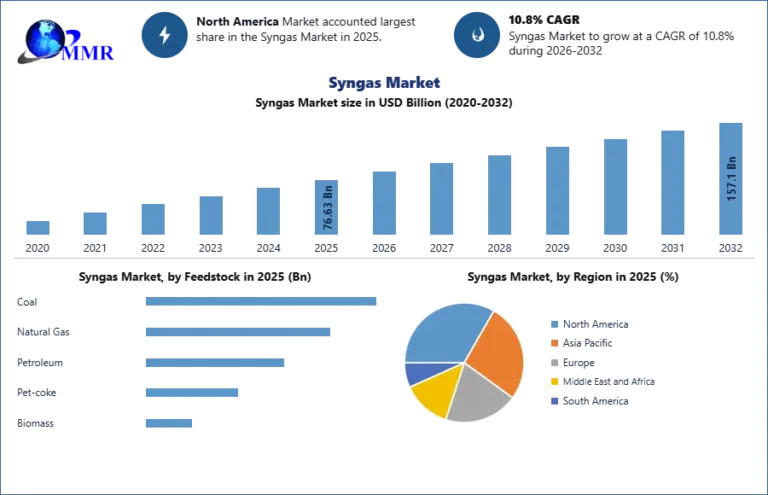
Global Market Scale and Valuation: Global Syngas Market valued at USD 76.63 Billion in 2025.
-
Forward Projection: Projected to scale steadily to USD 157.11 Billion by 2032, advancing at a 10.8% CAGR.
-
Structural Cost Reconfiguration: Advancements in membrane technology for $H_2$ and $CO_2$ separation are driving a 30% reduction in synthesis gas generation costs, significantly altering upstream refining margins.
-
Segment Leadership: The chemical application domain—primarily processing synthesis gas into bulk methanol, DME, and ammonia building blocks—held a dominant market share, running the absolute baseline of aggregate polymer and fertilizer demand.
-
Supply Chain Bottlenecks: Heavy industrial configurations rely directly on high-capital gasification reactors and intensive air separation units, leaving localized projects exposed to extended payback periods and high upfront investment barriers.
-
Key Regional Locomotive: The Asia-Pacific region dominated the global marketplace, driven by abundant coal-to-chemical corridors and massive municipal infrastructure mandates across China and India.
Why This Matters Now
Global chemical processing groups and industrial energy procurement teams can no longer view synthesis gas through the lens of simple legacy processing byproducts. For boardroom executives, infrastructure planners, and large-scale manufacturing buyers, the syngas network represents a critical component under intense supply-chain and regulatory pressure. The rapid transition toward modern zero-emission hydrogen economies and localized synthetic natural gas (SNG) loops requires immediate volume optimization. Production complexes that successfully balance volatile coal and natural gas feedstock prices with rising volume mandates will protect their structural margins. Meanwhile, legacy distribution networks that fail to implement efficient, low-energy gasification methods risk facing rising operational costs and sudden raw material supply shocks.
Market Overview
The Global Syngas Market is evolving from basic, captive oil-refinery stream processing into a highly specialized material segment split between high-volume synthetic transport fuels and foundational agricultural chemical intermediates. Achieving a baseline valuation of USD 76.63 Billion in 2025, the industry’s projected expansion to USD 157.11 Billion by 2032 underscores a global corporate reliance on process versatility, energy security, and cost-effective material substitution. As a primary alternative to traditional petroleum distillates, synthesis gas is actively displacing legacy hydrocarbon substrates in automated manufacturing setups due to its inherent compatibility with diverse feedstocks like natural gas, biomass, and low-value coal residues.
Advanced chemical engineering and integrated compounding configurations are fundamentally altering the basic overhead costs of the industry. Processing facilities are implementing advanced gasification catalysts and highly automated fluidized bed setups to maintain long operational runs without risking thermal fouling or catalyst degradation during high-temperature gasification cycles. These continuous processing updates, combined with a significant industry shift toward large-scale modular production units, enable chemical compounding plants to maximize total volume yields. This operational evolution ensures full compliance with strict cross-border industrial validation terms and technical delivery standards.
Key Trends Driving Growth
The systematic displacement of traditional petroleum fuels by heavy-duty synthetic natural gas (SNG), CNG, and LNG networks serves as a powerful growth engine. Municipal engineering teams prioritize automated gasification systems because they provide extended service lifespans and lower direct emission profiles across high-density urban infrastructure grids.
Rapid expansion within international agricultural manufacturing facilities drives significant volume demand for specialized, high-purity ammonia and urea lines. Fertilizer product engineering teams rely on syngas-derived hydrogen compounds to manufacture critical agricultural inputs where high-volume chemical integrity remains mandatory.
Escalating investment in regional hydrogen fuel networks and localized power grids creates a steady pipeline of specialized steam reforming and separation orders. The concentration of high-voltage sub-surface power cables and blue hydrogen distribution systems within modern industrial parks amplifies the continuous operational demand for high-efficiency gasification layouts and durable gas separation assemblies.
Furthermore, shifting consumer preferences and rising ecological awareness force global operators to transition toward alternative, renewable feedstocks such as lignocellulosic biomass and captured carbon dioxide ($CO_2$) hydrogenation loops. This structural shift drives manufacturing organizations to invest heavily in modern mechanical recycling equipment and alternative, energy-efficient production processes to limit their overall carbon footprints and reduce historical dependencies on direct fossil fuel feedstocks.
Segment Insights
-
Dominant Application Segment: Chemicals & Synthetic Fuel Production. Controlling the vast majority of global volume demand due to its critical integration into downstream methanol, DME, and ammonia fertilizer synthesis, this segment remains the central financial driver of the industry. Major buyers include public utility groups, global chemical conglomerates, and automated structural fertilizer manufacturers.
-
Critical Technology Segments: Gasification and Steam Methane Reforming (SMR). SMR setups generate the fastest infrastructure deployment rates due to low-cost natural gas extraction, while commercial gasification technologies command total volume dominance in heavy coal-and-biomass processing zones.
Regional Growth Story
The Asia-Pacific region maintains absolute volume dominance in the global marketplace, driven by massive manufacturing expansions and extensive urban infrastructure modernization programs across China and India. Local development initiatives focused on extensive clean synthetic gas networks and the rapid expansion of localized automotive and chemical clusters make the region the primary destination for top-tier global synthesis gas brands.
North America holds a substantial share of advanced, high-value shale-derived synthesis gas revenue, supported by a mature manufacturing base and a highly integrated network of petrochemical refineries. The United States market benefits from large-scale extraction operations, structured utility modernization programs, and strong corporate adoption patterns that prioritize low-cost natural gas feedstocks to optimize processing margins.
In Europe, industry development is heavily shaped by strict regional sustainability mandates and changing chemical safety frameworks. European syngas manufacturers focus on optimizing closed-loop carbon capture recycling loops and developing biomass-to-liquid formulas to satisfy regional environmental testing rules. Meanwhile, precision petrochemical manufacturing clusters in the Middle East continue to pioneer advancements in high-volume, feedstock-optimized gasification architectures and specialized industrial fuel exports.
Competitive Landscape
The global competitive profile features a highly consolidated mix of multinational chemical conglomerates and specialized gas processing brands. Top-tier industry organizations rely on massive manufacturing scale, integrated upstream raw feedstock assets, and extensive international logistics lines to secure multi-year volume contracts with global industrial chemical distributors.
To insulate their operational margins from volatile petroleum and coal costs, leading producers focus on vertical asset integration and the optimization of large-scale manufacturing centers. Prominent global enterprises—including Shell plc, Air Liquide, Air Products and Chemicals, Inc., Sasol, and Topsoe—maintain dominant international supply routes. These major players deploy licensed formulation systems to deliver application-specific synthesis gas mixtures directly to industrial conversion lines worldwide.
Smaller regional compounding facilities and localized independent suppliers capture targeted market share by providing custom gas ratios, specialized catalytic blending, and flexible shipping timelines. By serving localized automotive and consumer packaging clusters, these mid-sized organizations remain critical supply chain partners for domestic manufacturing plants.
Recent Developments
-
Cross-Border Supply Infrastructure Optimization (2025–2026): Major international chemical corporations complete significant manufacturing upgrades at their primary production sites, optimizing synthesis gas outputs to shield downstream chemical processing lines from raw material shortages.
-
Advanced Membrane Separation Technology Scaled (Late 2025): Top-tier industrial gas developers finalize massive refinery expansions featuring high-efficiency hydrogen separation modules, cutting total syngas production costs by roughly 30%.
-
High-Efficiency Carbon-Reduction Processing Deployed (Early 2026): Leading chemical technology suppliers introduce automated, low-energy gasifier modules designed to integrate directly into existing chlor-alkali and power lines, lowering power consumption during heavy manufacturing runs.
-
Regional Specialty Compounding Acquisitions Concluded (2026): Prominent global polymer and energy brands complete strategic asset buyouts of localized compounding specialist businesses, securing direct access to high-performance synthetic fuel networks.
Strategic Implications
For high-volume methanol synthesis plants, automated cable insulation facilities, and precision chemical device manufacturers, maintaining a resilient and monitored synthesis gas supply chain represents an absolute business priority. Production groups must establish long-term volume agreements and optimize inventory strategies to protect delicate manufacturing schedules from sudden upstream raw material or feed extraction interruptions.
National industrial development authorities must view domestic chemical compounding facilities and regional polymer logistics networks as vital pillars of economic durability. Governments that establish clear, uniform quality testing frameworks and provide upfront structural incentives for energy-efficient production methods will successfully attract premium chemical manufacturing investments while protecting regional industrial stability.
Future Outlook
The next competitive era will belong to synthesis gas operators who successfully combine absolute manufacturing scale with bio-attributed or highly alternative biomass configurations. Corporate structures that direct their long-term development spending toward alternative renewable feedstocks, advanced mechanical separation lines, and energy-efficient gasification processing methods will lock in high-volume distribution contracts in tomorrow’s circular economy. Conversely, unhedged component suppliers that stick to unmonitored legacy fossil-fuel processing routes will face falling profit margins and shrinking access to modern sustainable building and infrastructure projects.
Analyst Perspective
“The global syngas market is entering an era defined by non-negotiable smart integration and predictive processing rules,” says Ankita Kagwade, Analyst at Maximize Market Research. “While traditional liquid and gas separation steps continue to secure huge, reliable baseline order volumes, future value expansion is shifting rapidly toward data-connected systems and verified sustainable filter designs. With the global market scaling toward USD 157.11 Billion by 2032, long-term commercial leadership belongs to producers who embed real-time condition sensors directly into their products. Moving beyond basic component replacements and moving toward automated, performance-driven resource management is now essential for defending processing margins in an increasingly regulated global manufacturing landscape.” – Ankita Kagwade
About Maximize Market Research
Maximize Market Research Pvt. Ltd. (MMR) is a global market research and consulting company that provides reliable, data-focused, and practical business insights. The firm serves a wide range of industries, including healthcare, pharmaceuticals, technology, automotive, electronics, chemicals, personal care, and consumer goods. Through market forecasts, competitive analysis, strategic consulting, and industry impact assessments, MMR helps organizations understand changing market conditions, identify growth opportunities, and make informed business decisions for long-term success.
2nd Floor, Navale IT Park Phase 3
Pune Bangalore Highway, Narhe
Pune, Maharashtra 411041, India
+91 9607365656