Key Highlights
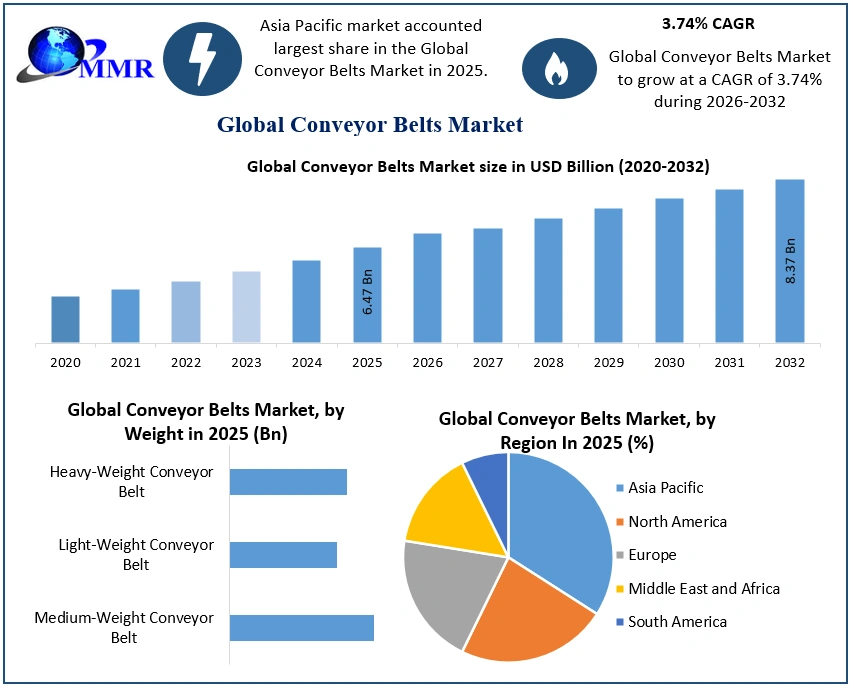
- Market valued at USD 6.47 billion in 2025.
- Forecast to reach USD 8.37 billion by 2032.
- CAGR estimated at 3.74% during 2026–2032.
- Asia-Pacific remained the largest regional market.
- Mining and metallurgy dominated end-user demand.
- Medium-weight conveyor belts held the largest share by weight category.
- Metal-reinforced rubber conveyor belts led product demand.
- Automation investments continue expanding conveyor adoption across manufacturing and logistics.
Why This Matters Now
Manufacturers, mining operators and logistics companies are investing heavily in automation to improve productivity and reduce operating costs. Conveyor belts have become essential infrastructure rather than supporting equipment, enabling continuous production, faster warehouse operations and efficient bulk material transport. Companies capable of delivering durable, low-maintenance conveyor solutions are well positioned to benefit from long-term industrial modernization.
Market Overview
The Conveyor Belts Market supplies material handling systems used across mining, manufacturing, ports, logistics, power generation, aviation and industrial processing. Conveyor belts improve operational efficiency by enabling continuous movement of raw materials, components and finished products with minimal manual intervention.
Growing industrial automation remains the primary demand driver. Manufacturers are expanding automated production lines, while warehouses increasingly deploy conveyor systems to support high-volume order fulfillment. Mining companies continue investing in heavy-duty conveyor networks to transport bulk materials across large operating sites.
Supply demand remains supported by expanding industrial output across emerging economies. At the same time, rising installation, maintenance and repair costs continue limiting adoption among small and medium-sized enterprises.
Urbanization, infrastructure development and increasing manufacturing investment across Asia continue strengthening long-term demand for industrial conveyor systems.
Key Trends Driving Growth
Industrial Automation Accelerates Demand
Manufacturers are integrating conveyor systems with automated production equipment to improve throughput, reduce labor dependency and minimize operational downtime. This increases demand for intelligent conveyor solutions capable of supporting modern manufacturing environments.
Mining Sector Maintains Strong Investment
Mining companies continue expanding conveyor infrastructure to reduce transportation costs and improve operational efficiency. Long-distance material movement remains one of the largest commercial applications for conveyor belts.
Sustainable Conveyor Technologies
Manufacturers are introducing energy-efficient and environmentally friendly conveyor systems that reduce power consumption and operating costs. Sustainability initiatives are increasingly influencing procurement decisions across industrial facilities.
Demand for High-Durability Materials
Industrial users increasingly prefer metal-reinforced conveyor belts due to superior tensile strength, wear resistance and longer operating life, reducing maintenance frequency and lifecycle costs.
Expanding Global Manufacturing
Manufacturing relocation toward Asia-Pacific continues driving conveyor installations across automotive, electronics, food processing and consumer goods industries, strengthening regional production capacity.
Explore detailed analysis, insights, and growth opportunities
Segment Insights
Dominant Segment: Mining and Metallurgy
Mining and metallurgy remained the largest end-user segment in 2025.
Conveyor belts are essential for transporting ore, coal, aggregates and minerals efficiently over long distances while reducing operational costs compared with conventional transportation methods.
The business impact is substantial because conveyor systems improve productivity, lower fuel consumption and support continuous mining operations. As mining investments expand globally, equipment suppliers continue benefiting from replacement demand and new project installations.
Fastest-Growing Segment: Manufacturing
Manufacturing is expected to remain one of the fastest-expanding application segments.
Industrial automation, smart factories and warehouse modernization are increasing conveyor deployment across production facilities. Manufacturers require systems capable of handling heavy workloads while supporting flexible production layouts and high-speed operations.
This trend creates recurring demand for advanced conveyor technologies with improved durability, modularity and automation compatibility.
Additional Key Segments
Metal-Reinforced Rubber Conveyor Belts
Metal-reinforced rubber conveyor belts lead the product category due to exceptional tensile strength, low elongation and superior resistance to continuous industrial stress.
These systems are particularly valuable in mining, heavy manufacturing and large-scale processing facilities where operational reliability directly affects production efficiency.
Medium-Weight Conveyor Belts
Medium-weight conveyor belts account for the largest share by weight category.
Their versatility allows deployment across food processing, retail logistics and manufacturing environments. Modular configurations improve maintenance efficiency while supporting complex conveyor layouts and automated production systems.
Cover Types
Abrasion-resistant, heat-resistant, oil-resistant and conductive conveyor belts continue serving specialized industrial applications. Growing industrial diversification is increasing demand for application-specific belt designs capable of operating under extreme environmental conditions.
Regional Growth Story
Asia-Pacific
Asia-Pacific remained the largest regional market and is expected to deliver the strongest growth through 2032.
Rapid industrialization, expanding manufacturing capacity and increasing automation investments continue strengthening regional demand. China, India, Japan and Southeast Asian economies remain major production and consumption centers for conveyor systems.
North America
North America benefits from extensive mining operations and advanced manufacturing facilities.
States including Ohio, Montana, Arizona and Utah continue supporting conveyor demand through mining activities, while warehouse automation and industrial modernization further strengthen equipment investment across the region.
Europe
Europe maintains a strong position through engineering excellence, industrial automation expertise and export-oriented manufacturing. Germany remains an important exporter of conveyor belt technologies, reinforcing regional competitiveness.
Middle East, Africa and Latin America
Infrastructure expansion, mining development and industrial diversification continue creating new opportunities across emerging markets. Investment in ports, power generation and resource extraction supports gradual market expansion.
Competitive Landscape
The market remains moderately consolidated, with global engineering companies competing alongside specialized conveyor manufacturers. Competition increasingly centers on automation integration, durability, lifecycle cost reduction and customized industrial solutions.
Leading companies including Siemens AG, TGW Logistics Group, Emerson Electric Co., Intelligrated, Daifuku Co. Ltd., Interroll Holding GmbH, Vanderlande Industries B.V., Taikisha Ltd., Fives, Swisslog, Bando Chemical Industries, Bridgestone, ContiTech, Fenner, Yokohama, Goodyear, Qingdao Rubber, Zhejiang Double Arrow, Nitta Corporation and Ammeraal Beltech continue strengthening market positions through engineering innovation and global manufacturing capabilities.
Large automation providers increasingly integrate conveyor technologies into complete warehouse and factory automation solutions, while specialized belt manufacturers focus on high-performance materials that reduce maintenance costs and extend operational life. This convergence between automation software and material handling equipment is reshaping competitive dynamics across the industry.
Recent Developments
According to the provided MMR report, no specific recent developments such as product launches, acquisitions, partnerships or facility expansions have been disclosed for the Conveyor Belts Market. The report primarily highlights competitive positioning, regional expansion opportunities and market dynamics.
Future Outlook
Manufacturers that combine intelligent automation capabilities with durable, energy-efficient conveyor technologies will secure the strongest competitive advantage as global industries continue modernizing material handling operations.
Analyst Perspective Ankita kagawade
The Bioactive Materials Market is entering a phase where clinical performance is becoming a stronger competitive differentiator than conventional implant durability. Healthcare providers are increasingly adopting materials that actively support bone regeneration, tissue integration, and faster patient recovery, creating sustained demand across orthopedics, dentistry, and regenerative medicine. Bioactive glass and advanced ceramic technologies are expected to remain at the forefront of innovation due to their proven biological compatibility and expanding clinical applications.
About Maximize Market Research
Maximize Market Research Pvt. Ltd. (MMR) is a global market research and consulting company that provides reliable, data-focused, and practical business insights. The firm serves a wide range of industries, including healthcare, pharmaceuticals, technology, automotive, electronics, chemicals, personal care, and consumer goods. Through market forecasts, competitive analysis, strategic consulting, and industry impact assessments, MMR helps organizations understand changing market conditions, identify growth opportunities, and make informed business decisions for long-term success.
Contact Us :
2nd Floor, Navale IT Park Phase 3
Pune Banglore Highway, Narhe
Pune, Maharashtra 411041, India
+91 9607365656
[email protected]