Key Highlights
- Rising focus on hygiene infrastructure in public and commercial spaces is reshaping facility planning priorities
- Demand for family-friendly amenities is increasing across retail, hospitality, and transportation hubs
- Institutional adoption is strengthening as compliance and accessibility standards evolve
- Public restroom modernization projects are driving steady equipment installation demand
- Safety, durability, and ease of maintenance remain central purchasing criteria
- Urban infrastructure development is expanding installation opportunities
- Manufacturers are focusing on compact, space-efficient designs
- Commercial real estate developers are integrating childcare-friendly infrastructure into design frameworks
Why This Matters Now
Public infrastructure is entering a design reset. Restrooms are no longer treated as utility spaces. They are becoming experience-driven environments tied to safety, hygiene, and inclusivity.
Baby changing stations sit at the center of this shift. They are no longer optional fixtures in premium facilities. They are becoming baseline expectations in modern commercial, transport, and hospitality infrastructure. Developers and operators that delay upgrades risk reputational friction and compliance pressure.
Market Overview
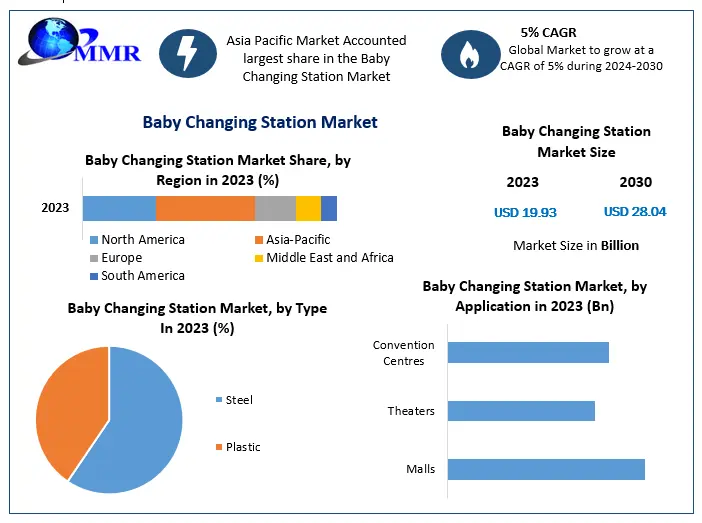
The Baby Changing Station Market is evolving alongside global upgrades in public hygiene infrastructure and commercial facility modernization. Demand is increasingly linked to how urban environments accommodate families in high-traffic public spaces.
Commercial developers, institutional facility managers, and public infrastructure planners are incorporating dedicated childcare-friendly amenities into restrooms. This reflects a broader shift toward inclusive infrastructure design, where accessibility extends beyond mobility to caregiving needs.
The market is shaped by functional requirements rather than discretionary adoption. Installations are driven by regulatory standards, building codes, and expectations of safety and hygiene in shared environments. As a result, procurement decisions increasingly prioritize durability, material quality, and compliance alignment.
Key Trends Driving Growth
Hygiene consciousness is one of the strongest structural drivers. Public spaces are under increasing scrutiny for cleanliness standards, particularly in high-footfall environments such as malls, airports, hospitals, and transport stations.
Family-centric infrastructure planning is becoming more visible in commercial real estate development. Developers are responding to consumer expectations that public spaces should support caregivers, not exclude them. Baby changing stations are becoming part of a broader “family accessibility layer” in building design.
Material innovation is also shaping procurement decisions. Stainless steel and high-durability polymer designs are gaining preference due to ease of cleaning and long service life. Maintenance efficiency is becoming as important as installation cost in long-term asset planning.
Space optimization is another emerging factor. Urban infrastructure constraints are pushing demand for compact and foldable designs that can be integrated into small restroom layouts without compromising usability.
Institutional adoption is expanding beyond traditional retail and hospitality sectors. Healthcare facilities, educational institutions, and transport infrastructure projects are increasingly standardizing baby care amenities as part of facility planning norms.
𝐃𝐨𝐰𝐧𝐥𝐨𝐚𝐝 𝐏𝐃𝐅 𝐁𝐫𝐨𝐜𝐡𝐮𝐫𝐞 @ https://www.maximizemarketresearch.com/request-sample/146312/
Segment Insights
- Dominant Segment: The report does not explicitly disclose a dominant segment. However, adoption is broadly concentrated in commercial infrastructure environments such as retail, hospitality, and public facilities where high footfall drives installation demand.
- Fastest-Growing Segment: The report does not specify a fastest-growing segment. However, growth momentum is strongly associated with modernization of public infrastructure and expansion of family-friendly commercial spaces.
- Application Areas:
- Commercial establishments
- Public infrastructure facilities
- Institutional buildings
- Healthcare environments
- Transportation hubs
- Product Types:
- Wall-mounted baby changing stations
- Surface-mounted units
- Vertical and horizontal configurations
- Compact space-saving designs
The structural insight is that value creation is shifting toward standardized deployment in mid-tier commercial infrastructure rather than limited premium-only adoption.
Regional Growth Story
Urban development is the primary regional driver of adoption. High-density cities are prioritizing public facility upgrades as part of broader infrastructure modernization programs.
Developed markets are leading adoption due to stricter hygiene regulations and established expectations around public restroom standards. These regions tend to integrate baby changing stations as standard building requirements rather than optional amenities.
Emerging markets are witnessing gradual expansion as commercial real estate development accelerates. Shopping malls, airports, and hospitality projects are increasingly incorporating family-friendly infrastructure to align with global facility benchmarks.
The regional trajectory suggests convergence. Public space design standards are becoming more uniform globally, driven by rising expectations for hygiene and inclusivity.
Competitive Landscape
Competition in the Baby Changing Station Market is increasingly defined by product durability, compliance alignment, and installation flexibility rather than brand differentiation alone.
Manufacturers are focusing on corrosion resistance, anti-bacterial surface technologies, and modular designs that simplify maintenance. This signals a shift toward lifecycle performance as a primary competitive metric.
For rivals, the competitive pressure is shifting downward into mid-tier commercial segments. Companies that once focused on premium institutional contracts are now competing in broader commercial infrastructure projects where price sensitivity is higher but volume potential is larger.
Over the next 12 to 24 months, competition is expected to intensify around smart facility integration, including designs compatible with automated restroom monitoring systems and hygiene compliance tracking. Firms unable to adapt to these infrastructure expectations may lose share to more agile manufacturers.
Recent Developments
- Increased integration of hygiene-focused materials in product design
- Expansion of compact and foldable baby changing station models
- Growing adoption in transport infrastructure projects
- Rising incorporation into retail and hospitality redevelopment plans
- Enhanced focus on durability and long-life product engineering
- Standardization of family-friendly restroom amenities in modern building codes
Strategic Implications
Manufacturers must reposition baby changing stations as infrastructure assets rather than auxiliary restroom fixtures. Procurement is increasingly tied to long-term building performance, not short-term installation cost.
Commercial developers should treat family-friendly amenities as part of tenant experience strategy. These installations directly influence customer satisfaction, dwell time, and brand perception in retail environments.
Public infrastructure planners face growing pressure to standardize accessibility features across facilities. Inconsistent adoption risks reputational gaps between regions and facility types.
The most important shift is commercial scale. What was once a niche facility upgrade is becoming a baseline requirement in modern infrastructure design frameworks.
Future Outlook
The Baby Changing Station Market is moving toward standardization across global public and commercial infrastructure. Adoption will expand as hygiene expectations, urban density, and family-centric design principles converge.
The industry’s future will be shaped by manufacturers that can deliver durable, compliant, and space-efficient solutions at scale. Companies that fail to align with infrastructure modernization cycles will be displaced by those that embed themselves into long-term facility planning ecosystems.
Winners will treat baby changing stations as essential urban infrastructure components. Losers will continue treating them as optional restroom accessories in a market that has already moved beyond that definition.
Analyst Perspective
“Baby changing stations are becoming a core component of modern public infrastructure design. The shift toward hygiene-focused, family-inclusive spaces is creating sustained demand across commercial and institutional environments.”
— Siddhi Dhole, Research Analyst
About Maximize Market Research
Maximize Market Research Pvt. Ltd. (MMR) is a global market research and consulting company that provides reliable, data-focused, and practical business insights. The firm serves a wide range of industries, including healthcare, pharmaceuticals, technology, automotive, electronics, chemicals, personal care, and consumer goods. Through market forecasts, competitive analysis, strategic consulting, and industry impact assessments, MMR helps organizations understand changing market conditions, identify growth opportunities, and make informed business decisions for long-term success.
2nd Floor, Navale IT Park Phase 3
Pune Banglore Highway, Narhe
Pune, Maharashtra 411041, India
+91 9607365656
[email protected]