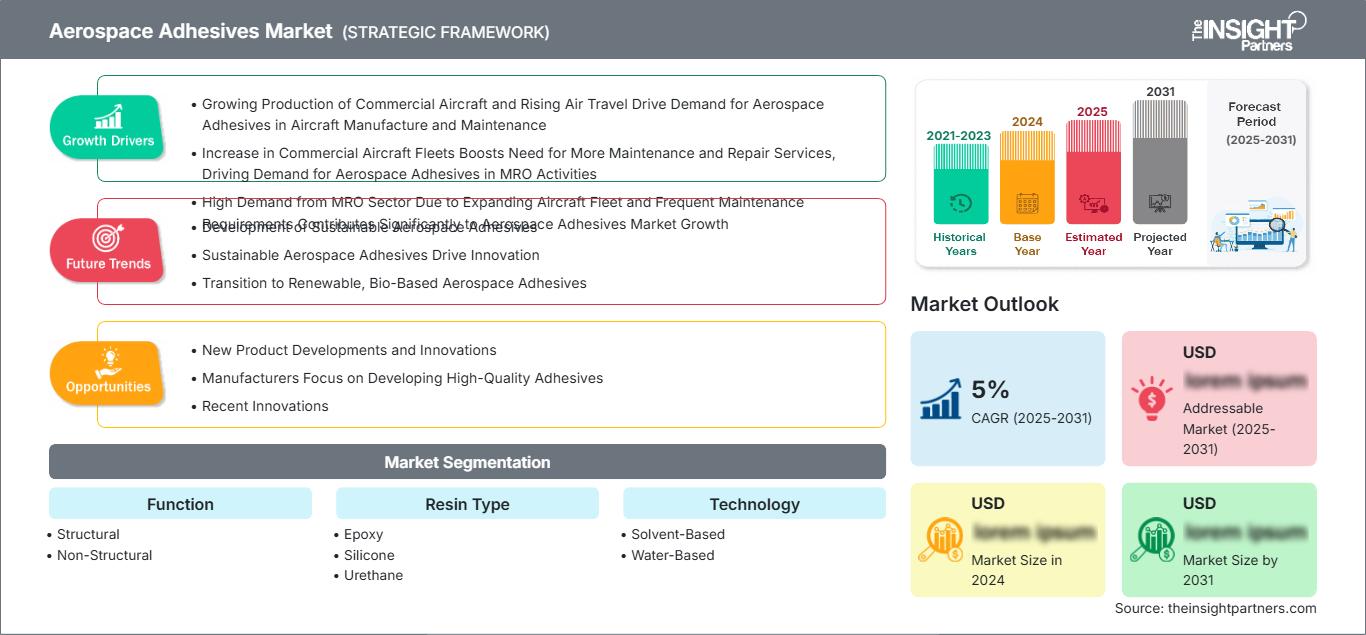
Aircraft are getting lighter, faster, and more fuel-efficient. Achieving that requires materials that bond strongly without adding weight. Aerospace adhesives are critical to that goal, replacing rivets and mechanical fasteners across airframes, interiors, and engine components. Aerospace Adhesives Market Size is expected to reach US$ 1,492.5 Million by 2034 from US$ 1,036.22 Million in 2025. The market is anticipated to register a CAGR of 4.67% during the forecast period 2026–2034.
What Are Aerospace Adhesives?
Aerospace adhesives are high-performance bonding and sealing compounds designed to withstand extreme temperature, pressure, vibration, and chemical exposure in aviation environments. They include structural adhesives and sealants used across aircraft assembly, maintenance, and repair operations. Key resin types include epoxy, silicone, polyurethane, and other speciality chemistries.
Request a Sample Copy of the Report: https://www.theinsightpartners.com/sample/TIPRE00005757
What Is Driving the Aerospace Adhesives Market?
Commercial aviation recovery is the primary growth driver. Air travel demand has rebounded strongly since 2022 and continues to grow, particularly across Asia Pacific and the Middle East. Aircraft manufacturers are ramping up production to clear large order backlogs. Boeing and Airbus together hold thousands of unfilled orders. Every new aircraft built requires substantial quantities of structural adhesives and sealants. This production ramp is generating consistent, long-term demand across the aerospace adhesives supply chain.
Lightweighting is a second powerful force. Airlines face intense pressure to cut fuel costs and meet carbon emission reduction targets. One of the most effective ways to reduce aircraft weight is to replace metal fasteners with adhesive bonds. Structural epoxy adhesives can carry the same loads as rivets at a fraction of the weight. Composite airframe structures, which now account for more than half the weight of modern narrowbody and widebody aircraft, depend on adhesive bonding for assembly and repair.
Military aviation is adding steady demand. Defence budgets are rising across NATO countries, the United States, and several Asian nations. New fighter programmes, transport aircraft, and unmanned aerial vehicles all use advanced adhesive systems. Military specifications often demand higher performance than commercial grades, driving premium pricing and sustained investment in product development from aerospace adhesive suppliers.
Maintenance, Repair and Overhaul is a large and resilient demand channel. The global commercial fleet numbers more than 25,000 aircraft. Each one requires regular maintenance, and adhesive and sealant consumption in MRO operations is substantial. Sealants for fuel tanks, windows, and pressurised structures must be replaced on a defined maintenance cycle. This creates a recurring revenue stream that is independent of new aircraft production volumes.
General aviation is a smaller but growing segment. Business jets, turboprops, and light aircraft are all seeing increased production as corporate travel and private aviation expand. These aircraft use a full range of adhesive and sealant systems, and the segment adds incremental volume to the overall market.
Segmentation Overview
By Type: Adhesives account for the larger share, used across structural bonding, panel assembly, and interior fitting applications. Sealants serve critical roles in fuel system sealing, pressurisation, and weather protection.
By Resin Type: Epoxy dominates due to its exceptional strength, chemical resistance, and compatibility with composite substrates. Silicone sealants are preferred for high-temperature applications around engines and exhaust systems. Polyurethane offers flexibility and impact resistance for interior and secondary structural applications. Other resin types address specialist performance requirements.
By Technology: Solvent-based systems remain widely used in MRO applications. Water-based technologies are gaining ground as environmental regulations tighten. Other technologies include film adhesives and paste systems used in primary structural bonding.
By User Type: Original Equipment Manufacturers account for the largest share by value. MRO is the largest segment by frequency of use and represents a stable, recurring demand base.
By End-Use Industry: Commercial aviation leads by volume. Military aviation commands premium pricing. General aviation contributes consistent growth.
By Aircraft Type: Single aisle aircraft, including the Boeing 737 and Airbus A320 families, consume the highest volumes due to their production rates. Wide body and regional jet programmes add significant additional demand.
Key Market Players
- 3M
- Arkema
- Huntsman Corporation
- Henkel AG
- Solvay SA
- H.B. Fuller
- PPG Industries
- Illinois Tool Works Inc.
- Lord Corporation
- Hexcel Corporation
Henkel, 3M, and Solvay are among the most established names in aerospace adhesive supply, with broad portfolios covering structural bonding, sealants, and surface treatments. Lord Corporation, now part of Parker Hannifin, brings deep expertise in vibration-damping and structural adhesive systems. Hexcel is a leading supplier of film adhesives used in composite sandwich structures for both commercial and military aircraft.
Sustainability and Innovation Trends
Sustainability is reshaping the aerospace adhesives sector. Solvent-based systems are being reformulated to reduce VOC emissions in both manufacturing and MRO environments. Water-based and film adhesive technologies are advancing rapidly to fill the performance gap. Chromate-free primers and adhesion promoters are replacing hexavalent chromium-based systems in response to REACH regulations in Europe and similar restrictions elsewhere.
Bio-derived epoxy resins are under active development by several major suppliers. These use plant-based feedstocks to partially replace petroleum-derived components. While still in early commercialisation, they represent a clear direction of travel as aerospace OEMs set ambitious supply chain sustainability targets for the coming decade.
Buy Premium Report: https://www.theinsightpartners.com/buy/TIPRE00005757
Regional Outlook
North America is the largest regional market, home to Boeing’s major production facilities and a dense base of defence contractors and MRO operators. The United States accounts for the dominant share of both OEM and MRO adhesive consumption. Europe is the second-largest region, led by Airbus production in France, Germany, and the UK, along with a strong network of defence and business aviation manufacturers. Asia Pacific is the fastest-growing region. China, Japan, South Korea, and India are all expanding domestic aircraft manufacturing capability and operating large and growing commercial fleets that generate MRO demand. South and Central America contribute through regional airline MRO operations and emerging defence aviation investment.
Related Reports:
Fiber Reinforced Polymer (FRP) Panels and Sheets Market
High Temperature Composite Resin Market
About The Insight Partners
The Insight Partners is among the leading market research and consulting firms in the world. We take pride in delivering exclusive reports along with sophisticated strategic and tactical insights into the industry. Reports are generated through a combination of primary and secondary research, solely aimed at giving our clientele a knowledge-based insight into the market and domain. This is done to assist clients in making wiser business decisions. A holistic perspective in every study undertaken forms an integral part of our research methodology and makes the report unique and reliable.
Contact Us:
If you have any queries about this report or if you would like further information, please contact us:
Phone: +1-646-491-9876
E-mail: [email protected]
Also Available in: Korean | German | Japanese | French | Chinese | Italian | Spanish