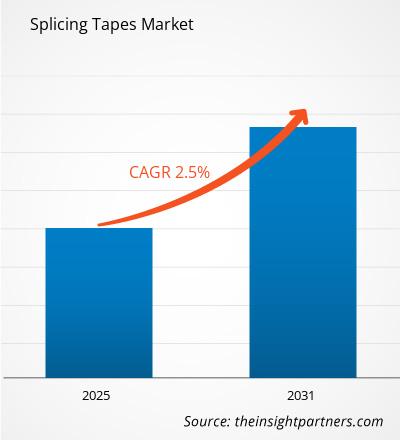
Modern manufacturing runs fast. Machines cannot stop every time a roll of paper, film, or label stock runs out. The Splicing Tapes Market is growing steadily as industries demand faster, cleaner, and more reliable roll changes across high-speed production lines. Splicing Tapes Market Size is expected to reach US$ 1.99 Billion by 2034 from US$ 1.3 Billion in 2025. The market is anticipated to register a CAGR of 5.48% during the forecast period 2026–2034.
What Are Splicing Tapes?
Splicing tapes are pressure-sensitive adhesive tapes used to join the tail of a finishing roll to the start of a new one without stopping a production line. They must bond instantly, hold under tension, and release no residue that could contaminate the product or foul the machinery. They are used in paper mills, printing presses, packaging lines, electronics assembly, and labelling operations.
Request a Sample Copy of the Report: https://www.theinsightpartners.com/sample/TIPRE00005359
What Is Driving the Splicing Tapes Market?
Packaging is the largest end-use driver. Global e-commerce growth has pushed packaging volumes to record levels. Flexible packaging lines run faster than ever, and any unplanned stoppage costs money. Splicing tapes allow roll changes at full line speed, cutting downtime to zero. As packaging manufacturers invest in faster equipment, the performance demands on splicing tape also rise, creating a steady upgrade cycle.
Paper and printing is another high-volume segment. Newspaper presses, magazine printers, and commercial offset facilities all rely on flying splices to maintain throughput. Digital printing is growing too, and web-fed digital presses use the same roll-change discipline as offset machines. Even as print volumes shift, the need for reliable splicing solutions remains strong across the sector.
Electronics manufacturing is a fast-growing application. Flexible circuits, battery electrode films, and display component films are all produced in roll-to-roll processes. These are precision operations where even minor tape failures cause expensive defects and material waste. Acrylic and silicone-based splicing tapes offer the cleanliness and temperature resistance that electronics producers need. As EV battery production scales globally, demand from this segment is rising quickly.
Labelling rounds out the key application areas. Label converters run high-speed printing and die-cutting lines that go through label stock at pace. Splicing tapes let them change rolls without halting the line or wasting expensive label material. Growth in pharmaceutical and food labelling, driven by tighter traceability regulations, is adding consistent volume demand.
So what makes acrylic-based splicing tapes the preferred choice across so many applications? Acrylic adhesives offer excellent temperature resistance, long shelf life, and compatibility with a wide range of substrates. They also age well in storage, which matters for converters who keep tape stock on hand. These practical advantages have made acrylic the dominant resin type in the market.
Segmentation Overview
By Resin Type: Acrylic holds the largest share, prized for its broad substrate compatibility, temperature resistance, and clean removal. Rubber-based tapes offer high initial tack and are used in lower-temperature applications. Silicone tapes serve high-temperature and specialty electronics applications. Other resin types address niche industrial needs.
By Backing Material: PET/Polyester backing dominates in precision and high-speed applications due to its dimensional stability and tensile strength. Paper and tissue backings are used in standard printing and packaging splices. Non-woven backings provide conformability for curved or irregular surfaces. Other backing materials serve specific technical requirements.
By Application: Paper and Printing and Packaging together account for the largest combined share. Electronics is the fastest-growing segment. Labelling contributes steady demand. Other applications include textile manufacturing and specialty industrial roll-to-roll processes.
Key Market Players
- 3M
- ACE Tech Korea Co., Ltd.
- Adhesive Research, Inc.
- American Biltrite Inc.
- Avery Dennison Corporation
- ECHOtape
- Nitto Denko Corporation
- Orafol Europe GmbH
- Scapa Group Plc
- tesa SE
3M, Nitto Denko, and tesa SE bring deep adhesive technology expertise and global distribution reach. Avery Dennison is particularly strong in labelling and packaging applications. Adhesive Research and Scapa Group serve precision and specialty segments with engineered tape solutions. Regional players such as ACE Tech Korea are growing their presence in Asian electronics and packaging markets.
Sustainability and Innovation Trends
Sustainability is pushing tape manufacturers to rethink their products. Solvent-based adhesive systems are giving way to waterborne and UV-curable alternatives that cut VOC emissions without sacrificing bond performance. Recyclable and compostable backing materials are under active development for use in paper and packaging applications where end-of-life material separation matters.
On the innovation side, double-sided flying splice tapes with precision pre-cut tab systems are reducing splice preparation time on high-speed lines. Thin, ultra-conformable backings are improving splice quality on film substrates where tape thickness creates defects downstream. Manufacturers are also developing tapes with built-in detection features, such as colour contrast or metallic elements, that allow automated vision systems to locate and verify splices on the production line.
Buy Premium Report: https://www.theinsightpartners.com/buy/TIPRE00005359
Regional Outlook
Asia Pacific is the largest and fastest-growing regional market. China, Japan, South Korea, and India all have large printing, packaging, and electronics manufacturing bases that consume splicing tapes in high volumes. The region’s rapid EV battery production expansion is creating additional demand in precision roll-to-roll applications. Europe is a mature market with strong demand from Germany, France, and the Nordics across printing, flexible packaging, and specialty converting. North America shows steady growth, led by packaging, pharmaceutical labelling, and electronics manufacturing. South and Central America contribute growing demand, with Brazil’s packaging and printing industries driving the bulk of regional consumption.
Related Reports:
Thermal Lamination Films Market
Anti-reflective Coatings Market
About The Insight Partners
The Insight Partners is among the leading market research and consulting firms in the world. We take pride in delivering exclusive reports along with sophisticated strategic and tactical insights into the industry. Reports are generated through a combination of primary and secondary research, solely aimed at giving our clientele a knowledge-based insight into the market and domain. This is done to assist clients in making wiser business decisions. A holistic perspective in every study undertaken forms an integral part of our research methodology and makes the report unique and reliable.
Contact Us:
If you have any queries about this report or if you would like further information, please contact us:
Phone: +1-646-491-9876
E-mail: [email protected]
Also Available in: Korean | German | Japanese | French | Chinese | Italian | Spanish