Key Highlights
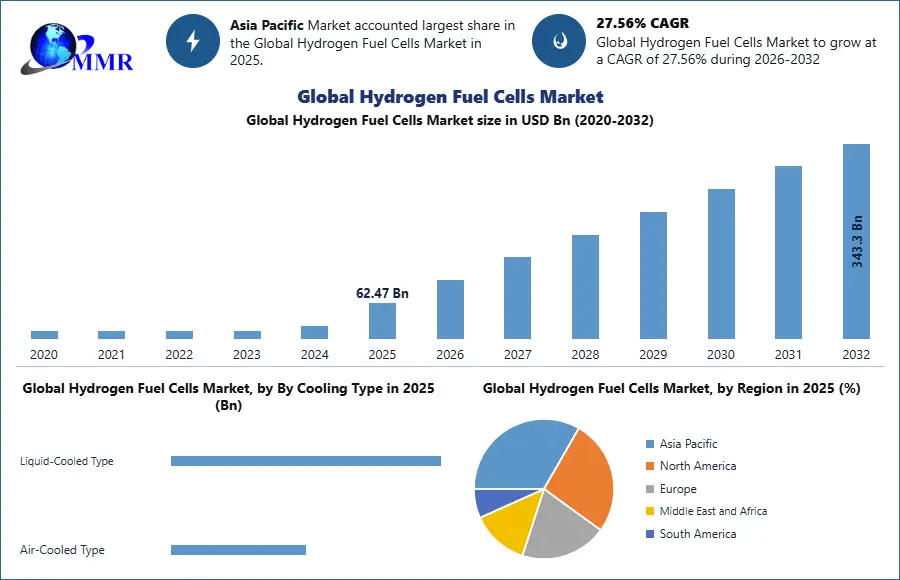
- Hydrogen Fuel Cells Market valued at USD 62.47 Billion in 2025
- Market projected to reach USD 343.34 Billion by 2032
- CAGR estimated at 27.56% during the forecast period
- Growing investment in hydrogen infrastructure supporting deployment
- Transportation sector remains a major adoption catalyst
- Industrial decarbonization initiatives driving commercial demand
- Energy security concerns increasing government support for hydrogen ecosystems
- Technological advancements improving fuel cell efficiency and scalability
Why This Matters Now
Energy transition strategies are entering a new phase. Renewable electricity deployment has expanded rapidly, but industries continue to face challenges involving long-duration energy storage, heavy-duty transportation, and emissions-intensive manufacturing processes.
Hydrogen fuel cells address these gaps by converting hydrogen into electricity with high efficiency and low emissions. As governments strengthen climate commitments and industries seek alternatives to fossil fuels, fuel cell technologies are becoming increasingly important for achieving net-zero objectives.
The result is a market moving from demonstration-scale adoption toward commercial deployment across transportation, power generation, logistics, and industrial operations.
Market Overview
The Hydrogen Fuel Cells Market economy is evolving from a long-term vision into an active investment theme. Public and private sector stakeholders are directing capital toward hydrogen production, storage, distribution, and fuel cell deployment.
Fuel cells offer operational advantages in applications where battery-only solutions face limitations. Long-range transportation, continuous industrial operations, and backup power systems benefit from rapid refueling capabilities and reliable power generation.
The projected growth from USD 62.47 Billion to USD 343.34 Billion indicates that hydrogen fuel cells are becoming a critical component of global energy diversification strategies. For manufacturers, this creates opportunities to scale production capabilities. For investors, it signals expanding commercial adoption. For governments, it supports broader decarbonization and energy independence goals.
Key Trends Driving Growth
One of the most significant developments is the expansion of hydrogen infrastructure. Fuel cell deployment depends on reliable hydrogen production and distribution networks. Investments across hydrogen refueling stations, storage facilities, and production plants are reducing one of the market’s historical barriers.
Transportation remains a major growth engine. Commercial fleets, buses, trucks, rail systems, and specialized vehicles are increasingly evaluating hydrogen solutions to achieve emissions targets while maintaining operational flexibility. This trend is encouraging manufacturers to accelerate fuel cell innovation and production scaling.
Industrial decarbonization is also reshaping market demand. Energy-intensive industries are exploring hydrogen technologies to reduce dependence on fossil fuels while maintaining productivity. Fuel cells provide a pathway for cleaner operations without sacrificing performance requirements.
Another important trend is the growing integration of renewable energy systems with hydrogen production. Excess renewable electricity can be used to generate hydrogen, creating opportunities for energy storage and grid balancing. This positions fuel cells as part of a broader clean energy ecosystem rather than a standalone technology.
Government policy support continues to influence market expansion. National hydrogen strategies, infrastructure funding programs, and emissions-reduction initiatives are creating favorable conditions for long-term investment.
Get a free sample:https://www.maximizemarketresearch.com/request-sample/71651/
Segment Insights
- Dominant Segment: Transportation applications continue to represent a significant area of market adoption as governments and fleet operators pursue low-emission mobility solutions.
- Fastest-Growing Segment: Hydrogen-powered solutions supporting industrial decarbonization and energy infrastructure modernization are emerging as major growth opportunities.
- Fuel cell deployment is expanding across commercial vehicles, logistics operations, and public transportation systems.
- Stationary power applications are gaining traction for backup power and distributed energy generation.
- Renewable energy integration is increasing demand for hydrogen storage and conversion technologies.
- Industrial users are evaluating fuel cell systems to support sustainability objectives and operational efficiency goals.
Regional Growth Story
North America remains an important market due to ongoing investments in hydrogen infrastructure, transportation electrification, and clean energy programs. The United States continues to support hydrogen development through public-private partnerships and strategic energy initiatives.
Europe is advancing hydrogen deployment through aggressive climate policies and industrial decarbonization efforts. Germany and the United Kingdom are actively investing in hydrogen ecosystems, including production capacity, transportation infrastructure, and commercial deployment programs.
Asia-Pacific represents one of the most dynamic regions for hydrogen fuel cell adoption. China, Japan, and South Korea continue to prioritize hydrogen technologies as part of broader energy transition strategies. Government-backed programs and industrial participation are accelerating commercialization efforts across multiple sectors.
India is emerging as a notable opportunity as policymakers focus on clean energy expansion, energy security, and industrial modernization. Hydrogen development initiatives are expected to support future market growth while contributing to national sustainability objectives.
Across regions, the common theme is clear: hydrogen is increasingly viewed as a strategic asset rather than a niche technology.
Competitive Landscape
Competition in the hydrogen fuel cells market is shifting from technology validation to scale execution. Companies that can secure supply chains, expand manufacturing capacity, and establish ecosystem partnerships are likely to gain long-term advantages.
Infrastructure investments signal confidence in sustained commercial demand rather than short-term experimentation. As hydrogen production and distribution networks expand, adoption barriers decline and customer confidence increases.
Strategic partnerships across energy providers, transportation operators, industrial companies, and technology developers are becoming increasingly important. These collaborations reduce deployment risks while accelerating commercialization timelines.
Innovation remains a critical differentiator. Companies improving fuel cell durability, efficiency, and operational economics are helping broaden addressable markets and strengthen the business case for adoption.
The competitive landscape also reflects a transition toward integrated solutions. Market leaders are increasingly focused on complete hydrogen ecosystems encompassing production, storage, distribution, and end-use applications.
Recent Developments
- Expansion of hydrogen infrastructure investments worldwide
- Increased government support for hydrogen economy initiatives
- Growing deployment of fuel cell-powered transportation systems
- Rising integration of renewable energy and hydrogen production
- Greater focus on industrial decarbonization through hydrogen technologies
- Continued advancement of fuel cell efficiency and performance capabilities
- Strategic collaborations across energy, transportation, and industrial sectors
Strategic Implications
For energy companies, hydrogen fuel cells represent a pathway to diversify clean energy portfolios and participate in emerging value chains.
For transportation operators, fuel cells offer an alternative approach to emissions reduction while supporting operational requirements that may exceed current battery capabilities.
For industrial organizations, hydrogen technologies provide an opportunity to address decarbonization challenges without compromising productivity.
For investors, the market’s projected expansion reflects growing confidence in hydrogen as a commercially viable energy solution rather than a purely developmental technology.
The broader implication is that hydrogen fuel cells are increasingly becoming an enabling technology for sectors that have struggled to achieve meaningful emissions reductions through conventional approaches.
Future Outlook
The next phase of market development will depend on how effectively stakeholders scale hydrogen production, infrastructure deployment, and commercial adoption. As costs decline and ecosystem maturity improves, fuel cells are expected to move deeper into mainstream energy and transportation markets.
Organizations that establish leadership positions today through infrastructure investment, technology innovation, and strategic partnerships will be better positioned to capture future value. Those that delay participation risk losing influence in a market that is rapidly becoming central to global decarbonization strategies.
The defining divide by 2032 will not be between companies that understand hydrogen and those that do not—it will be between organizations that built scalable hydrogen ecosystems and those left competing in increasingly carbon-constrained markets.
Analyst Perspective
“Hydrogen fuel cells are transitioning from an emerging clean-energy technology into a strategic pillar of global decarbonization efforts. As infrastructure investment, industrial adoption, and transportation deployment accelerate simultaneously, the market is entering a period of large-scale commercialization that will redefine competitive dynamics across the energy value chain.” — Neha Nalawade, Research Analyst
About Maximize Market Research
Maximize Market Research Pvt. Ltd. (MMR) is a global market research and consulting company that provides reliable, data-focused, and practical business insights. The firm serves a wide range of industries, including healthcare, pharmaceuticals, technology, automotive, electronics, chemicals, personal care, and consumer goods. Through market forecasts, competitive analysis, strategic consulting, and industry impact assessments, MMR helps organizations understand changing market conditions, identify growth opportunities, and make informed business decisions for long-term success.
2nd Floor, Navale IT Park Phase 3
Pune Banglore Highway, Narhe
Pune, Maharashtra 411041, India
+91 9607365656
[email protected]