Key Highlights
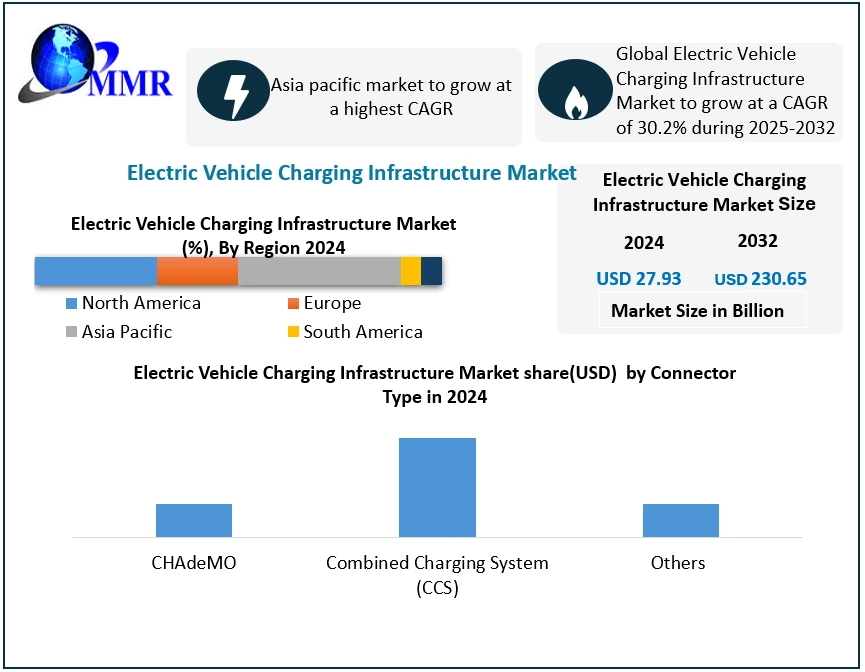
- The Electric Vehicle Charging Infrastructure Market was valued at USD 27.93 Bn in 2024.
- Market revenue is projected to reach USD 230.65 Bn by 2032.
- The market is expected to grow at a CAGR of 30.2% from 2025 to 2032.
- Rapid EV adoption is forcing governments, utilities, and private operators to accelerate charging deployment.
- Fast-charging technologies and smart charging platforms are becoming strategic investment priorities.
- Grid integration and digital energy management are emerging as competitive differentiators.
- Asia-Pacific remains a key growth engine due to large-scale electrification initiatives.
Why This Matters Now
The transportation sector is entering a decisive infrastructure cycle. Electric vehicle adoption is no longer constrained primarily by vehicle availability; it is increasingly shaped by charging accessibility, charging speed, and network reliability.
For infrastructure providers, utilities, equipment manufacturers, investors, and policymakers, the race has shifted from selling electric vehicles to building the ecosystems that support them. The Electric Vehicle Charging Infrastructure Market, valued at USD 27.93 Bn in 2024 and projected to reach USD 230.65 Bn by 2032 at a CAGR of 30.2%, illustrates the scale of this transformation. The implication is clear: charging infrastructure is becoming a foundational asset class within the broader energy transition.
Market Overview
The Electric Vehicle Charging Infrastructure Market sits at the intersection of transportation, energy, software, and digital connectivity. As governments implement emission reduction strategies and automotive manufacturers accelerate electrification programs, charging networks are evolving into critical public infrastructure.
The market’s projected expansion from USD 27.93 Bn in 2024 to USD 230.65 Bn by 2032 signals more than vehicle electrification. It reflects a structural shift in how energy is distributed, consumed, and managed across cities, highways, commercial facilities, and residential environments.
What changed is the scale of deployment. Early charging networks focused on pilot projects and urban clusters. Today’s investment strategies target nationwide coverage, commercial fleet electrification, and integrated energy management systems.
What happens next is the emergence of intelligent charging ecosystems capable of balancing electricity demand, integrating renewable energy, and supporting future mobility services.
Key Trends Driving Growth
The most significant trend is the rapid expansion of public and private charging networks. Governments are introducing policies that encourage infrastructure deployment, while private operators are pursuing aggressive expansion strategies to capture growing charging demand.
Fast-charging technology is becoming a major competitive battleground. Consumers increasingly expect charging experiences that resemble conventional refueling convenience. This is pushing investment toward higher-power charging systems capable of reducing charging times and improving network utilization.
Digitalization is also transforming the sector. Smart charging platforms allow operators to monitor asset performance, manage energy consumption, optimize pricing models, and improve user experiences. Charging stations are evolving from standalone assets into connected infrastructure nodes within broader energy networks.
Grid modernization is another major driver. Utilities are investing in technologies that enable efficient integration of charging infrastructure while maintaining grid stability. As EV penetration rises, energy management capabilities become increasingly important.
Commercial fleet electrification is creating additional opportunities. Logistics operators, public transit agencies, and corporate fleets require dedicated charging infrastructure, creating new revenue streams for charging solution providers.
Get a free sample :https://www.maximizemarketresearch.com/request-sample/14654/
Segment Insights
- Dominant Segment: The report identifies the leading segment based on market share within the charging infrastructure ecosystem, supported by broad deployment requirements and established adoption patterns.
- Fastest-Growing Segment: The report highlights the fastest-expanding segment driven by increasing demand for rapid charging capabilities and enhanced consumer convenience.
- Growing investment in smart charging technologies is improving operational efficiency and network utilization.
- Public charging deployment continues to expand alongside residential and workplace charging installations.
- Digital energy management platforms are increasing the value proposition of charging infrastructure investments.
Regional Growth Story
Asia-Pacific remains a central growth region for electric vehicle charging infrastructure development. Large-scale EV adoption programs, government incentives, and extensive urbanization are creating substantial demand for charging networks.
China continues to play a pivotal role due to its leadership in electric vehicle production and adoption. The country’s charging infrastructure investments are helping establish one of the world’s most extensive charging ecosystems.
Europe is advancing through ambitious decarbonization policies and transportation electrification targets. Countries such as Germany and the United Kingdom are expanding charging accessibility to support growing EV fleets and achieve climate objectives.
The United States is accelerating infrastructure deployment through public and private investment initiatives. Charging network expansion is increasingly viewed as essential for supporting long-term EV adoption and strengthening energy resilience.
India represents an emerging opportunity. Rapid urbanization, supportive policy frameworks, and growing interest in sustainable mobility are creating favorable conditions for charging infrastructure development.
Japan and South Korea continue to invest in advanced charging technologies, leveraging strong automotive ecosystems and innovation capabilities to support electrification goals.
Competitive Landscape
Competition is shifting beyond hardware deployment toward ecosystem leadership. Market participants are competing on network reliability, charging speed, software integration, energy management capabilities, and customer experience.
Technology providers investing in smart charging platforms are positioning themselves to capture recurring revenue opportunities through software services, data analytics, and energy optimization solutions. This signals a transition from infrastructure ownership models toward platform-driven business strategies.
Partnerships between charging operators, utilities, automotive manufacturers, and energy companies indicate growing recognition that charging infrastructure cannot operate independently from broader energy systems. These collaborations are accelerating deployment while improving network efficiency.
Competitive activity also reflects changing customer expectations. Fleet operators, commercial property owners, and consumers increasingly evaluate charging providers based on uptime, accessibility, digital services, and charging performance rather than charger availability alone.
As infrastructure density increases, market leadership will increasingly depend on operational excellence and network intelligence rather than simple deployment volume.
Recent Developments
- Expansion of fast-charging networks across major transportation corridors.
- Increased investment in smart charging and connected infrastructure technologies.
- Growing collaboration between utilities and charging network operators.
- Deployment of advanced energy management systems to optimize charging performance.
- Rising integration of renewable energy resources within charging ecosystems.
- Strategic investments supporting large-scale public charging accessibility.
Strategic Implications
For equipment manufacturers, the opportunity extends beyond charging hardware. Software-enabled charging management, predictive maintenance, and energy optimization services are becoming critical value drivers.
For utilities, charging infrastructure represents both a demand growth opportunity and a grid management challenge. Investments in smart charging capabilities will be essential to balance electricity demand and maintain system reliability.
For investors, charging infrastructure is emerging as a long-duration growth sector supported by transportation electrification, policy support, and infrastructure modernization.
For governments, charging accessibility remains a critical factor in accelerating EV adoption. Infrastructure deployment strategies increasingly influence the success of broader decarbonization initiatives.
Future Outlook
The next phase of market growth will be defined by intelligent infrastructure rather than charger deployment alone. Connected charging networks, digital energy management platforms, and integrated mobility ecosystems will determine competitive advantage.
As charging infrastructure becomes increasingly embedded within transportation and energy systems, market leaders will be those that combine scale, software intelligence, and energy integration capabilities. Organizations that view charging as a connected digital platform will shape the future of mobility, while those focused solely on hardware deployment risk losing relevance in an increasingly data-driven ecosystem.
Analyst Perspective
“The Electric Vehicle Charging Infrastructure Market is entering a phase where infrastructure scale, charging intelligence, and energy integration become equally important. Organizations that align charging deployment with digital energy management and evolving mobility requirements will be best positioned to capture long-term value creation opportunities.” — Neha Nalawade, Research Analyst
About Maximize Market Research
Maximize Market Research Pvt. Ltd. (MMR) is a global market research and consulting company that provides reliable, data-focused, and practical business insights. The firm serves a wide range of industries, including healthcare, pharmaceuticals, technology, automotive, electronics, chemicals, personal care, and consumer goods. Through market forecasts, competitive analysis, strategic consulting, and industry impact assessments, MMR helps organizations understand changing market conditions, identify growth opportunities, and make informed business decisions for long-term success.
2nd Floor, Navale IT Park Phase 3
Pune Banglore Highway, Narhe
Pune, Maharashtra 411041, India
+91 9607365656
[email protected]