The District Heating Industry is expanding as cities, utilities, and industrial operators look for more efficient ways to distribute thermal energy across dense urban and industrial environments.
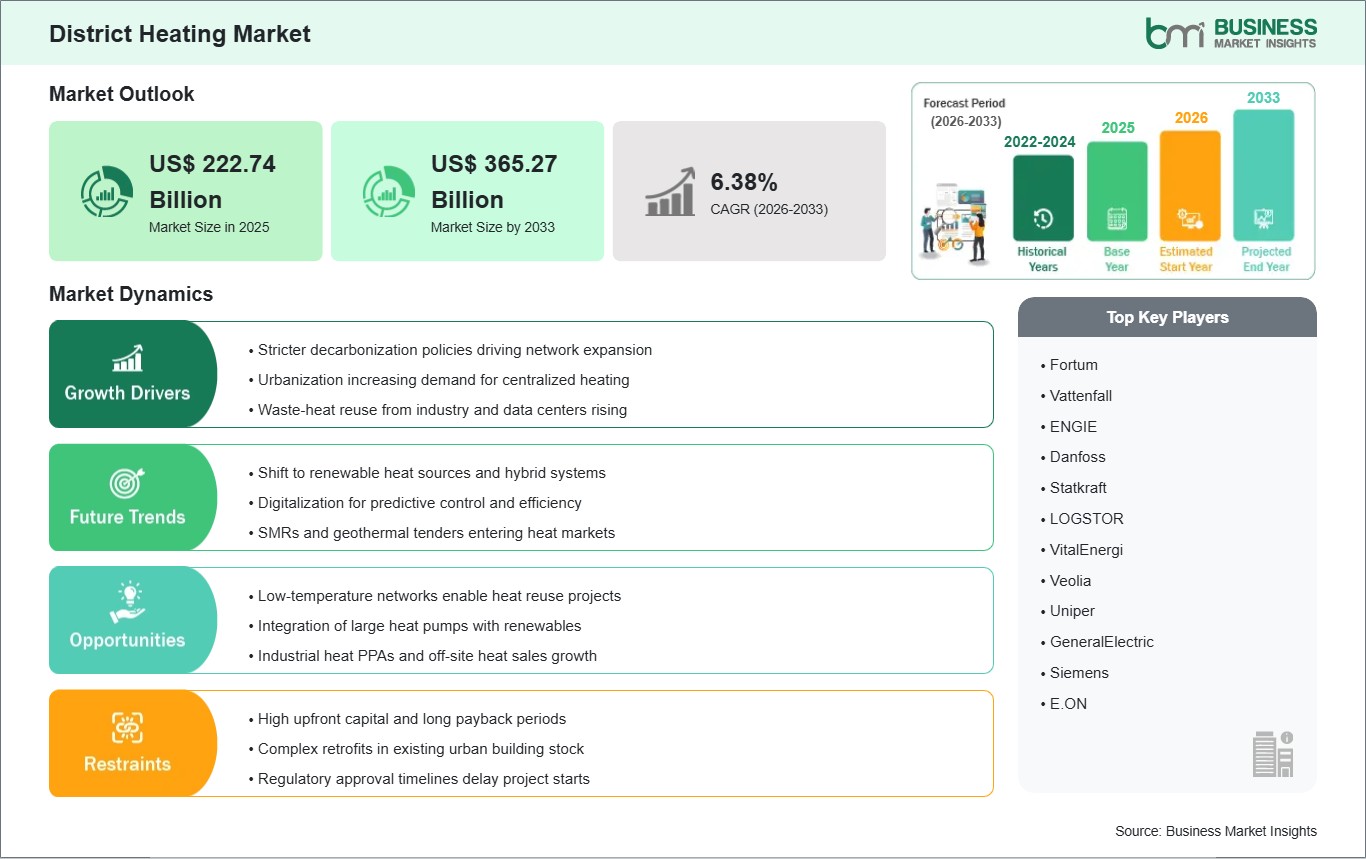
According to Business Market Insights, the global District Heating Market size is expected to reach US$ 365.27 Billion by 2033 from US$ 222.74 Billion in 2025.The market is estimated to record a CAGR of 6.38% from 2026 to 2033.
Technological improvements in digital monitoring, advanced heat exchangers, large-scale heat pumps, and waste-heat recovery are reshaping the District Heating Market. These innovations are helping operators improve thermal balancing, expand renewable heat integration, and increase overall network flexibility. As utility providers and municipalities continue to prioritize low-emission heating solutions, district heating is becoming a more important part of modern energy infrastructure.
Download Sample Report : https://www.businessmarketinsights.com/sample/BMIPUB00035392
What Is District Heating?
District heating is a centralized thermal energy distribution system that supplies heat and hot water to homes, businesses, and industrial facilities through a network of insulated pipes. Instead of relying on separate boilers in each building, district heating uses one or more central energy sources to generate heat more efficiently at scale. This approach supports better energy management, lower emissions, and improved reliability in high-density urban areas.
These systems can use a wide range of energy sources, including fossil fuels, biomass, geothermal energy, heat pumps, and recovered waste heat. Because they can integrate renewable and recovered thermal energy, district heating networks are increasingly viewed as a flexible and sustainable solution for cities looking to modernize their heating infrastructure.
Market Drivers
A major driver of the District Heating Market is the expansion of urban energy efficiency initiatives. Municipalities are investing in centralized thermal infrastructure to replace inefficient local heating systems and reduce emissions. This is especially important in crowded urban areas where reliable heating, lower fuel consumption, and improved environmental performance are key planning priorities.
Another important growth factor is the integration of renewable and recovered heat technologies. Large-scale heat pumps, geothermal systems, biomass-based plants, and industrial waste-heat recovery are helping utilities diversify heat supply while improving sustainability. These technologies are making district heating more adaptable and more attractive for future energy planning.
The market is also being supported by public-private investment models, long-term utility agreements, and infrastructure upgrades. As governments and energy providers focus on decarbonization and resilience, district heating networks are gaining attention as a scalable solution for residential, commercial, and industrial heating needs.
Get More Details: https://www.businessmarketinsights.com/buy/BMIPUB00035392
Market Segmentation
By Heat Source
- Coal: Legacy heating infrastructure that continues to operate in some established networks.
- Natural Gas: Flexible and widely used for large-scale urban heating systems.
- Geothermal: Provides stable baseload thermal output for long-term energy reliability.
- Biomass & Biofuel: Supports lower-emission heating and renewable energy integration.
- Solar: Works with thermal storage systems to improve renewable heat use.
- Oil & Petroleum Products: Used in backup and peak-demand heating applications.
By Plant Type
- Combined Heat & Power: Generates electricity and heat simultaneously for improved fuel efficiency.
- Boiler Plant: Supports centralized steam and heat production in conventional systems.
- Heat Pumps: Electrified systems that improve low-temperature network performance.
- Waste-Heat Recovery: Captures and reuses industrial thermal energy to reduce fuel consumption.
By Application
- Residential: Serves urban housing developments with consistent thermal delivery.
- Commercial: Supports institutional and business facilities with centralized energy management.
- Industrial: Delivers continuous large-scale heat to manufacturing and processing sites.
- District Cooling: Extends centralized thermal network concepts to cooling applications.
- Other End Users: Includes specialized facilities requiring customized thermal solutions.
According to the report, natural gas remains prominent because of its infrastructure compatibility and operational flexibility. Combined heat and power plants are also widely adopted because they improve both thermal and electrical energy production. Residential applications account for a significant share because centralized heating offers strong efficiency benefits in dense urban settings, while commercial and industrial users continue to adopt district heating to improve long-term energy management.
Regional Insights
- Europe is a mature district heating region with extensive pipeline infrastructure and strong renewable integration, especially in biomass, geothermal, and waste-energy systems.
- North America is seeing growing interest in integrated thermal infrastructure across municipalities, campuses, and commercial developments.
- Asia-Pacific is expanding rapidly due to urbanization, industrial growth, and smart city initiatives that include centralized thermal systems.
- Middle East & Africa is gradually exploring district thermal solutions for large urban and institutional projects.
- South & Central America is also developing as governments and utilities consider more centralized energy distribution models.
Top Players in the District Heating Market
The market is competitive, with major companies focusing on network efficiency, renewable integration, thermal storage, and long-term infrastructure development.
- Fortum
- Vattenfall
- ENGIE
- Danfoss
- Statkraft
- LOGSTOR
- VitalEnergi
- Veolia
- Uniper
- General Electric
- Siemens
- E.ON
These companies continue to invest in low-carbon heating systems, advanced thermal infrastructure, waste-heat recovery, and digital monitoring to improve performance and support the transition to cleaner urban energy networks.
Technological Innovations
Innovation is reshaping the District Heating Market through smarter system control, better heat exchange efficiency, and improved thermal balancing. Digital monitoring tools help operators track system performance in real time, allowing more precise management of heat supply and demand across connected networks.
Large heat pumps and waste-heat recovery technologies are also becoming more important. These solutions support lower-emission heating, improve network flexibility, and make it possible to redirect excess industrial heat into municipal systems. This is helping district heating evolve into a more efficient and resource-conscious energy model.
Thermal storage and renewable integration are further strengthening the market. As more utilities adopt smart energy district strategies, district heating systems are becoming better equipped to handle fluctuating demand, variable renewable energy inputs, and long-term decarbonization goals.
Future Market Outlook
The future outlook for the District Heating Market remains positive. Urban energy efficiency programs, renewable heat integration, and infrastructure modernization are expected to support steady growth through 2033. As more cities pursue low-carbon and resilient heating solutions, district heating is likely to play an increasingly important role in global energy systems.
Companies that focus on digital control, renewable heat sources, thermal storage, and network optimization are likely to capture the strongest opportunities. With governments and utilities seeking scalable centralized heating models, the market is positioned for continued expansion in both mature and emerging regions.
Frequently Asked Questions (FAQs)
What is the projected size of the District Heating Market by 2033?
The market is projected to reach US$ 365.27 Billion by 2033, rising from US$ 222.74 Billion in 2025.
What is the CAGR for the District Heating Market?
The market is expected to grow at a CAGR of 6.38% from 2026 to 2033.
Which heat source segment remains prominent?
Natural gas remains prominent in the market.
Which plant type is widely adopted?
Combined heat and power plants are widely adopted.
Which application holds a significant share?
Residential applications represent a significant share.
Browse More Reports:
https://www.businessmarketinsights.com/reports/green-tires-market
https://www.businessmarketinsights.com/reports/individual-quick-freezing-market
https://www.businessmarketinsights.com/reports/hydraulic-workover-unit-market
About Us
Business Market Insights is a market research platform that provides subscription service for industry and company reports. Our research team has extensive professional expertise in domains such as Electronics & Semiconductor; Aerospace & Defense; Automotive & Transportation; Energy & Power; Healthcare; Manufacturing & Construction; Food & Beverages; Chemicals & Materials; and Technology, Media, & Telecommunications.
Contact Us
If you have any questions about this report or would like further information, please contact us:
Contact person: Ankit Mathur
Email: [email protected]
Phone: +16467917070