Key Highlights
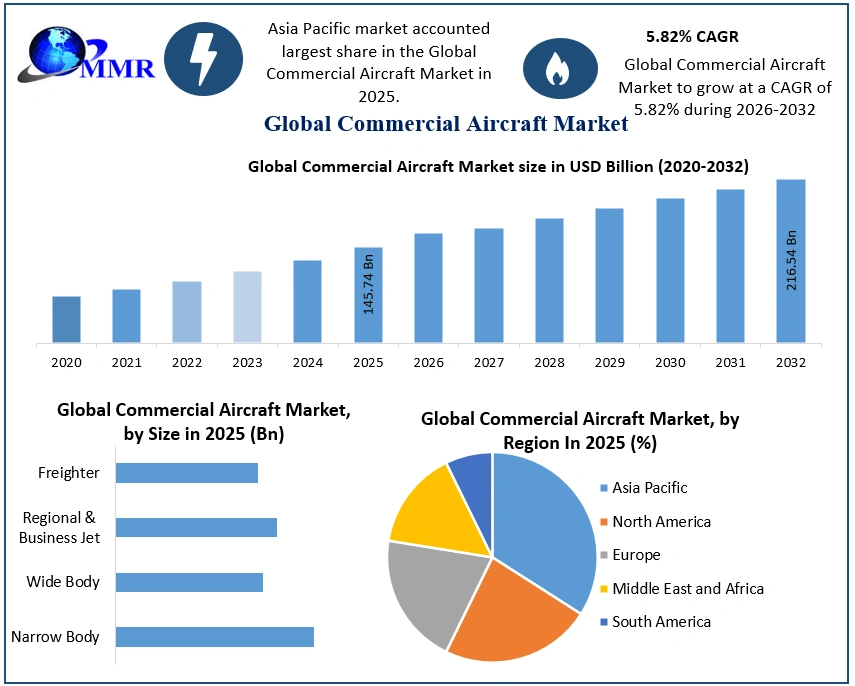
- Commercial Aircraft Market valued at USD 145.74 billion in 2025.
- Market projected to reach USD 216.54 billion by 2032.
- CAGR of 5.82% during 2026–2032.
- Fleet modernization remains a primary investment priority for airlines.
- Lightweight carbon composites are increasingly integrated into aircraft manufacturing.
- Airbus delivered 661 aircraft in 2023, up 8% year-over-year.
- Boeing delivered 480 aircraft in 2023 as production recovery accelerated.
- Airbus entered 2023 with a backlog of 7,239 aircraft.
- Boeing reported a backlog of 4,578 aircraft entering 2023.
Why This Matters Now
Commercial aviation has moved beyond post-pandemic recovery and entered a capacity-constrained growth phase. Airlines are rebuilding networks, replacing aging fleets, and pursuing lower operating costs through fuel-efficient aircraft acquisitions.
The challenge is that demand is expanding faster than production capacity. Aircraft backlogs stretching across several years have become strategic assets for manufacturers and suppliers. Companies able to increase output, secure critical components, and maintain certification compliance stand to capture substantial market share.
For investors, the story is no longer simply traffic recovery. It is about production scalability, supply-chain resilience, and technology leadership.
Market Overview
Commercial aircraft Market remain the backbone of global passenger and cargo transportation. Aircraft manufacturers are benefiting from growing tourism activity, business travel recovery, e-commerce logistics expansion, and airline investments in next-generation fleets.
The industry’s growth is closely linked to advances in aviation technology. Airlines face increasing pressure to reduce fuel consumption and emissions while maintaining profitability. This has accelerated demand for aircraft incorporating lightweight carbon composites, improved aerodynamics, and more efficient propulsion systems.
The result is a multi-year replacement cycle that extends beyond mature aviation markets and increasingly includes high-growth regions such as Asia-Pacific and India, where fleet expansion remains a strategic priority.
Key Trends Driving Growth
Aircraft deliveries in 2023 provided evidence that the industry has shifted from recovery toward expansion. Airbus delivered 661 aircraft and maintained its leadership position, while Boeing increased deliveries to 480 aircraft despite ongoing operational and supply-chain challenges.
Backlogs are becoming one of the industry’s most important indicators. Airbus entered 2023 with more than 7,200 aircraft in backlog, representing roughly 11 years of production at prevailing rates. Boeing’s backlog exceeded 4,500 aircraft. These order books provide long-term revenue visibility while also highlighting manufacturing bottlenecks.
Advanced materials continue to gain importance. The increasing incorporation of lightweight carbon composites is reducing aircraft weight, improving fuel efficiency, and helping airlines meet sustainability targets. These developments are influencing supplier investment decisions and reshaping aerospace manufacturing strategies.
Another major trend is propulsion innovation. Industry leaders are investing in next-generation engine architectures designed to reduce fuel burn and emissions. Technology development programs aimed at future aircraft platforms are becoming increasingly important as regulators and airlines pursue long-term decarbonization objectives.
Supply-chain disruption remains a significant risk. Component shortages, engine availability issues, and production constraints continue to limit delivery rates. Companies capable of securing supplier capacity are gaining a competitive advantage.
Unlock more insights request a free sample report now.
Segment Insights
- Dominant Segment: Passenger transportation aircraft continue to account for the largest share of commercial aviation demand, supported by global airline network expansion and rising passenger traffic.
- Fastest-Growing Segment: Fuel-efficient aircraft categories benefiting from fleet replacement programs are seeing accelerated demand as airlines prioritize operational savings and emissions reduction.
- Lightweight composite-equipped aircraft are attracting increased airline investment due to lower lifecycle operating costs.
- New-generation aircraft platforms are gaining traction as carriers seek greater range flexibility and improved economics.
Regional Growth Story
North America remains a critical manufacturing and innovation hub because of the presence of major OEMs, suppliers, and aviation technology companies. Boeing’s recovery trajectory remains important for the region’s industrial output and aerospace employment base.
Europe continues to benefit from Airbus’ strong delivery performance and extensive order backlog. The region’s aerospace sector is also advancing sustainable aviation technologies and next-generation aircraft programs.
Asia-Pacific represents one of the most significant long-term growth opportunities. Expanding middle-class populations, rising air travel penetration, and airline fleet expansion are creating sustained aircraft demand. India is emerging as a particularly important growth market, with both Airbus and Boeing projecting substantial fleet additions over the coming decades.
China, India, Japan, and South Korea continue investing in aviation infrastructure and airline capacity, increasing the region’s influence on future aircraft procurement cycles.
Competitive Landscape
The competitive environment is defined by production capacity, backlog strength, technology leadership, and supply-chain management.
Airbus strengthened its market position through superior delivery performance and a large order backlog. The company’s ability to maintain production momentum despite industry-wide constraints signals operational resilience and strengthens supplier confidence.
Boeing’s rebound in deliveries demonstrates improving execution, but supply-chain and manufacturing challenges remain critical factors influencing future performance. Successfully stabilizing production could improve cash generation and strengthen competitive positioning.
Competitive pressure is also emerging from alternative manufacturers seeking opportunities in underserved market segments. The long-term growth outlook and extensive global aircraft demand create openings for challengers beyond the traditional duopoly.
For suppliers, competitive advantage increasingly depends on securing long-term contracts tied to major aircraft programs, supporting production ramp-ups, and investing in advanced manufacturing technologies.
Recent Developments
- Airbus delivered 661 commercial aircraft in 2023, increasing deliveries by 8% year-over-year.
- Boeing delivered 480 aircraft in 2023, marking a significant improvement from 2022 levels.
- Airbus maintained a backlog exceeding 7,200 aircraft entering 2023.
- Boeing reported a backlog of 4,578 commercial aircraft entering 2023.
- Airbus raised its long-term aircraft demand forecast despite geopolitical and trade uncertainties.
- India and South Asia are projected to require thousands of additional commercial aircraft over the coming decades.
Strategic Implications
Aircraft manufacturers are entering a period where execution may matter more than demand generation. Order books are strong. The challenge is converting backlog into deliveries.
Suppliers capable of supporting higher production rates will gain negotiating leverage. MRO providers are positioned to benefit as airlines extend service lives of existing fleets while awaiting new aircraft deliveries.
Investors should focus on manufacturing throughput, supplier diversification, certification progress, and technology readiness rather than demand fundamentals alone. Demand visibility is already established through extensive industry backlogs.
For governments and procurement agencies, commercial aerospace remains strategically important because it supports industrial employment, advanced manufacturing capabilities, and broader aerospace innovation ecosystems.
Future Outlook
The Commercial Aircraft Market is entering a multi-year expansion cycle driven by fleet modernization, sustained passenger demand, advanced materials adoption, and next-generation aircraft technologies; the companies that scale production fastest while managing supply-chain risk will define the industry’s next decade.
Analyst Perspective
“The commercial aircraft industry has shifted from recovery to execution. Strong order backlogs, fleet modernization programs, and rising demand for fuel-efficient aircraft are creating long-term opportunities, but manufacturers and suppliers must overcome production constraints and supply-chain pressures to capture the full value of this growth cycle.” — Rucha Deshpande, Analyst
About Maximize Market Research
Maximize Market Research Pvt. Ltd. (MMR) is a global market research and consulting company that provides reliable, data-focused, and practical business insights. The firm serves a wide range of industries, including healthcare, pharmaceuticals, technology, automotive, electronics, chemicals, personal care, and consumer goods. Through market forecasts, competitive analysis, strategic consulting, and industry impact assessments, MMR helps organizations understand changing market conditions, identify growth opportunities, and make informed business decisions for long-term success.
Contact Us
2nd Floor, Navale IT Park Phase 3
Pune Banglore Highway, Narhe
Pune, Maharashtra 411041, India
+91 9607365656
[email protected]