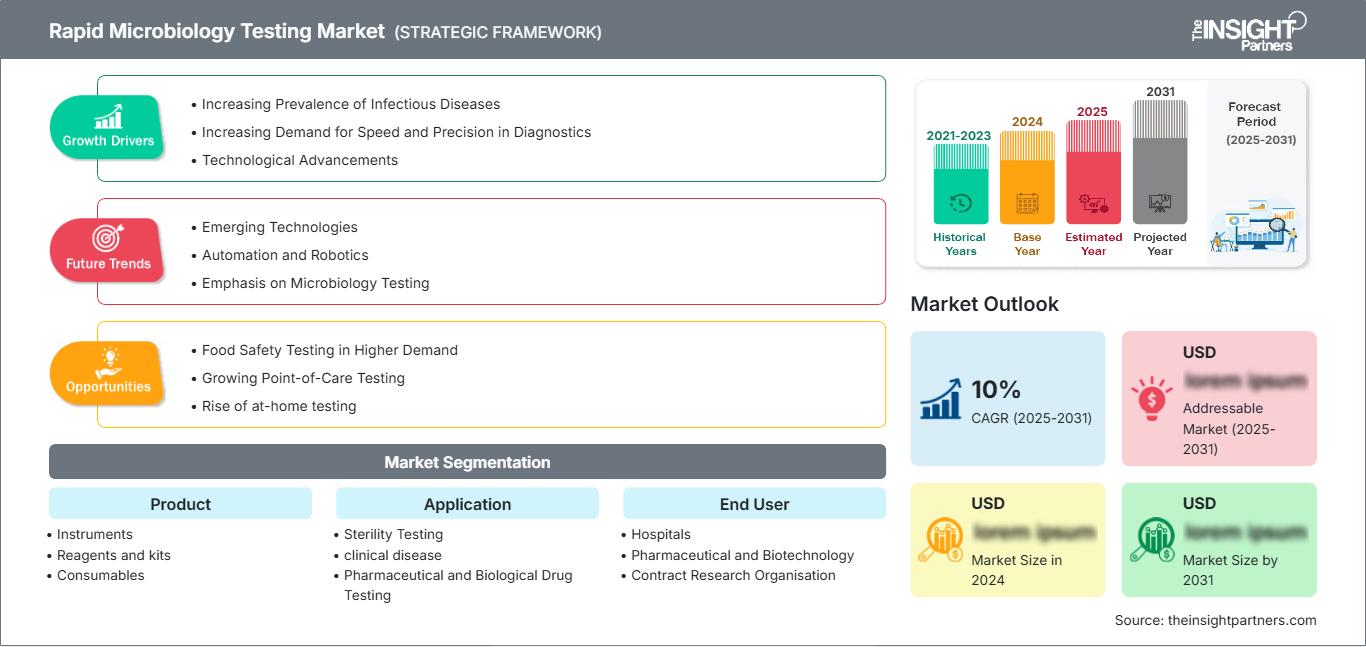
According to The Insight Partners, The Rapid Microbiology Testing Market size is expected to reach US$ 7,745 million by 2031. The market is anticipated to register a CAGR of 8.8% during 2025–2031.
Regulatory frameworks, technological innovation, and rising healthcare spending collectively shape Rapid Microbiology Testing Market Dynamics globally. These factors continue to influence competition, pricing strategies, and long-term industry growth.
Market Overview
Rapid microbiology testing refers to advanced technologies used to detect microbial contamination in significantly shorter timeframes compared to traditional culture-based methods. These solutions are widely used in pharmaceuticals, clinical diagnostics, food and beverages, environmental monitoring, and biotechnology industries.
Get a Sample PDF – https://www.theinsightpartners.com/sample/TIPBT00002598
The market is transitioning from conventional testing techniques toward automated and molecular-based solutions such as PCR, immunoassays, and biosensors. As industries continue to prioritize quality control, safety, and regulatory compliance, the adoption of RMT solutions is accelerating globally.
Key Market Drivers
- Rising Burden of Infectious Diseases
The growing prevalence of infectious diseases worldwide is one of the most significant drivers of the rapid microbiology testing market. Emerging pathogens, hospital-acquired infections, and antimicrobial resistance are increasing the need for fast and accurate diagnostics. Healthcare providers are increasingly adopting rapid testing solutions to ensure early detection, reduce mortality, and improve treatment outcomes.
Rapid microbiology testing enables clinicians to identify pathogens within hours rather than days, helping healthcare systems respond more effectively to outbreaks and epidemics.
- Increasing Demand for Faster Diagnostic Results
Traditional microbial culture methods often take 2–7 days to deliver results. In critical healthcare and pharmaceutical settings, such delays can lead to severe consequences, including treatment delays and production losses.
Rapid testing technologies significantly shorten the time required for microbial detection. This improved turnaround time allows:
- Faster patient diagnosis and treatment
- Reduced hospital stays
- Improved infection control
- Increased productivity in pharmaceutical manufacturing
As healthcare providers shift toward real-time decision-making, the demand for rapid microbiology testing continues to rise.
- Stringent Regulatory Requirements in Pharmaceutical and Food Industries
Regulatory bodies worldwide have implemented strict guidelines to ensure product safety and quality. Pharmaceutical and food companies must comply with stringent microbial testing standards before releasing products to the market.
Rapid microbiology testing offers:
- Real-time monitoring of contamination
- Faster batch release in pharmaceutical production
- Enhanced compliance with global safety standards
- Reduced risk of product recalls
These regulatory pressures are significantly accelerating the adoption of advanced microbial testing solutions.
- Growth of the Pharmaceutical and Biotechnology Industries
The pharmaceutical and biotechnology sectors are expanding rapidly due to increasing investments in drug development, vaccines, and biologics. Microbial contamination testing is a critical step in ensuring the safety and efficacy of pharmaceutical products.
Rapid microbiology testing helps pharmaceutical companies:
- Accelerate production timelines
- Reduce manufacturing downtime
- Improve product quality assurance
- Optimize supply chain efficiency
As biologics and personalized medicine gain momentum, the need for advanced microbial testing technologies is expected to grow further.
- Increasing Focus on Food Safety
Foodborne illnesses continue to be a major public health concern globally. Governments and regulatory authorities are enforcing strict food safety regulations to prevent contamination and ensure consumer protection.
Rapid microbiology testing enables food manufacturers to:
- Detect pathogens quickly
- Reduce contamination risks
- Minimize food recalls
- Improve brand reputation
The rising global demand for packaged and processed food is further boosting the need for advanced testing technologies.
- Technological Advancements in Rapid Testing
Innovation is transforming the rapid microbiology testing landscape. Advanced technologies such as automation, artificial intelligence, biosensors, and molecular diagnostics are improving testing accuracy and efficiency.
Key technological trends include:
- PCR-based microbial detection
- Next-generation sequencing
- Automated microbial identification systems
- Real-time monitoring solutions
These innovations are making rapid testing more reliable, cost-effective, and scalable across industries.
- Increasing Adoption of Automation in Laboratories
Automation is revolutionizing microbiology laboratories by reducing manual intervention and minimizing human errors. Automated rapid testing systems provide high-throughput screening, consistent results, and improved operational efficiency.
Laboratories adopting automation benefit from:
- Reduced labor costs
- Enhanced testing accuracy
- Faster sample processing
- Improved workflow efficiency
This shift toward laboratory automation is a key growth driver for the market.
Market Opportunities
Expansion in Emerging Markets
Emerging economies are investing heavily in healthcare infrastructure, pharmaceutical manufacturing, and food safety initiatives. Countries in Asia-Pacific, Latin America, and the Middle East are witnessing increasing adoption of rapid microbiology testing solutions.
Factors driving growth in these regions include:
- Growing healthcare expenditure
- Rising awareness of infectious diseases
- Expanding pharmaceutical manufacturing hubs
- Government initiatives supporting food safety
These regions present significant growth opportunities for market players.
Growing Demand for Point-of-Care Testing
Point-of-care testing is becoming increasingly popular due to its ability to deliver rapid results outside traditional laboratory settings. The integration of rapid microbiology testing into portable and user-friendly devices is expected to create new market opportunities.
Market Segmentation Overview
The rapid microbiology testing market can be segmented based on:
By Product:
- Instruments
- Reagents and Kits
By Method:
- PCR-based Testing
- Immunoassays
- Growth-based Testing
- Biosensors
By Application:
- Clinical Diagnostics
- Pharmaceutical and Biotechnology
- Food and Beverage Testing
- Environmental Monitoring
By End User:
- Hospitals and Diagnostic Laboratories
- Pharmaceutical and Biotechnology Companies
- Food Manufacturers
Regional Insights
North America currently dominates the rapid microbiology testing market due to advanced healthcare infrastructure, strong regulatory frameworks, and high adoption of innovative technologies.
Europe follows closely, driven by stringent food and pharmaceutical safety regulations.
Asia-Pacific is expected to witness the fastest growth during the forecast period due to rising healthcare investments, expanding pharmaceutical manufacturing, and increasing awareness of microbial testing.
Competitive Landscape – Top Players
The rapid microbiology testing market is highly competitive, with key players focusing on innovation, partnerships, and product launches to strengthen their market position. Major companies operating in the market include:
- bioMérieux SA
- Danaher Corporation
- Thermo Fisher Scientific Inc.
- Merck KGaA
- Sartorius AG
- Charles River Laboratories
- Becton, Dickinson and Company
- Agilent Technologies
- Shimadzu Corporation
- Bruker Corporation
These companies are investing heavily in research and development to introduce advanced and automated testing solutions.
Future Market Trends
Key trends expected to shape the market by 2031 include:
- Integration of AI in microbial detection
- Expansion of rapid testing in decentralized healthcare
- Increasing demand for automated laboratory workflows
- Growth of molecular diagnostic technologies
- Rising investment in biosensor-based testing
Get Premium Research Report Market Size and Growth Report at: https://www.theinsightpartners.com/buy/TIPBT00002598
Future Outlook
The rapid microbiology testing market is set for strong growth through 2031, driven by rising infectious disease prevalence, stringent regulatory requirements, and rapid technological advancements. As industries continue to prioritize safety, efficiency, and compliance, the adoption of rapid testing solutions will expand across healthcare, pharmaceuticals, and food safety sectors.
With increasing investments and innovation, rapid microbiology testing is expected to play a crucial role in shaping the future of diagnostics and quality assurance worldwide.
About Us
The Insight Partners is a one stop industry research provider of actionable intelligence. We help our clients in getting solutions to their research requirements through our syndicated and consulting research services. We specialize in industries such as Semiconductor and Electronics, Aerospace and Defense, Automotive and Transportation, Biotechnology, Healthcare IT, Manufacturing and Construction, Medical Device, Technology, Media and Telecommunications, Chemicals and Materials.
Contact Us
Ankit Mathur | The Insight Partners
E-mail: [email protected]
Phone: +1-646-491-9876
Also Available in : Korean | German | Japanese | French | Chinese | Italian | Spanish